The Out-of-Towners
Promoting the Movie
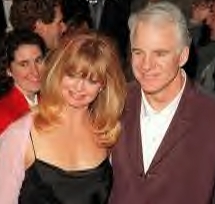
Steve and Goldie did a round of promotional interviews to plug the movie, as well as having two separate premieres. The first was in Atlanta, Georgia.
What comes very clear from the interviews is the mutual liking and respect the two stars have for each other.
========================================
Star Interviews
, 1 Jan. 1999THE OUT OF TOWNERS: STEVE MARTIN INTERVIEW
Prairie Miller
Comic whiz Steve Martin can get pretty serious when talking about being funny. Martin has been mixing and matching the two opposing modes lately, with his recent sinister turn in David Mamet's The Spanish Prisoner and his more familiar side in the new Out Of Towners remake. Here's what Martin had to say about exactly what life is like for a very funny guy.
PRAIRIE MILLER: What's new and different about the new Out Of Towners?
STEVE MARTIN: I think the writer had a brilliant idea. In the original movie, New York was an unpleasant place. Now New York is a vibrant place. I think New York was a place we wanted to end up in and succeed in, so that makes a difference.
There was another element that Goldie pointed out to me. She said , 'This is a story about kids leaving home, and now what does the couple do? Are they going to rekindle their love, or are they going to dissolve?' And that was for her, and became for me the point of the piece, rather than just a bad travel experience.
PM: This movie speaks about a mature relationship, a thing that's quite rare for Hollywood today.
SM: I think you're right, although I haven't seen that many films lately. When Goldie and I worked on Housesitter, we played adversarial type people who were going to fall in love. Now we're playing husband and wife who are already in love. We were always on screen together, which created - we already had a nice report - the swing of working together, joking. We'd get a break and we'd already be in New York in Central Park, so we'd walk a block and have dinner. And I'd force her to drink and tell me things!
PM: How do you put together physical comedy, like that shower scene?
SM: I visualize it and then try to live it. I don't think I've ever thought about it, or maybe I thought about that 20 years ago and was reminded of it. Yeah, something you think like, 'this will look funny.'
PM: What I can't figure out is how you keep a straight face! Do you maybe find you lose some of it because you've learned not to laugh at yourself?
SM: No, because when you're totally in character you're not thinking it's funny at all. I think the actor has to go 'This isn't funny. It's dead serious.'
They thought the shower scene was so funny, they were willing to pay thirty eight thousand dollars to get 'Fly Me to the Moon.' Forty eight thousand really, not counting my kickback! That was one of those things where I thought, let me try something. And you try not to tell them, because if you try to tell me let me sing Fly Me to the Moon while my silhouette is on the glass, it's just not funny. You kinda keep it a secret and whisper something to the cameraman, so I'll be in focus. Then sometimes it works and sometimes it doesn't.
Like the scene in the limousine where I'm a little high and talking about getting frisky. I made that up, and everyone got into the swing. Goldie and I got along so well that when they said action, there was no change from what we were doing off screen.
PM: What do you get out of acting?
SM: I was talking to a friend the other day, we were sort of lamenting aspects of the movie business. One of the problems today is that success is a total success. You can succeed critically or artistically, but if it isn't at the box office, you're not a success, you're out. You can't take pride unless it's a total success, and a total success is very rare, maybe 10 movies a year out of 300.
But to me the satisfaction for movies is when I make them. Once it's done, you don't know what's going to happen. You don't know if it's going to be awful or good, whether people are going to like it. You can do the greatest thing, and someone somewhere is going to say 'This is the lowest scum ever.' There's always that little bit of take back.
PM: You've had some big successes, and others that didn't do quite as well at the box office. Are you getting better at predicting the box office, or is it just some great mystery?
SM: No, but I do get certain opinions. And I didn't understand exactly what the movie business was, or what the audience wanted to see. Then sometimes I didn't have the big picture, and the movie was a smash.
PM: Talk a little about your book, Pure Drivel.
SM: The main reward was that I liked it. So many people contribute to a movie, and there's so much controversy. This was a small thing that you can control, and people who want to read it can read it. It's not people dragged to the theater by an upset boyfriend and it's a tiny little thing that came out of your head, so it's easy to take pleasure in this.
PM: What is your own worst Out of Town story?
SM: Ironically, when we did Planes, Trains and Automobiles, we lived that movie. We were flying all around looking for snow. We'd land in Rochester and the snow was melting, so we'd have to fly to Buffalo. John Candy and I laughed a lot over this. It was our life while making the movie.
PM: What was it like working on a very different movie for you, like David Mamet's The Spanish Prisoner?
SM: I liked conforming to the lines. A Mamet line is the way people speak. They stop and they start and go back. On the other hand, when you try to go back it's very hard, because it's completely spontaneous. It gives this weird dimension to the characters. David is very strict because he doesn't want his words changed. With comedy sometimes, you just twist the line a little bit so the joke's there.
PM: Tell me a little about your next project, 'Bowfinger's Big Thing.'
SM: It's with Eddie Murphy. It's already shot and in the can. It's a Hollywood story, about a loser producer who wants to get the biggest star in his movie, played by Eddie Murphy. And of course he won't do it, so they decide to shoot the movie without telling him. They follow him around and ruin his life.
PM: Say, where do you get ideas like that?
SM: I probably had that idea 15 years ago, and walked around and kept it in my head. Then finally two years ago I said, now's the time.
PM: When I think of you in L.A. Story, I think about how the movie was a comment on the movie culture.
SM: It was a comment on L.A. and romance. This is just a funny movie. My character's talent is so effortless. My God, he tosses off these things and can ad lib in that character. I'm appreciating it from a comedian's point of view. His talent is so obvious up there on the screen.
PM: Does being funny just pour out of you, or do you have to work at it?
SM: I think it begins as something innate, and then it develops and becomes something more sophisticated through experience. It also becomes more lucid, because you realize that you've done something for 30 years and you don't know anything. You get that feeling sometimes. I hear about people who write screenplays, and every time they sit down to write a screenplay they feel like an amateur.
PM: What made you want to become a comedian?
SM: I saw comedy on television with Laurel and Hardy, Steve Allen, Jerry Lewis and Jack Benny, and that's where I started to love it. I started as a magician, then I became a standup comedian. And then a writer.
PM: How do your writing and acting influence each other?
SM: It helps, because if you're in a scene and it's not working you can say 'what if...?' And it also makes you think all the time that you can find a joke that wasn't there.
PM: What happens when you see your early stuff on television?
SM: I can't watch it. I don't know why. I was looking at a Carson show, and I saw him introduce me. I think I had this instant flash, like I don't think I like this bit. Some things I like, some things I can't watch.
PM: So is comedy a young guy's game?
SM: I think it is. I think Walter Matthau is hilarious, but the heat of comedy is a young man's game. They get hot and become funny because of their heat. When you're not hot, it's a struggle to be funny. That's when you're put to the test, whether you survive.
====================================
The Record (Bergen County, NJ)
March 30, 1999; Tuesday
A Mild and Brainy Guy; At 53, Steve Martin is Taking Success Seriously
My Longsdorf
Steve Martin is letting his fingers do the walking. The setting is a ritzy hotel in Beverly Hills where he and Goldie Hawn have come to beat the drum for" The Out-of-Towners," their new movie opening Friday.
Hawn has been asked who designed the flowery silk skirt and fuschia sweater she's wearing. Without missing a beat, Martin is practically undressing his co-star." I'll find out," he smirks, reaching into her sweater." Well, we've done this before."
At that, Hawn lets out one of her trademark giggles." The designer is Marnie," he informs her.
"And the skirt is by whom?" wonders Hawn, egging him on.
"Hmm, let me check," says Martin, flexing his fingers." Well, your pantyhose are by 'Hand wash cold." This time, Hawn whoops it up even more. In a few minutes, when the actress and her explosive giggle are gone, the room feels like a balloon with all of its air let out.
"Do you want to come over and check my labels?" deadpans Martin, a strained expression on his face.
Once labeled the ultimate wild and crazy guy, the comedian is actually a mild and sober man. He doesn't crack jokes in interviews. He never pulls practical jokes on friends. He's not a showoff.
"It's embarrassing," he admits," but I just cannot be on."
It makes sense that at 53, Martin derives the most satisfaction from writing. His output in recent years has included the hit play "Picasso at the Lapin Agile," the upcoming Eddie Murphy movie "Bowfinger's Big Thing," and a best-selling short story collection, "Pure Drivel." "There's a different thrill from signing a movie contract, which is nice, to getting a royalty check," says the man who routinely makes $6 million a film." I look at that $2,000 royalty check and I'm just tickled. I'm thinking, 'Wow, they liked my play in Raleigh. ."It's hard to take pleasure in movies anymore because the only success is total. You can't take pride in a medium success or an artistic success. You're only respected if your success is total." It's been a while since Martin has enjoyed a total success. He hasn't been onscreen since he played a supporting role two years ago in David Mamet's "The Spanish Prisoner." Before that, he starred in the ill-fated "Sgt. Bilko" and the pleasant "Father of the Bride" flicks.
In some ways, he believes that "Bowfinger's Big Thing," which is about the odd-couple pairing of a loser movie producer (Martin) and a Hollywood superstar (Murphy), is his most personal script to date.
"I really enjoy writing for the theater and I think it helped my movie work," he says. "When you do something so often, you get better at it, of course, but you also get disconnected from it.
"When you find something new you get connected again, which is what I did with writing. After I wrote my play about Picasso, I thought, 'Why can't I write a screenplay in the same spirit, not caring about what anybody thinks?'
"So I did that with 'Bowfinger,' which comes out this summer.
Writing it gave me the feeling of what it means to be connected to something again. It stirred up my interest in movies. Even with my acting, I feel as if I can invest more in it again." Case in point: "The Out- of-Towners," which is an update of the 1970 Neil Simon classic starring Sandy Dennis and Jack Lemmon as a couple whose journey to New York City for a job interview turns out to be a trip from hell. In the update, Martin and Hawn go through travel nightmares while trying to halt the unraveling of their marriage.
"I felt free to sort of boldly ad-lib stuff," says Martin, who was born in Waco, Texas, but raised in Southern California." There's a scene in a limo with John Cleese and Goldie where I was going, 'Frisky, frisky, frisky.' I came up with it on the spot. And Goldie laughed, which is all I needed. It worked."
Hawn and Martin seem to bring out the best in each other." The "Out-of-towners" marks their first collaboration since 1992's "Housesitter," about a control freak driven crazy by a free spirit.
"Steve is my favorite leading man," enthuses Hawn." With him, it's like a musical duet. We riff and play and create. And he makes me laugh all the time."
Martin returns the compliment." The attraction of 'The Out-of-Towners' for me was purely Goldie. To be honest, I was nervous about doing it, but she called me up and said, 'This is about something important. It's about the empty-nest syndrome and the rekindling of a love affair that happens afterwards. You can't say no to Goldie or she drives you nuts.
"But I warned her if six months down the line she told me her psychic told her to do the movie, I'd kill her." The man who stepped into Spencer Tracy's shoes for "The Father of the Bride" movies and who took over for Jack Nicholson in "Little Shop of Horrors" had no reservations about adding another remake to his filmography.
"I just wish someone would update 'The Jerk, " he says, referring to his smash film debut. "I'd find that flattering, as a matter of fact. I'd especially like it if Jim Carrey did it, and I wound up making a lot of money."
Martin is a big fan of Carrey's but stops short of praising any of today's other wild and crazy comics. "I haven't seen 'The Waterboy,'" he says." And that's not a slam against Adam Sandler. I just haven't had time. I liked 'Rushmore.' That was interesting."
Unlike fellow Seventies stand-up icons Whoopi Goldberg and Robin Williams, Martin's critically heralded work in movies like "Roxanne" and "L.A. Story" has never received an Oscar, or even an Oscar nomination.
Asked about the slight, Martin shrugs. "After a while you go, 'Oh, they really don't like me. It's sort of the reverse of Sally Field." Martin maintains that he gets all the respect he needs from fans, especially now that his admirers aren't as wild and crazy as they used to be. "I like getting older because with time, they respect you," he muses. "People are a little awe-struck and more polite than back in the old days when they'd come up to me and practically assault me by yelling, 'Be funny! Do something! Sing 'King Tut."
These days, fans who stop Martin on the street are as likely to rave about his play or his New Yorker essays than to ask him to stick a rubber arrow on his head.
"I get a much bigger thrill from the person who says that they read my essay than the person who says they saw my latest movie. I don't know why exactly. Maybe it's because I'm just shocked that anyone is actually reading what I've written. It's a more intimate experience between a writer and his readers. There's a giant publicity mill behind these movies. My stories in The New Yorker, it's just me and them."
======================================================
New York Daily News
From: New York Now | Movies |
Sunday, March 28, 1999
Tuning In On 'Out-of-Towners' Goldie Hawn & Steve Martin, Hollywood's favorite 'married' couple
Bart Mills
LOS ANGELES: Never in a million years could you imagine Goldie Hawn and Steve Martin married to each other. But their high potential for incompatibility has served them well onscreen - first as a faux couple in "Housesitter" (1992) and now as old marrieds in "The Out-of-Towners."
Born three months apart in 1945, the two durable comics have wildly varying lives and styles. The wacky Hawn is a serial mom with four children, including the son of her companion, Kurt Russell. Her daughter Kate Hudson has her own movie out, "200 Cigarettes."
The buttoned-down, once-wed Martin has no children.
Seated together on a couch in a Beverly Hills hotel suite, Martin is quiet and contained in a sport coat and slacks while Hawn makes sure there's a candle on the coffee table and keeps her face and body in constant motion. She draws her bare feet up under her long dress, with only her crimson toenails showing.
Something is not right, and Martin notices it: "What's that green stuff on your nail?"
Hawn, unconcerned, says, "It must be my mask."
"Your toenail mask?"
"The goop I put on my face this morning. Some of it must have spilled."
Clearly, they're comfortable with each other. But the pairing comes years too late, as far as Martin is concerned. He was writing for "The Smothers Brothers Comedy Hour" when she was a national sensation on "Laugh-In" in the late '60s and Martin worshiped her from afar.
"I wanted her desperately," he says. Unfortunately, she says, she was into older men.
How does this partnership of opposites work?
"We both started in television, which has a tempo you learn to work in," says Martin. "Unlike many actors, we had daily experience working in front of audiences. So we both have a certain spontaneity - let's do it and see what happens. That's the way we worked in 'The Out-of-Towners,' with a lot of intuitive understanding."
For instance, there's a scene in a limo involving Martin, Hawn and John Cleese, who plays the haughty manager of the hotel where the bedraggled out-of-town couple are denied shelter.
"The whole scene, all of it, was ad-libs by Steve that John and I picked up on."
The film itself is one of Hollywood's curious dives into its archives - a remake of a largely unmemorable 1970 Neil Simon farce that starred Jack Lemmon and Sandy Dennis.
In the original movie, Lemmon plays an executive who flies to New York with his wife (Dennis) for a job interview - only to experience a series of disasters.
"Just being unable to make it to a job interview - that isn't enough for a story today," says Hawn. "We gave the story some real consequences for the relationship."
So the update "has a different twist," Martin interjects, "what does a couple do when their children are grown and gone?"
Martin's knowledge in this area is purely theoretical. He is unmarried now, following a divorce from actress Victoria Tennant and a pre-Ellen DeGeneres fling with Anne Heche. Though childless, he nevertheless plays fathers in movie after movie, such as "Parenthood" and the "Father of the Bride" series with Diane Keaton.
"I like playing a family man, a man who has a normal life and gets involved in simple events with a lot of emotion attached - as long as it's played with humor," he says. "Spencer Tracy played the perplexity of this type of man. I like to play perplexed."
As for fatherhood, he says, "I've grown to like children more, from making so many movies with them."
Hawn butts in: "You're great with children, Steve. You pay attention. I've watched you and admired your comfortable way with children. You'd be a great father."
It's not too late, Martin admits grudgingly. "But I do have a dog - and they never leave you."
Of the four children Hawn has raised, two are grown and working in films.
"They're grown but not gone!" she exults. "Katie [Kate Hudson of "200 Cigarettes"] has her acting career but she's still living at home. Oliver - he plays our son in the movie - went away to school and came back reinvented, renewed. I don't feel regret about the end of their childhood, just anticipation about their adulthood."
Both Hawn and Martin have branched out from acting. Martin has written scripts ("Roxanne"), plays ("Picasso at the Lapin Agile") and books ("Pure Drivel").
Hawn has produced several films ("Private Benjamin") and directed one ("Hope," for TNT in 1997).
Currently, Hawn is writing a script for Fox that takes place in India.
Despite other interests, Martin has just finished writing and acting in "Bowfinger's Big Thing," with Eddie Murphy.
"Actually, you never finish a movie," he says. "I wanted to write a comedy that wasn't sentimental, just funny. I play this loser producer who wants a big star for his movie. He can't get him, but he shoots the movie anyway, grabbing shots of the star where he can. It's about how they ruin this guy's life."
Hawn has completed "Town and Country," with Warren Beatty and Diane Keaton. She calls it "a very interesting sexual comedy of manners. My role is pretty small.
"Something else I'm doing is 'The Anchorwoman,' which I'm producing with Brian Grazer. I'll play one of three women vying for an anchorwoman job. It'll be a big, broad comedy with a tone like 'The First Wives Club.' "
Like the earlier film, it will address the question of female longevity, this time in the context of career.
"Girls have a harder time with longevity," Martin observes, "since so many of them are hired for being fresh and pretty."
Loyal to his co-stars, he adds, "The girls that have stuck around are Diane and Goldie, because they have the talent."
"You should use the word tools," Hawn says. "Diane, more than me, has the tools to do drama as well as comedy. But funny is an essence you always carry with you. I was never dependent on beauty, on being the girl. I was never the girl. In fact, when I was younger, it was hard getting guys to work with me because it was usually my movie. I needed strong men opposite me, because otherwise what happens when you hit the ball, does it get returned?"
Martin has the last word:
"I do my best."
=====================================================
ABC News
ABC Good Morning America
(7:00 am ET) MARCH 31, 1999
"The Out-of-Towners"
Guest: Steve Martin
Charles Gibson, Diane Sawyer
DIANE SAWYER: The song "New York, New York" says if you can make it there, you will make it anywhere. Steve Martin and Goldie Hawn can't make it through five minutes in the Big Apple in their new movie. It is called "The Out-of-Towners." Everything that can go wrong in traveling goes wrong. Here's a clip.
|
(Clip from "The Out-of-Towners") |
|
1st ACTRESS: Hi. Can I help you folks? |
|
STEVE MARTIN: Yes. But first, how are you? |
|
1st ACTRESS: Fine. |
|
STEVE MARTIN: Oh, great. We would like to rent a car. |
|
Compact, mid size or luxury. |
|
GOLDIE HAWN: Compact. |
|
1st ACTRESS: We are all out of compacts. |
|
STEVE MARTIN: Mid size would be fine. |
|
1st ACTRESS: OK. Oops. Actually, we don't have any mid- size vehicles. All we have is one luxury sedan. |
|
STEVE MARTIN: I'm not sure why you asked then what car we would like. |
|
GOLDIE HAWN: We will take a luxury sedan. Sounds good. |
|
STEVE MARTIN: You know, Honey, they should change the sign to "We Have Car." |
DIANE SAWYER: Steve Martin joins us this morning.
Hi.
STEVE MARTIN, "The Out-of-Towners": Nice to be here.
DIANE SAWYER: Glad you are here. Do you hate to travel? Does this sort of thing happen to you all the time?
STEVE MARTIN: It did. I did a movie once before about travel, "Planes, Trains and Automobiles." We had everything go wrong that could. I think everyone has had the horrible experience of, you know, bags lost, airlines lying. I like this new Passenger Rights Bill.
DIANE SAWYER: Me too. Can you afford to get angry? Because people will remember you if you do.
STEVE MARTIN: Well, I -- I don't -- I don't know. I don't really get -- I'm not an angry guy. I steam in silence. It is true. If I go off the handle, then I'm reported.
DIANE SAWYER: I usually go off the handle and then tell people I'm Martha Stewart and skirt out of the room.
STEVE MARTIN: Or you are doing a news story.
DIANE SAWYER: You haven't done a movie in a while. I read that you said that you were going to spend the time reorganizing your entire self.
STEVE MARTIN: This is the result. What do you think?
DIANE SAWYER: It is a fabulous thing.
STEVE MARTIN: I'm glad.
DIANE SAWYER: I imagined you alphabetizing yourself.
STEVE MARTIN: Filing. Personality disorders.
DIANE SAWYER: Putting yourself in folders.
STEVE MARTIN: Yes. Working on the computer. It was just a time of thinking and sitting -- stepping back about from the business a little bit. Relaxation. I worked all my life. I thought, I can do this. I can allow myself this.
DIANE SAWYER: Very brave to do that.
STEVE MARTIN: I'm very, very brave.
DIANE SAWYER: I want to ask you something else. It is a very personal question.
STEVE MARTIN: OK.
DIANE SAWYER: Only because I know you very well. You won't tell anyone.
STEVE MARTIN: No.
DIANE SAWYER: Do you think I'm funny?
STEVE MARTIN: Oh, boy, the hour is late.
DIANE SAWYER: No.
STEVE MARTIN: Yes, I do think you are funny. I think you are happy. That translates into funny. You are a happy person.
DIANE SAWYER: The thing I envy the most in the world, and I watched you in movie after movie, is this amazing physical comedy where you simply know what to do with your body to make everybody laugh. I hate this thing where people say, you know, she's reserved, which I'm not, as we know.
STEVE MARTIN: No, I know.
DIANE SAWYER: I wonder, truly, if inside everybody is a gesture. Here comes yours. Or one of yours. Is there something that everybody has that's funny that they can do? Or are some people just not funny?
STEVE MARTIN: I think some people are not funny and some people just are. It doesn't seem to have a relevance to who they are, where they are from. I meet funny people all over. They have a sly thing about them. Sometimes people are funny just standing there doing nothing.
DIANE SAWYER: Why aren't you laughing?
STEVE MARTIN: At you, you mean? Here, I'll tell you. I can give you something you can do. I will say something like Diane, you should never try and be funny. And then you do a take to the camera.
=====================================================
CBS This Morning
April 2, 1999, Friday, (7:00 AM ET)
Goldie Hawn and Steve Martin Discuss Their New Movie, "The Out of Towners, " and Share Their Admiration with One Another
Jane Robelot, co-host:
Goldie Hawn and Steve Martin battle The Big Apple in their new movie, a remake of "The Out of Towners." Just about everything goes wrong for Steve and Goldie in New York, even renting a car.
(Excerpt from "The Out of Towners," courtesy of Paramount Pictures)
ROBELOT: Ohio is nothing like the 'Big Bad Apple.' Goldie Hawn and Steve Martin play a long-married couple leaving the Midwest for the possibility of a job in New York City. But just existing in New York is a job in itself, as they face robbery, imprisonment and overexposure in Central Park.
(Excerpt from "The Out of Towners")
ROBELOT: Goldie and Steve are two of the screen's most admired comedians, and they see much to admire in each other.
Mr. STEVE MARTIN (Actor): Well, you know, it'll sound like bad, you know, celebrity chat, but...
Ms. GOLDIE HAWN (Actress): Yeah.
Mr. MARTIN: ...she just has a great spirit, you know, and she brings that to the set. And it's--you're there in the morning, and you're happy to see her, and she's already laughing and she's been there for two minutes. And it just makes the day so--so wonderful to be, you know--to be able to--first, we could talk seriously with each other...
Ms. HAWN: Yeah.
Mr. MARTIN: ...which was really fun, and frankly, I'd love to g--have her have too much wine, and then she'd blab about her life, which I'll tell you later.
Ms. HAWN: Yeah, it's, 'Oh, have another glass of wine, Goldie.'
(Excerpt from "The Out of Towners")
Ms. HAWN: Well, Steve is endlessly available. He is generous. He's really funny. He keeps me feeling happy inside. There's many sides to Steve, so it's wonderful to be a part of it.
Mr. MARTIN: The dark side--I have a dark side, too.
Ms. HAWN: I like your dark side.
Mr. MARTIN: Oh, OK.
Ms. HAWN: I love it. I love it, because it makes you what you are.
(Excerpt from "Housesitter," courtesy of MCA/Universal Home Video)
ROBELOT: Steve and Goldie have worked together before, pitted against each other in the comedy "Housesitter." They both bring a keen intelligence to their roles, but does being smart ever get in the way of being funny?
(Excerpt from "Housesitter")
Mr. MARTIN: Smart is such a relative term. I mean, I'm around people--people are around me, and they think, 'Oh, he's smart.' But I'm around people and I'm going, 'Oh, I'm stupid.'
Ms. HAWN: Oh, no. It's so true.
Mr. MARTIN: So it is very relative.
(Excerpt from "Cactus Flower," Columbia TriStar Home Video)
ROBELOT: Ironically, Goldie Hawn got her start by playing dumb, winning an Oscar for Best Supporting Actress 30 years ago in "Cactus Flower." When she watches her performance now, what does Goldie herself see on the screen?
Ms. HAWN: I see a very young Goldie.
Mr. MARTIN: Yeah.
Ms. HAWN: Very young and very new and...
Mr. MARTIN: Did you like yourself then?
Ms. HAWN: I did.
Mr. MARTIN: Yeah.
Ms. HAWN: Mm-hmm, I did. I mean, it was--I don't know. She's just a young girl, and I was very happy to be there.
Mr. MARTIN: But always of the stories you tell me, like, very together, very smart and learning about life really quickly. You took your lessons in a really--learned it. Yeah.
Ms. HAWN: Yeah, I--I--I--I did. I did. I took my lessons fast. Yeah, that's true.
ROBELOT: The original "Out of Towners" starred Jack Lemmon and Sandy Dennis. Steve and Goldie's version opens today.
======================================================
Saturday Today
April 3, 1999, Saturday (7:00 AM ET)
Goldie Hawn and Steve Martin Discuss Their New Movie, "The Out-of-Towners"
John Seigenthaler, co-host:
When Goldie Hawn and Steve Martin get together on the big screen, you know they're bound for a lot of laughs and more than a little bit of trouble. They find both in their new movie, a remake of "The Out-of-Towners." Our man in Hollywood, Jim Brown, has the story.
(Excerpt from "The Out-of-Towners" shown)
JIM BROWN reporting:
The premise is still the same as the original "Out-of-Towners," the Midwest couple who find that everything goes wrong on a trip to New York.
(Excerpt from "The Out-of-Towners" shown)
BROWN: The difference now is in casting a Steve Martin and Goldie Hawn with a secondary player like John Cleese. Moments funny rather than frustrating.
(Clip from "The Out-of-Towners," 1970, shown)
BROWN: Thirty years ago in the original "Out-of-Towners," Jack Lemmon and Sandy Dennis were the couple. Manhattan was a city hit by a garbage and transit strike and Lemmon was full of outrage, everything conspired against him--frustrating rather than funny.
(Clips from "The Out-of-Towners" shown during interview)
BROWN: Goldie Hawn and Steve Martin, who last appeared together in 1992's "Housesitter," said that Neil Simon's original screenplay for "Out-of-Towners" needed updating. 'Times have changed,' they said. And Martin, sounding a little like the New York Chamber of Commerce, said 'So has the city.'
Mr. STEVE MARTIN ("The Out-of-Towners"): You know, New York was--was portrayed as a place you didn't want to be, that it was cold and cruel and nasty. And it might have been that way, but--that certainly was its perception--but now, it's a really fun, exciting place. And so we made it a place that we would want to be and would want to win at.
BROWN: And speaking of winning, if you don't think that New York considers this new "Out-of-Towners" a valentine to the city, even a scene that implied a little lovemaking in the park had onlookers that included New York Mayor Rudolph Giuliani.
BROWN: Goldie Hawn's role in this movie has a duplicitous side that, for example, in order to get a room, she blackmails the John Cleese character, implies to a bar patron that she'll be waiting in his room for him, thereby hoping to use room service before he returns. He gets back early. And by this point we had already learned that Hawn knew Martin's credit card had been maxed out by their daughter. OK, so it's only a comedy, but hardly as the press information states, a quote, "Ultimately honest look at love and marriage."
Ms. GOLDIE HAWN ("The Out-of-Towners"): I mean, audiences today, I think, really want more in a way of story. So we created a back story of empty nest and also in terms of what--what about these relationships really. Because, obviously, Sandy Dennis was an archaic prototype of a woman of that era, which today we've moved so far away from those women. So when...
BROWN: There might be some who would disagree with your phrase, Goldie, "archaic prototype," who say she was at least supportive of him, whereas...
Ms. HAWN: Right.
BROWN: ...this character, your character...
Ms. HAWN: Mm-hmm.
BROWN: ...is ready to dump him.
Ms. HAWN: Yes. No, my character isn't ready to dump him, my character is ready to stand up for what she believes is the right thing, and that's different.
Mr. MARTIN: I think that moment when it looks like you might dump me, I think it's really done to help him.
Ms. HAWN: Completely. I mean, I don't think anyone would ever doubt that these two people were not in love through this entire film.
BROWN: This "Out-of-Towners" is a movie for its time. The 69 version was a movie for its time. Do you think that's a fair analysis?
Mr. MARTIN: Yeah, it's pretty fair.
Ms. HAWN: Well, you know...
Mr. MARTIN: Unless, God forbid, that movie was a movie for this time and our movie was a movie for that time, which could be a problem.
Ms. HAWN: I was going to say.
(Clips from "The Out-of-Towners," 1970, shown)
BROWN: Well, that bit of Steve Martin humor aside, it would seem that in "The Out-of-Towners," the more things change...
BROWN: ...the more they stay the same.
The Out-of-Towners" has arrived on theater screens and baggage carousels nationwide. For TODAY, Jim Brown, NBC News, Hollywood.
SEIGENTHALER: Right up next, the musical magic of Joe Scruggs. But first, this is TODAY on NBC.
=====================================================
Last updated 6 August 2001