Post Staff Writer
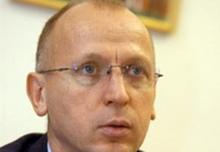 Rada deputy Ihor Ostash has upset Diaspora Ukrainians by supporting a bill that would do away with language calling them an integral part of Ukraine. (Post photo by Oleksandr Medvedev) |
President Kuchma signed into law on March 26 a revised bill that will allow ethnic Ukrainians living outside the country to apply for special status in Ukraine, but stopped short of calling them an �integral� part of its citizenry. Proponents of the bill hope to bolster the number of foreign Ukrainian-speaking university students in Ukraine, but critics say they may just end up getting drafted into Ukraine�s army instead. |
The bill has had a tumultuous ride through the halls of the Verkhovna Rada over the last six months. The original law, �On the legal status of Ukrainians living abroad,� passed first reading in the Rada on Nov. 20 of last year. But on Dec. 13, Kuchma vetoed the bill and sent it back to committee for changes.
Changes have been made to the bill, upsetting Diaspora groups.
The current bill allows for any person living abroad who can prove some Ukrainian ancestry to apply for �special status� in Ukraine, and the law does not discriminate � it also applies to descendants of people who were born in Ukraine, but who are not necessarily ethnic Ukrainians. Diaspora groups noted that they are no longer considered an �integral� part of Ukraine under the new wording.
Askold Lozynskyj, the president of the Ukrainian World Congress, a Diaspora political lobbying group, told the Post his organization�s recommendations were ignored after Kuchma got involved with the bill in December.
�The legislation in November was adequate. The revised version was based on [Kuchma�s] objections. [Our Ukraine deputy Ihor] Ostash appears to have concurred with Kuchma. It demonstrates to us that neither President Kuchma nor [Ostash] truly understand the Diaspora.�
Although the exact details are yet to be worked out, applicants can theoretically approach any Ukrainian consular office abroad to apply, says Ostash, the bill�s promulgator.
�We want Ukraine to consider these people as part of the Ukrainian nation, even if they reside elsewhere,� Ostash said in defense of the bill. Ostash liaised with the UWC in writing the original bill.
Demanding equal rights?
Lozynskyj said the UWC was looking for all rights and privileges afforded to Ukrainian citizens, except the rights to elect and to be elected, and pension rights. He listed adoption privileges and the right to study equally with Ukrainian citizens, neither of which have been included in the new bill.
Lozynskyj added that foreign Ukrainians should not be required to serve in the Ukrainian military. �Under the current version, this is possible,� he said.
Ostash, however, said that one of his main goals with the law is to invite students from abroad to study at Ukrainian universities.
�I foresee a quota of university spots set aside for Ukrainian students from poorer states, like Transdniestr [in Moldova], Russia and Romania,� he added. �It would give them a chance to study in the Ukrainian language, something not available to them in their own countries.�
The law, Ostash says, would allow anyone who can prove that their ancestors came from the territory of Ukraine to apply for a five-year tourist, private, business or student visa free of charge. Any official documentation, such as a birth certificate, would count as proof. Furthermore, as long as the applicant has at least one ancestor from Ukraine, they can apply, with no language test required, he said.
Ostash admitted there may be problems in how the bill defines �Ukraine.� Details will need to be finalized, he said, for ancestors of ethnic Ukrainians from what today stands outside of Ukraine, such as Western Halychyna in Poland, or the Kuban in Russia.
�With this bill, we are adhering to Ukraine�s Constitution, which says that Ukraine cares about Ukrainians living abroad,� Ostash said. �There are anywhere from 12 to 20 million Ukrainians living outside of Ukraine�s borders.�
The bill passed the Rada in November with 327 deputies voting in favor of it. Most opposition to the bill in parliament came from the Communist Party, Ostash said, but he�s confident about the bill�s outcome.
�Lots of neighboring countries work extensively with their Diasporas,� he said, citing Slovakia, Hungary, Romania and Russia, all of which have passed similar laws.