Post Staff Writer
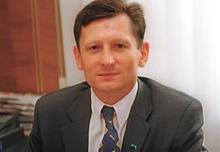 Mykhailo Volynets, Rada deputy and president of the Independent Coalminers� Union of Ukraine. (Post photo by Dima Gavrish) |
Ukraine�s teachers have organized their first independent trade union, but gains for the country�s teachers have been tempered by setbacks in the mining union, union leaders said. On Oct. 22, almost 40,000 teachers and academics from Lviv, Ternopil, Zhytomyr, Chernihiv, Kirovohrad and Kherson oblasts voted to join the Confederation of Free Trade Unions of Ukraine, formed in 1997 to represent the free trade union movement. They join more than 120,000 mining, railway, Kyiv Metro and port workers who are already members of the confederation. |
Volodymyr Fundovny, who led the existing teachers� union in Kirovohrad oblast, was elected to lead the Free Trade Union of Teachers and Science. He said teachers� salaries were the most pressing issue the new union will take up with the Education Ministry. Though wages vary by region, he said, in most cases they are below the minimum standards set by law.
�The existing unions aren�t doing the job,� said Fundovny. �Teachers across the country aren�t being paid what they are supposed to be.�
The addition of the teachers union to the confederation is a victory for Mykhailo Volynets, the Yulia Tymoshenko Bloc deputy who helped spearhead formation of the union.
�There is a lack of civil society in Ukraine,� said Volynets on Oct. 25. �Only 25 percent of Ukrainians belong to unions. Only 6.5 percent belong to parent-teacher associations. And less than 3.7 percent are members of political parties. There are few women�s groups or youth groups. This is the reality today in Ukraine.�
Volynets is no stranger to union organizing. He heads the Free Trade Union of Miners, created in 1990. He was present at a news conference announcing the formation of the teachers� union on Oct. 22.
But Volynets has had trouble keeping members in the mining union, and faces an uphill struggle with the fledgling teachers� union as well.
The effort to organize Western-style free trade unions is complicated by the variety of existing, competing unions. Volynets said that competition comes from what he calls �yellow� unions run by businessmen. Instead of representing their members to management, �the [union bosses] are the management,� Volynets said.
Other trade unions are relics of the Soviet Union, and were created in the 1930s to propagate Communist Party ideology. They are often still steered by directors appointed during Soviet times.
�They�re old,� said Volynets of these directors. �Most are over age 70, and can�t adjust to the fact that unions today have a different mandate.�
The bosses may be old, but the organizations they control are wealthy and powerful.
After the collapse of the Soviet Union, the trade unions retained ownership of real estate and other assets valued at more than $3 billion, including sanatoriums and Crimean resorts. They also control office buildings across the country, including the Trade Union Federation building on Maidan Nezalezhnosti, which only this summer, prior to Independence Day celebrations, removed the prominent hammer and sickle emblem from its facade.
�All of it is prime real estate, and they�ve sold half of it,� said Volynets, who charged that �the [directors] live off the profits and steal the rest.�
The older unions are also supported by a dues-paying membership of close to 12 million.
The State Union of Teachers and Science has about two million members, 110,000 in the Kyiv branch alone, said Oleh Smirnov, the union�s deputy head. He welcomed the new union, saying that choice is a good thing.
�When there is competition, that�s a positive development,� he said.
Certainly, there are ways in which the state union can do a better job address teachers� concerns, Smirnov said. But if the union isn�t doing its job, losing members to the new trade union is a possibility, he added.
�We do our best,� Smirnov said, adding that his union has led demonstrations several times since independence, including a one-day march to Kyiv�s Friendship Arch in 1994. Right now, he added, the union is working on wage-related issues.
With only a relative handful of members, the free trade unions in the confederation rely on a much more Spartan budget than the state unions. Even so, the larger, more established unions would like to put them out of business, Volynets said.
He said that members in his mining trade union are systematically pressured due to their union activity, and that management makes it difficult for union members to pay dues to the union of their choice. Dues are deducted from workers� pay and forwarded to the unions recognized by the employer. To have dues sent to the free trade union, employees must write letters to both management and to company accountants. They must do so �often more than once,� and often unsuccessfully, Volynets said.
Employees who identify themselves as free trade union members are often harassed by management, which uses various forms of direct and indirect coercion to discourage union activity.
In eastern Ukraine, where many towns lack central heating, coal is withheld from union workers. Leaders have been bribed and co-opted. Violence is also common. One Luhansk oblast activist, Aleksy Alekseev, has twice suffered beatings by unknown assailants, purportedly due to his union activity.
Volynets has experienced violence first-hand. In December 2002, the former miner and mining engineer was the victim of a vicious police beating in a Kyiv courtroom.
Sustained pressure, Volynets said, has resulted in the loss of about 133,000 members from the free miners� union since last spring.
Nevertheless, Volynets remains optimistic.
�Where we lose in some areas, we gain in others,� he said.
Volynets said that the free trade unions �have not received any outside help� in the struggle to attract members and represent workers. But that may change soon.
On Nov. 4, the confederation will likely vote to join the International Confederation of Free Trade Unions. The international group is sending a delegation to evaluate the confederation�s bid for membership.
Membership in the international organization, Volynets said, could give the free trade union movement a recruiting boost and help provide some international protection from harassment.
In the meantime, the embryonic teachers� union still wants to increase its strength.
�We are still looking for new members,� said Fundovny. �If people want their rights respected, they should join us.�