Post Staff Writer
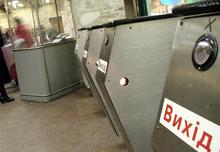 Mayor Omelchenko thought that his transit fare hike would pass without protest, but protest is exactly what he has gotten, including from President Kuchma. The metro workers union wants to see a hike, though. (Post file photo) |
The union representing metro workers has called for an emergency meeting after the Justice Ministry refused to pass into law a proposal to increase the rates for Kyiv�s public transport. This follows weeks of back-and-forth increases, adjustments, and recommendations from, it has seemed, almost everybody affected by the fare hike. The union, which includes subway drivers and escalator watchers, was threatening to go on strike March 4, but backed down when Kyiv Mayor Oleksandr Omelchenko said rates for public transport would go up in mid March. |
It is not yet known whether the union will threaten strike action again as a result of the Justice Ministry�s refusal.
The cost for one ride on all city-funded modes of transportation � including the metro, buses, trams and trolleybuses � was to go up to Hr 0.80 from Hr 0.50 on March 14, Omelchenko said.
Discounted fares for pensioners, students, schoolchildren and the disabled were to remain as they were.
But on March 9, Deputy Justice Minister Lidia Horbunova nixed that plan, at least for now. She said that Omelchenko exceeded his powers in unilaterally increasing public transportation rates in Kyiv.
The bill remains unpassed, and as a result the union is once again on the move and agitating.
�Naturally, we did not expect this,� said union head Oleksandr Mozolevych on March 9. He said he was dumbfounded that that Ministry did not allow for an increase.
The proposed Hr 0.80 fare in itself was a compromise. Initially, Omelchenko had wanted the fares to be even higher.
Back on Feb. 6, Kyiv�s mayor decreed that metro rates would go up on March 1, to Hr 1 per ride. City buses, trams and trolleybuses would go up to Hr 0.70 or Hr 0.75 on the same day.
�The decision�s been made,� Omelchenko said at the time, �and it cannot be challenged or disputed.�
However, it was challenged and disputed.
�I am categorically against the raising of any prices, including transportation and komunalni posluhy,� said President Leonid Kuchma a few days later from Kharkiv, where he also announced that he was against Kharkiv Metro increasing its subway rates.
Ukraine�s Anti-Monopoly Committee also spoke out against it, arguing that it was being done too quickly and without enough research.
�Our committee thinks that these changes cannot happen without first consulting with Kyivans,� said Oleksy Kostusyev, the committee�s head, on Feb. 24. �For any fare increase, there must be a full economic and social analysis of the consequences. To date, we have no evidence that such an independent analysis is taking place.�
The Anti-Monopoly Committee does not have the power to veto Omelchenko�s proposals, but its opinion may have played a role in the Justice Ministry�s refusal to pass Omelchenko�s bill into law. It is unclear what role Kuchma�s pronouncements had on the Ministry. There remains no comment to date from the Ministry beyond Horbunova�s comments.
Omelchenko and the union representing Kyiv�s metro employees argued that fares had not gone up in almost five years, while inflation had. Omelchenko added that without the increase, Kyiv City Metro would lose between Hr 130 million to Hr 140 million this year, which would be better spent on social programs.
The metro workers union, in turn, threatened to go on strike on March 4 if there was no increase in the metro rates. The union said that without an increase, the metro system�s finances would be in serious trouble.
The threatened strike on March 4 was averted when the metro worker�s union was assured that rates would rise to at least Hr 0.80, the minimum amount Omelchenko said was needed to pay Kyiv�s 17,000 public transport workers.