Post Staff Writer
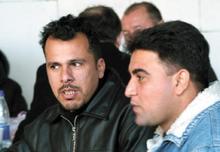 Iraqis Amer Mahid Ismaili and Waleed Talib Humood consider themselves refugees in Ukraine. The Ukrainian government, however, won�t give them that status.(Post Photo by Oleksandr Medvedev) |
When Waleed Talib Humood left his native Iraq, he thought he was headed for Germany. But emerging after 30 days locked inside a cargo container, he found himself in Fastiv, a town in Kyiv oblast, with no hope of traveling any farther. He smiled while retelling the story over coffee in Kyiv two years later. That, he implied, was the risk he took when he paid an Iraqi people-smuggler $4,500 in cash. |
�Today, Humood claims to be a refugee who can�t go any further and can�t return home. He has no family here, and lacks papers granting him a legal status in Ukraine. Every day, he risks harassment by police.
Humood�s road to Kyiv began in 2001. He was a member of Wa Islama, a sunni Moslem group that was militantly opposed to Saddam Hussein�s regime. He said the group published anti-government newspapers and was forming an underground militia when it was infiltrated by Hussein�s secret police.
�When the secret police found out about our army,� said Humood, �they killed whole families in revenge.�
Humood eluded capture and was ordered out of Iraq by the group�s leader.
He met a Kurdish people smuggler in Turkey. In return for cash, the smuggler promised Humood a life of freedom and prosperity in Germany.
�[Germany] seemed different than Iraq,� said the 36-year-old. �Life there is very beautiful. People understand you. You have protection from the government and the United Nations looks after you.�
Humood entered a large metal shipping container with 17 others. The door was locked for a month as the truck made its way overland into Ukraine.
It was autumn, and the temperature dipped lower each day. The immigrants sat in the dark, largely silent.
�We drank only water, and we ate bread, apples and biscuits,� Humood remembered. �We also ate sugar once a day, because sugar helps keep you warm.�
Four weeks later, the journey ended. The group found themselves in a small village. The truck driver took them inside an empty house, warning them to stay away from the windows so that they wouldn�t be seen. The driver promised to return in a few days, and left them without food.
�After three days, no one came for us,� said Humood. �I left.�
Dirty, unshaven and starving, Humood left the group and wandered down the street. He doesn�t know what happened to those he left behind.
Humood wandered into a grocery store, where a sympathetic employee gave him food and later accompanied him to Kyiv by train.
�Eleven days later, I had my first Ramadan in Ukraine,� recalled Humood. He�s celebrated Ramadan two more times since, all the while waiting for any �official status� that would allow him to legally remain in Ukraine.
There are about 1,000 registered refugees in Kyiv, according to the State Committee on Nationalities and Migration. Three times that number are registered elsewhere in Ukraine, principally in Odessa, Lviv, Poltava and Kharkiv. The numbers grow steadily each month.
About a third of Ukraine�s refugees are from Chechnya, Europe and Africa. The remainder, about 2,400, are Asian, with the largest group being from Afghanistan. About half the country�s refugee population is Afghan.
Two types of refugees come to Ukraine, said Alla Kuraeva, an expert with Social Democratic Youth of Ukraine, a civil liberties group in the capital.
�Some of them end up in Ukraine because they were on their way west,� Kuraeva said. �But others chose Ukraine, because it�s better than where they came from.�
Many of them, especially those from Afghanistan, know Russian, she said. Yet many refugees have difficulty finding work.
Mykola Yerukh, spokesman for the State Committee on Nationalities and Immigration, said that refugees are entitled to almost the same rights as citizens.
�I understand there are problems,� said Yerukh. �There�s probably a language barrier, and we have high unemployment to begin with.�
�But [registered refugees] have the same rights as locals. They don�t need permission to work. Immigrants do, but refugees do not.�
Humood said that the problem is that he and other refugees are not recognized as such by the Ukrainian government. He claims the status, and the United Nations High Commissioner for Refugees has backed up his claim, but the state committee has not accepted it.
Officially, there are about 60 documented Iraqi refugees in the country. Humood said that he believes there to be many more.
The police know where many of the refugees live. Occasionally, they stop them and ask for the documentation they know doesn�t exist.
�If you�re intelligent, you pay them off,� Humood said. �If not, you go to jail.�
Through the refugee grapevine, Humood said that he has heard of refugees who tried to leave Ukraine through Uzhgorod, in western Ukraine. They were caught and served six months in jail.
In a country that requires an internal passport for everything from renting an apartment to booking movie tickets, life can be difficult for undocumented refugees.
Presently unemployed, Humood last worked illegally in a market, but was fired for not speaking Russian well. He fears that he will be evicted from his apartment if he can�t pay his rent next week.
Natasha Prokopchuk, a public information assistant for the UN in Kyiv, said the organization does what it can to help refugees like Humood, but cannot do much financially.
�We can only provide information and some technical and material aid,� Prokopchuk said. She said that every refugee who comes to them is individually evaluated, and that recent refugees, especially children, the elderly and the disabled, are more likely to qualify for financial aid. How much cash a refugee receives is determined on a case-by-case basis, she said. The assessments determine whether medical, legal or material assistance is offered.
�We give money, but on a very limited basis,� Prokopchuk said.
Humood said that he believes that the UN should do more for refugees, and that all refugees should qualify for monthly stipends.
�Everyone who is a refugee here gets $40 a month,� he said. �But because I speak English and I am young, I don�t get anything. They only give money to the old, the sick and children. However, [the cash] is our right as refugees.�
�We don�t typically give money to young men,� said Prokopchuk. �They are free to take courses in Russian or professional training classes.�
Classes in Ukrainian and English are available as well. The UN hopes that the training will help refugees to get jobs.
Humood said the classes wouldn�t help him, since they are offered during the daytime, when he is likely to be working.
Kuraeva agreed that classes could conflict with work schedules.
�Mostly, it�s women who attend, because the men are working during the day,� she said. �The classes aren�t offered on weekends.�
Ukrainian law forbids the government from repatriating Humood to Iraq if his life would be endangered there. Anyway, the country lacks the funds necessary to deport illegal immigrants.
Although Iraq�s government has changed, Humood doesn�t want to return to a country where violence is a daily event.
�My people [in Iraq] steal everything,� he said. �They�re even going into hospitals and stealing blankets. I can�t go back.�
�If [the Ukrainian government] gives me a chance, I�d like to stay here,� he said. �I like Ukraine. The people here are easy to talk to.�