Post Staff Writer
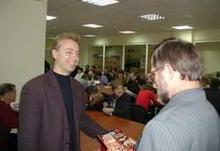 Maksym Rozumny trades books with Yury Kokharchuk, one of the contributors to �Pereyaslav Treaty: Historical Meanings and Political Consequences,� during a conference in Pereyaslav on Nov. 7. (Post photo by Roman Zakaluzny) |
Amidst continuing tensions over Tuzla Island, Ukraine and Russia are set to celebrate 350 years of friendship in January when the nations commemorate the 350th anniversary of the Treaty of Pereyaslav. But not all see the signing of the treaty as an event worth celebrating. No original copy of the treaty is known to exist today, leading experts to disagree about its terms and who was first to breach the agreement, signed by Cossack Hetman Bohdan Khmelnytsky on Jan. 18, 1654, after unprecedented victories over the Poles. Fearful of a return of the Catholic Poles and new attacks by Muslim Tatars, Khmelnytsky turned to the Orthodox Muscovites, signing an alliance with the Russian tsar. |
The Soviets used the treaty as an example of the friendly bond shared by Russians and Ukrainians, and last March, President Leonid Kuchma declared that, in January, festivities would mark its anniversary. That announcement spurred present-day Ukrainian scholars to make an effort to shed a different light on the treaty, and on what they see as its consequences for Ukraine�s independence.
Two publishing houses have issued books of essays on the treaty, rushing to complete the works ahead of the planned celebrations.
�The Treaty of Pereyaslav of 1654,� a hefty 885-page tome published by Smoloskyp, combines old views on the treaty with modern reviews by academics from around the world. The 178-page �Treaty of Pereyaslav: Historical Meanings and Political Consequences� surveys 16 contemporary writers and is published by Prosvita. The publishers have joined to promote the Ukrainian-language books, organizing a multi-city nationwide tour.
The book tour came to Kyiv on Nov. 6 and 7, coinciding with a conference on the treaty that included a day trip to Pereyaslav, about 100 kilometers outside Kyiv.
Maksym Rozumny, a journalism professor at Taras Shevchenko University, said that the books were commissioned �to balance the opinions that were out there.�
�It is important that we interpret the history behind this treaty correctly, because we don�t want to repeat what happened,� he said. �We want to learn from it.�
If the books are intended to revise public opinion about the treaty and its consequences, the publishers must fight an uphill battle: For more than three centuries, Tsarist, Soviet and Ukrainian rhetoric has held that the treaty was beneficial to both states. Not true, say the essayists whose work is included in the books. The treaty primarily benefited Russia, with Ukraine losing much as a result.
Views on the treaty vary from the belief that it was a temporary military alliance between two sovereign countries to the conviction that it brought about the total subjugation of Ukraine under Muscovy. Most opinions fall somewhere in-between, however. Government positions during Soviet and Tsarist times, the spirit of which the publishers claim are still influential today, did not allow for differing interpretations. They allowed only that Khmelnytsky asked to be the loyal servant of the Orthodox Russian Tsar.
�Pereyaslav has been mythologized and politicized,� said Leonid Zaliznyak, a professor at Kyiv-Mohyla Academy and the State Institute of Archeological Studies, and who contributed to the Prosvita book. �Does anyone really think that after having survived years of Tatar and Polish bloodshed, all the Cossacks wanted to do was unite with their older � really, younger � brothers [the Russians] as quickly as possible?�
�The treaty was supposed to acknowledge an equal relationship,� he said. �Well, Tuzla shows us how equal they consider us.�
Zaliznyak said that the controversial treaty would likely be celebrated in Ukraine despite the writers� efforts, because the same people govern Ukraine today as governed it during the Soviet era.
�Our elite are the same as in the old colonial administration,� he said. �The Baltic countries and Poland changed their elites. Belarus, Moldova and Ukraine have not.�
Oleksandr Portnov, 21, a history student at Mykolayiv State University, was invited to make a presentation during the conference.
�History is tied to politics,� Portnov said. He said that unlike in Soviet times, schools no longer teach that the Pereyaslav treaty was an inevitable reunification. But, he added, modern Ukrainian perspectives are still missing.
�Today, we learn that there was a treaty, and that�s that,� said Portnov.
Portnov said that after 1654 the Cossacks began a steady and rapid decline, culminating in the Battle of Poltava. In 1876, Tsar Alexander II issued an edict that simultaneously denied the existence of the Ukrainian language and banned its use � an example of the unequal relationship between the two nations, Portnov said.
He said he is skeptical that the government will review its decision to celebrate the treaty.
�I�m not going to be surprised if, in January, our leaders host a banquet to celebrate, perhaps inviting [Russian President Vladimir] Putin, [Russian Ambassador to Ukraine Viktor] Chernomyrdin, and Vladimir Zhirinovsky,� he said.
�Our universities will probably celebrate it too,� said Portnov. �You have to understand our professors: They have a Soviet education.�