Post Staff Writer
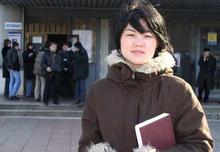 Yulia Vokalyuk, a student, can�t imagine how she�ll continue her studies now that the government�s new flat tax applies to the charity money she receives to help her buy food and clothing. Vokalyuk, an orphan, has no means of support except charity. (Post photo by Vitaly Pavlenko) |
Ukraine�s new flat income tax may be proving a boon to government tax collectors, but it�s a bane to many orphans and university students living on charity stipends. Since Jan. 1, 2004, when the new flat tax law took effect, the State Tax Administration has left no stone unturned in their implementation of the regulations, even turning its eyes on those who receive monetary or material charity. These monies and goods are now automatically taxed at a rate of 13 percent, forcing local and international donors who provide such funds to rethink their generosity in the light of the fact that a portion of what they give will disappear into state coffers rather than go to help those in need. |
In drafting the new legislation, legislators �forgot about the orphans,� said Iryna Mitko, an accountant with the organization Help Us Help the Children (HUHTC). �They simply forgot.�
According to 2003 Ukrainian government figures, an average orphan needs about $70 a month for living expenses and foodstuffs. Given inflation since then, Mitko and HUHTC now believe the minimum should be about $95 a month.
The new tax law states that the maximum a person can earn tax-free is $95, not per month, but per year. This means that most pensioners� incomes and charitable donations to the poor and needy, including orphans without any other means of support, are now liable to income tax. Tax inspectors can levy the 13 percent tax on all charitable donations and stipends received, regardless of their intended use.
If these stipends are deemed taxable, they are also liable to various other deductions, including contributions to the state pension plan and unemployment insurance, Mitko said. When these are combined, she says, about 51 percent of every donation ends up in the coffers of various government agencies.
The new tax law, she adds, will hurt orphans who have the grades to enter university, but not the money.
Currently, HUHTC is helping 68 students at universities and trade schools across Ukraine, including institutions in Kyiv, Kharkiv, Berdyansk, Sevastopol and Zhytomyr.
One of these is Yulia Vokalyuk, who�s in her last year in the linguistics faculty at Kyiv�s National Aviation University. She�s been receiving stipends for four years, after arriving in Kyiv from a state orphanage in Vinnytsya oblast. Without the help, she doesn�t know how she would have lasted.
�I can�t even imagine,� said the 22-year-old. �Actually, I can imagine, and it scares me. I�d be much worse off, really.�
Vokalyuk�s donor is an American organization, and she is one of 30 students receiving financial and other help from the United States. Five others students known to HUHTC are sponsored by a Ukrainian cosmetics firm called Vladikom.
The HUHTC strives to find surrogate �parents,� or donors, for university-aged orphans. They�ve found philanthropists in Ukraine and abroad who cover the students� medical and dental needs, as well as providing them with money for textbooks, stationery, clothes, and footwear. In addition, about $20 cash is deposited into each orphaned student�s bank account every month for miscellaneous needs.
�The kids can spend that money on whatever they want,� Mitko said. The majority, she said, probably spend it on food.
�All students get a small stipend from the government,� she added. �Some even get something from their universities for food, but not all do, and we know that many of our orphans use the cash just to eat properly.�
Most university students in Ukraine take it for granted that their parents will be able to support them financially from time to time. In most cases that money comes from income earned by their parents at work, on which taxes have already been paid.
Now, however, those who give to charity to support others in need will have that money taxed a second time. According to Mitko, that�s essentially what�s happening to orphaned students.
Unlike many Ukrainians, who receive an �official� salary then have their monthly incomes topped up in undeclared cash, the orphans hide nothing from the government. Tax inspectors can easily see the amounts they receive, making them vulnerable targets.
The HUHTC itself claims to embody a financial virtue rare in Ukraine, transparency. �Everything is on paper and above board,� Mitko said. �We deal with Western groups. We don�t deal in cash. Everything is wired through bank accounts.�
According to statistics released by the Committee of Family Affairs and Youth of Ukraine, there were nearly 90,000 orphans in state-run Ukrainian orphanages in 2002. On average only a fraction of those, about 18 percent, go on to some sort of post-secondary education, below the 26 percent national average. Those who don�t manage to study, says HUHTC employee Tamara Bolotenko, end up on the streets, in criminal gangs, or in the sex trade.
Bolotenko�s group tries to make small differences in the lives of at least some orphans who show promise. They are the lucky ones. Another 12 are being sponsored by a Canadian donor.
�Since hearing of the new tax laws, [the donor] has decided to withhold his donation until we can think of ways to get around this obstacle,� Bolotenko said. �[The donor] would have to pay over $25,000 in taxes to [the] government, on top of his donation of $50,000.� The new tax regulations also made him cancel a plan to sponsor an additional 50 children, she said, and others are following suit in reviewing their charitable donations.
�Sponsors are dropping out,� Mitko admitted. �They�re leaving because they don�t understand why money on which they�ve already paid taxes to their various governments (Ukrainian or foreign) is being taxed again when it�s being donated to an underprivileged group.�
�Every country has categories of people who don�t pay taxes, like pensioners or people who don�t make enough money,� Mitko continued. �Orphans don�t earn an income. They obviously fit into this group.�
Fearing the money would be taxed, the HUHTC paid nothing to their orphans in January. In February, after assurances from the Shevchenkivksy region tax office, they paid the orphans the usual amount, setting aside nothing for taxes.
�I think we did the right thing,� Mitko said. �But we fear repercussions down the road.�
Mitko�s group is now contacting parliament deputies to alert them to their plight. The group hopes that by raising awareness of the issue they can get the new law on taxes modified. So far they�ve yet to receive a reply.
In the meantime, they�re desperately trying to hold on to the last remaining donors, lest all their sources of funding dry up.
�If the students don�t receive the minimum, if they�re poor and have no hope for the future, no clothes, no food, no post-secondary education, they�ll starve,� Mitko said, �making them dependent on the state in the long run anyway.�