Post Staff Writer
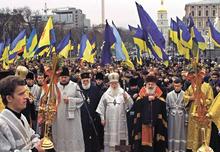 Priests, politicians and 2,000 others carrying Ukrainian flags marched to a monument to victims of the Great Famine in Kyiv on Nov. 22.(AP) |
As Ukrainians marked the 70th anniversary of the country�s Great Famine with an art exhibit, a commemorative stamp and memorial services, the committee that administers one of the most prestigious awards in journalism angered Ukrainian Diaspora groups by announcing that it would not revoke a Pulitzer Prize awarded in 1932 to a controversial New York Times correspondent. |
Josef Stalin engineered the artificial famine, or Holodomor, in 1932 and 1933 to accelerate the Soviet collectivization effort. Ukrainian wheat was shipped out of Ukraine, leaving millions of Ukrainian peasants to starve. The famine was never acknowledged by the Soviets, and many Communists continue to insist that it did not occur.
Solemn memorial
Early on Nov. 22, Prime Minister Viktor Yanukovych and parliament Speaker Volodymyr Lytvyn laid wreaths in memory of the famine�s victims at a memorial on St. Sofia Square. President Leonid Kuchma, who is recuperating from abdominal surgery, was unable to attend, but issued a statement.
�The truth [about the 1932-33 famine] has only become common knowledge for the international public in the years since Ukraine�s independence,� the president said in the statement. �In fact, the famine is today recognized as a tragedy of mankind.�
In 2000, Kuchma declared that the fourth Saturday in November be set aside as a day of remembrance for the famine and its victims.
Later on Nov. 22, former Prime Minister Viktor Yushchenko led a separate memorial service at the Holodomor memorial. More than 2,000 people, including hundreds of youths bussed in by Yushchenko�s Our Ukraine bloc from every oblast in the country, were present.
�We�re not only a post-communist society, we�re a post-genocide society,� an unidentified speaker said over a public address system as people, many carrying yellow and blue national flags, gathered near St. Michael's Cathedral. �We are a people who have undergone hell and persevered.�
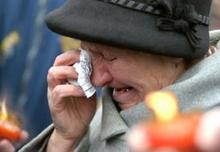 An elderly woman weeps during a memorial service for victims of the holodomor on Nov. 22 in Kyiv. (Post photo by Oleksandr Medvedev) |
Standing near the back of the crowd, Raisa Nevolina, an elderly retiree, listened, occasionally wiping away tears and holding one of thousands of candles left at the memorial after the service. �No one talked about the famine when it was still the USSR,� she said, wiping away tears. �We didn�t even know.� |
�Stalin is to blame,� she continued. �No other country has suffered as much.�
�My grandfather cut and dried loafs of bread and hid them in sacks to his dying day, many years after the famine,� Lidia Kolysnichenko told the Associated Press.
�Our neighbor killed his wife, dismembered her body and was seen to make soup of her,� said 82-year old Volodymyr Pianov, his hand trembling.
Small turnout
Event organizers said that they hoped that as many as 25,000 candles will eventually be purchased and left behind at the site � a number symbolic of the 25,000 Ukrainians who are believed to have died daily at the height of the famine.
The crowd in Kyiv, although one of the largest in recent years for a famine commemoration, was smaller than some had hoped.
�I�d like to have seen more people,� said Oleksandr, a middle-aged man who attended with his 10-year-old daughter, Sofika. He asked that his surname be withheld, fearing repercussions from his employer. He suggested that the effects of the famine are still felt in Ukraine.
�Central and southern Ukraine, the regions that suffered the holodomor, haven�t grasped their Ukrainian nationality as much as western Ukrainians, who didn�t suffer as greatly,� Oleksandr said. �A lot of Ukrainians were killed, but those that weren�t, their spirit was destroyed.�
Famine art
An exhibit showcasing more than 70 works of art and posters recalling the artificial famine of the 1930s and other Soviet-era famines opened its doors Nov. 21 and will run through Nov. 29 at Ukrainian House on Khreshchatyk.
�The history of this tragedy has been buried for too long,� said Andrew Robinson, Canada�s ambassador to Ukraine, who attended the exhibit�s opening. He said that his country�s senate has ensured that the Holodomor will be remembered.
Robinson added that Canada was a signatory to a United Nations statement that described the famine as a genocide. President Leonid Kuchma spearheaded the drive for UN recognition in October.
Pulitzer stands
The country�s observance of the famine was not without controversy.
The day before in New York, the 18-member Pulitzer Prize committee, which awards annual Pulitzer Prizes for journalism, literature, drama and music, declined to revoke a Pulitzer awarded to New York Times Moscow correspondent Walter Duranty in 1932 for a series of glowing articles on Stalin�s five-year plans.
Duranty�s work has been largely discredited, because he regularly wrote dispatches reflecting the Communist party line in exchange for exceptional access to Soviet leader Josef Stalin. Duranty�s stories claimed that there was no famine in Ukraine.
Ukrainians and Diaspora groups intensely lobbied the committee, mailing thousands of pre-printed postcards, and demanding that the correspondent be posthumously stripped of the prize.
No Pulitzer Prize has ever been revoked, although one was returned by a reporter who later admitted to having deceptively fictionalized her work.
The committee said that Duranty�s Pulitzer had been awarded for stories written prior to the Ukrainian famine.
�The board focused its attention on the 13 articles that actually won the prize, articles written and published during 1931,� wrote Sig Gissler, the committee�s administrator. �The Board concluded that there was not clear and convincing evidence of deliberate deception, the relevant standard in this case. Revoking a prize 71 years after it was awarded under different circumstances, when all principals are dead and unable to respond, would be a momentous step and therefore would have to rise to that threshold.�
During the famine, Duranty belittled reporters who visited Ukraine and wrote about the famine, calling them liars.
�There is no actual starvation or death from starvation,� Duranty wrote.
Privately, Duranty admitted to a colleague that as many as 10 million Ukrainian peasants may have died, but added, �they�re only Russians.�
Duranty died in 1957.
Mark Von Hagen, a Columbia University historian hired by the New York Times to review Duranty�s work, called Duranty�s articles �dull and largely uncritical recitation of Soviet sources.�
�I think that both for the integrity of the Pulitzer Prize and for the people that might get it in the future and for the New York Times, they should take it away from him,� Von Hagen told the Columbia Daily Spectator on Oct. 30.
This was not the first time the Pulitzer board reviewed Duranty�s award. The board conducted a less-intensive review in 1990.
Lubomyr Luciuk, director of the Ukrainian Canadian Civil Liberties Association, the lobby group that spearheaded the campaign to revoke Duranty�s prize, called the decision wrong, and said that the board had been insensitive by announcing its decision as events commemorating the famine were about to begin.
�The Pulitzer Prize committee must review their standards of journalistic integrity,� Michael Sawkiw, president of the Ukrainian Congress Committee of America told the Associated Press. He added that his group would continue to press for revocation.
Stamp of memory
Also on Nov. 21, Ukrposhta, the state postal service, began distributing a stamp commemorating the famine�s 70th anniversary. The stamp was hastily redesigned after it was discovered that the initial version was flawed.
Earlier this year, the postal service and Marka Ukrainy, its printing subsidiary, came under fire from historians and Diaspora groups that faulted the design for being historically inaccurate, since it incorporated elements of a photograph of a starving family from a 1921 Russian famine, instead of a photograph from the later Ukrainian famine.
The redesigned stamp, which carries a face value of 45 kopecks, pictures a starving child�s face in the middle of a traditional stone cross.