Post Staff Writer
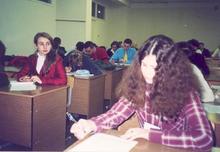 Students competing for the opportunity to serve a two-month internship in Canada�s parliament sat for qualifying examinations in Kyiv on Nov. 29. Of the 450 students who applied this year, only about 25 will be selected.(Post Photo by Roman Zakaluzny) |
An international exchange program that sends Ukrainian students to Canada for two months to intern in that country�s parliament is expanding to include Ukrainian-speaking post-secondary students in three former Soviet Caucasian republics. And according to Ihor Bardyn, director of the Canada-Ukraine Parliamentary Program, it will be just in the nick of time for the �eastern Diasporas.� |
�Ukrainian community life there will weaken and diminish and will probably disappear soon,� said Bardyn.
A native Ukrainian who immigrated to Canada and now practices law in Toronto, Bardyn was at Kyiv Mohyla University on Nov. 28 and Nov. 29 to attend a reunion of past participants in the 14-year-old program, and to administer examinations for next summer�s crop of interns. Some of the hopeful students came from as far away as Armenia to take the test.
Of the more than 450 students from across Ukraine who applied to the program this year, 109 were invited to Kyiv to take a Ukrainian-language examination and demonstrate proficiency in either French or English (Canada�s two official languages).
Competition to get a spot in the program is tight. Bardyn said that only about 25 students would get the nod to go to Canada.
This year, the program is expanding beyond Ukraine�s borders, adding spots for each of the three newly independent countries of the Caucasus � Georgia, Armenia and Azerbaijan.
The parliamentary program, which began in 1991, was initially set up as a true exchange program, with the intention of sending Canadian students to Ukraine as well. They would intern in the Verkhovna Rada. While that part of the program never materialized, the one-way exchange remained.
Since then, more than 300 students have served two-month stints in the offices of a Canadian member of parliament. Some were there in the midst of federal election campaigns, and observed how they are run in Canada.
The students return with a better command of English, improved chances of gaining full graduate scholarships abroad, different perspectives on politics and society, and improved job prospects, Bardyn said.
Program alumni who attended the reunion in Kyiv are now serving on city councils in Yalta, Odessa and Lviv, or working for the Constitutional Court. Universities across the country have hired the former students, as have the World Bank and Ukraine�s embassies in Washington and Ottawa.
One alumnus, who now works for Poltava Petroleum, made a $1,000 donation to the program during the reunion.
�Fourteen years ago, we wanted to give the opportunity to Ukrainian students to observe the Canadian parliament, meet Canadians and see the work of the Ukrainian community in Canada,� Bardyn said. �Then, to take it all back and perhaps have some of it applied in Ukraine.�
By expanding to include new countries, Bardyn said, he was paying heed to a resolution passed by the World Ukrainian Congress last summer in Kyiv. The congress was critical of Ukrainians around the world and in Ukraine for neglecting Ukrainian-speakers living outside Ukraine, in countries other than western liberal democracies like Canada, the United States and Australia.
�The eastern Diaspora is often neglected,� agreed Bardyn. �Expanding the program to those countries will bring a whole new perspective to the program. It�s a Diaspora that�s been ignored by Ukraine, and by the Western Diaspora.�
After the Caucasus, Bardyn said, he hoped to expand the program to students in Russia, which has a Ukrainian population of more than 2 million by some accounts.
China has a small Ukrainian Diaspora as well.
�We�re going to go as far as China. On their border there�s a place called Zeleney Klyn,� said Bardyn. �Ukrainians fled there after the World Wars.�
The program is funded with interest earned on a $1 million endowment fund put up entirely by Ukrainians living in Canada. Though students are required to have a working knowledge of the Ukrainian language, that has not restricted students from other ethnic groups from participating in the past.
�Other countries promote themselves in this way,� said Bardyn. �We don�t restrict Russians from participating. It�s a question of attitude. You have to be tolerant, and you have to speak Ukrainian. Interestingly enough, in one of our first years, three out of five of the interns were ethnic Russians.�
Bardyn said that he does not see his program differing much from other international language-promotion organizations, like Alliance Francaise or the Goethe Institute, which promote the use of the French and German languages, respectively.
�It�s a rule of the program,� said Bardyn. �No one should be offended. But the challenge has made people prepare themselves.�