 |
 |
 |
 |
 |
 |
 |
 |
 |
 |
|
|
|
|
|
|
|
|
|
| RUBELLA BALLET...
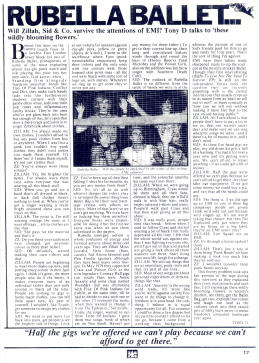
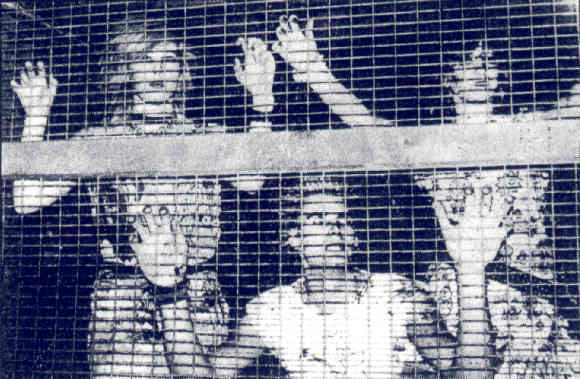
Will Zillah, Sid & Co. survive the attentions of EMI? Tony D talks to 'these wildly blooming flowers.' Behind this door on the twenty fourth floor of a faceless East London tower block lies two of Rubella Ballet, protagonists of some of the most exploding plastic day-glo punk wrath and role playing this poor boy has seen since. God knows when. Standing firm alongside 'hardcore anarchist' bands like Flux Of I'ink Indians, Conflict and Dirt, they make such bands fade into the furthermost shadowy corners with their gaudy dress sense, seditious little pop tunes and inflammatory catchy hooks. They're the ones who've put glam back into bam but enough of this, let's open that door a mere crack and listen in to singer Zillah talk about clothes... ZILLAH: I've always made my own clothes, I couldn't afford to buy any punk clothes from boy or anywhere. When I was first a punk you couldn't buy punk clothes, they didn't exist unless you made them yourself. It's more 'me' if I make them myself, it's not just clothes then. ZZ: You've always worn those colours? ZILLAH: Yes, the brighter the better. I've always worn these even when everyone else was wearing all this black stuff. SID: When you go and see a band that's all dressed in black, or dark dull clothes there's nothing to look at. When you've got a singer wearing a really bright coloured dress you can focus on that. ZILLAH: The point is, I'm still wearing onstage the same as I wear offstage ... all my clothes are like that. SID: She pays for the material and that's it. ZZ: Do you think your audiences have changed, got anymore colour in them than before. SID: Oh definitely, started making their own t-shirts and that. ZILLAH: People are beginning to wear more make-up now, and putting crazy colour in their hair again. I think it's great, the more people who do it the better, it makes everyone more of an individual rather than just walk around in black all the time. People are coming to gigs in home made clothes, you can tell them apart now. it's part of yourself. I wouldn't, like Toyah, get someone to design my clothes for me. SID: We want to put more fun back into punk, get people to see the brighter side of things. Look at our t-shirts for instance (garish day-glo pink, yellow or green objects de kitsch), I went to the warehouse where Fans (punk memorabillia emporium) keep their t-shirts and the only ones with our colours were those leopard skin print ones - all the rest were black with some sort of logo on, with sleeves. Whenever we ring up to get some they've never got any. ZZ: You've been top of their Best Selling T-shirt list for months, do you net any money from them? SID: No, it's all to do with whoever designs the t-shirt. they re-arranged the poster thing from Ballet Rag a bit (their nine tracK, tape release only album on Xntrix. More of that later) so we don't get anything. We even have to fucking buy them ourselves! Everyone thinks we're responsible for doing it but the first we knew was when we saw them advertised in the papers. Rubella emerged amidst a whole confusion of energy and fenzied activity about three odd years ago. They are Zillah Minx (vocals). Gem Stone (bass, vocals), Sid Attion (drums) and Pete Fender (guitar), although there have been many other lineups. In May 1979 they supported Crass and Poison Girls at the now legendary Conway Hall gigs (on vocals then were Annie Anxiety and some chap named Womble). Sid was drumming with Flux Of Pink Indians for awhile, at the same time, till he had to decide to stay with one or the other ('I invented the name, when they wanted to change it from The Epileptics,' Sid recalls. Colin, the singer, wanted to call them Tribe Of Indians. I gave them two songs, both of which are on Neu Smell. Haven't got any money for them either.) To get to their current line-up, their long and convoluted history winds through and round the likes of (Honey Bane's) Fatal Microbes and the Poison Girls, also on the sidelines was lan (now singer with Southern Death Cult). SID: The outlook of Rubella Ballet is so different from the circle of bands we were in at the time, and the colourful anarchy bit came out from there. ZILLAH: When we were going up to Birmingham, Crass would be there and all their fans, dressed in black, then me 'n Sid'd walk in with blue hair, really bright tattered t-shirts and jeans. People'd walk past Crass and that then start giving us all this abuse ... SID: It was really good, people need that break - before when I used to follow Crass and started wearing a lot of black I felt really depressed all the time. I felt that the whole world was against me, that I was fighting everyone else, until I got out of that and started not giving a fuck about all those wankers out there. Start living your own life, laugh for a change. ZILLAH: We still say things that are as important, punk roots and that, it's part of our lives... SID: Most of our songs are about personal experiences or dreams, things like that. ZILLAH: 'Anarchy' is the wrong word really, it's more like you're/we're against society .You want to do things to change it. freedom is in your head, the only thing I believe in is equal opportunity for all. For instance I could've done a law degree but my parents couldn't afford to let me go, because I come from a working class background - whereas the parents of one of Sid's friends paid for him to go and study for four years. That's the sort of thing I'm against. EMI have their talons ready sharpened ready to rip the soul out of the poverty stricken Ballet. Though their first vinyl offering (Right To Live Not The Need To Survive EP) is still on the independent Xntrix label, the question they are currently grappling with is the eternal internal one that usually crops up - in its naked form as "shall we sell out or not?', or more cynically as 'how can we sell out without making it seem like that to the-vast record buying public?' ZILLAH: All I care about is that people don't have to pay a lot to see us, that our records aren't dear and make sure we can sing whatever songs we want - and if there's a bit of money in it, well I don't mind. SID: At these live band gigs we play, my old drum kit gets a hell of a bashing. I've had it lor over a year now and it's getting worn out. We can't afford to repair anything - if we could get a bit of money ... ZILLAH: Half the gigs we're offered we can't play because we can't afford to get there - let alone take our equipment. If we got some money we could buy a p.a. and van that all the bands could use. SID: The thing is, if we did sign up to EMI or one of these big companies people are gonna think we'd sold out just because we'd singed up. It's not worth taking that chance, but then The Exploited only got where they are by being on a big label, they're on EMI aren't they'.' ZILLAH: Vice Squad are on EMI. ZZ: It's through a licencing deal I think ... ZILLAH: That's just a way of them being 'Punk Bands' without making it look too much like they've sold out. ZZ: I wouldn't consider them punk bands anywav. This thorny problem took up a fair portion of the tape during this interview as they explained their (very real) poverty and such like. Let's encourage these wildly blooming flowers in society's dustbin, see them, get the Ballet Bag, get two, explode into colour and laugh out loud as the vultures crash into their rancid pits of filthy lucre never to smear freedom's untainted landscape ever again. TONY D. ZIG ZAG 1982 |
 |
 |