 |
 |
 |
 |
 |
 |
 |
 |
 |
 |
|
|
|
|
|
|
|
|
|
 |
 |
| RUBELLA BALLET |
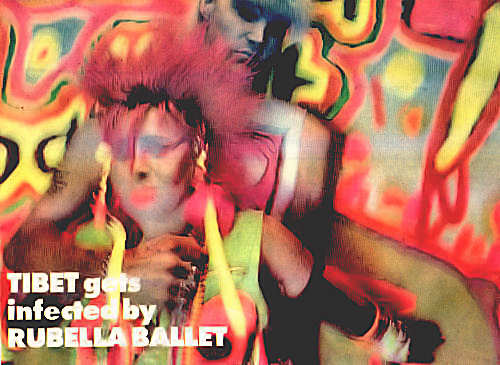
| WELL WHAT do you want to talk about first?", I enquire of Zillah and Sid, the two mainstays of the Rubella Ballet story. "What about this," says Zillah, as she drags out a review that I had done of their live show at an ill-fated Jungle Records bash at Heaven some months ago. "Well, people spoke to me about this live review of yours and said that you'd given us a pretty crappy review; but I don't think it was, was it?" No. Actually, it was a good review, especially considering that the rest of the evening was fairly bad ... "Bad? It was fucking awful," responds Sid with some feeling. "Put it this way" explains Zillah patiently. "We've been going five years, and in all that time we've had to do everything ourselves: we've had to get the gigs ourselves, we've had to get the promoter to put it to the price we want �which has also caused a lot of hassle � and we always end up having to pay for everything out of the money we're meant to get from the door, which is especially difficult as we like to keep the door prices down." Well, a remarkably defensive start to the interview. Rubella Ballet are pissed off at the way they've been treated, which is fairly unsurprising. As usual, their's is a story of coming up against the legions of creeps who inhabit the rotten wood of the music biz, and who often win due to their handy lack of morals and truthfulness. "The trouble with those sort of people," says Sid, "is that they think that punks are all thick and stupid, and they can rip them off of their money really easily." But isn't there good ground for believing that is the case? As long as people are prepared to tolerate being treated like shit, other people are going to oblige them. "Well, they are until somebody comes along who knows the business. And that's where the other problem starts, because it. gets to the situation where the bands haven't got anywhere left to play, and so they have to let themselves be ripped off so they can play. So which is worse, being ripped off, or not having anywhere to play? I'd think not having anywhere to play is worse." Agreed, agreed. Many promoters are not of the highest character; but unfortunate though that may be, how can you fight against it? "Well," replies Zillah, "not too much when you're the group that's playing, 'cause you've got to get there in the first place, then set everything up, then play, and than pack it all up and leave. "It's true what you said" continues Zillah. "You said that Rubella Ballet are a band that 'aim high and sometimes screech to a miserable halt.' That happens to us all the time, because we've never had any financial backing, and we've always had to arrange everything ourselves. "And that's why we sometimes get pissed off with the way people go on about us. Look at the bands like Death Cult: people forget that they've got stage managers, their own PAs, their own sound engineers, and someone controlling everything that's going on. People like that get a lot more help..." Warming to her theme, Zillah moves onto the bias of the press and their minions, the journalists, although, happily, the venom isn't directed at myself. "When we played the Ace, at the end of the set I'd never heard so much applause, people were shouting for more. But the journalist, whoever he was, just went on about Miner's make-up. What's that got to do with it?" "When I get upon stage, I don't care whether anyone likes my clothes or not. And the colourfulness is nothing to do with being against Crass � it's the way I want to look, and I'll take it to whatever lengths I want to." A DISCUSSION develops on the nature of reviews. All a review is is a statement of the reviewer's own opinion, biased though it certainly is � just as everyone's is. And if people read a review and they consider that it either is the gospel truth or the reviewer is pretending that it is the gospel truth, then that's their problem. So if people want to read more into an article about a record or concert, that's up to them. That having been said, it's true that reviewers sometimes mislead; they'll say that something was crap in their opinion, but won't mention that the rest of the audience went into throes of ecstasy. "That's just what I mean", answers Zillah. "Most writers don't say that; they just see the side that they want to, and never even give the other side a look-in. We even heard of a bloke that gave a gig a real slagging, but the gig had been cancelled, and he hadn't even gone! "Somebody once said the Omega Tribe sounded like the Jam, and the next thing we heard, Polydor were interested in them precisely because of that. "It just makes me so sick that the record business is still so intent on making money out of everyone; they don't go out to see anything, they just live on what they read." It's a poisonous game, as anyone who has any sense realises. Doesn't such distrust and dislike of the record business render it extremely difficult to get a record deal that is honest � if such a thing exists anyway? "We've spent two years since we did our last single trying to get the record deal we wanted" says Zillah. "And we were offered things like Anagram and a fifteen album and sixteen singles deal with �1,000 in six years and all that shit. And we thought � Bollocks! We're not going to do that sort of shit. And then we got the Jungle one, which was what we wanted." But all record deals tie you down; what was the pound of flesh that went with this particular one? "The agreementt," answers Sid. "is that we do one single and then decide on the performance whether we want to do any more. It's our option to drop the record company." "They wanted to offer us more," adds Zillah, "so they would have more on us, but we didn't want to do that. A lot of independent labels don't have the distribution, but Jungle have been pretty good." Your last single before the Jungle 12 inch was on Xntrix, the Poison Girls' label. What made you leave that home, and into the "independent" but not independent market? "Welt, Poison Girls went to another record company," explains Zillah, "so they stopped the label." But wouldn't you prefer to do things on your own label, bearing in mind your complete distrust of all the established companies? "As I said," replies Zillah, "we've got enough hassle trying to organise the gigs, drive the van, do the gigs, take down the equipment, arrange the tours, live, go to Tesco's..." "Our dole money lasts two days", chips in Sid. "We haven't had a penny off Xntrix or a penny off Jungle � all the money we got off Jungle was spent on doing the record." RUBELLA BALLET have often been described as the punks who have carved out an alternative to the depressing self-obsession of the misery-punx; but Sid and Zillah are adamant that they never considered themselves a movement against the stark monotones that dominated the punk crowd for so long. Notwithstanding the comments that their flourescent bright attire has garnered: "At the beginning we were used against Crass and similar bands; but that wasn't our doing," says Zillah. "When there were newspaper strikes on, there was a headline on some music magazine saying 'ASLEF blacked out The Sun, but Rubella Ballet eclipse Crass.' So all these people that support Crass are against Rubella Ballet because the music papers have made it out that we're opposed to them. But we've never been against anybody. . ." "Apart from people who've been against us...." adds Sid. "So now the new slant," continues Zillah "is that all we're interested in is our stage apearance, and all our songs are childish." "Which is a load of bollocks!" snaps Sid. "The thing about the music press." says Sid, "is that if they slag you off, there's nothing you can do about it � you can't be guaranteed of a chance to reply � and it just makes things that little bit harder for you to get back to the position you were in before they slagged you off. But if they want to say we're crap, then we don't give two fuckin' bollocks; it just surprises us how many people ask us if we're upset that we've been slagged off." "Like you should see some of the letters we get," moans Zillah. "We got this letter saying 'Don't you think you've sold out for being in Punk Lives?' What they don't realise is that we don't get paid for that; we don't have any money to publicise ourselves, and it's the only way we can get any sort of publicity ourselves, and it's the only way can get any publicity, and we do need some, 'cause otherwise you're still ignored." But for better or worse, I point out, that's the function of the music press. Even if you are being slagged off, it's still publicity, and through the press is more or less the only way that you can get exposure. "Yeah, I agree." says Zillah. "It's like the lyrics; I've thought a lot about the way that people keep changing their minds about them, and sometimes I think that maybe they should be more obvious. Like with the 'Ballet Dance' single, ('Do The Ballet Dance/ Punk Exist') � nobody's ever asked me about the lyrics on that because they're not obvious enough for people to understand. "Those lyrics meant a lot to me; I thought that perhaps I should put them more straightforwardly, but then all I would get is arguments, and I'd never be able to prove my point anyway. So the more we go on, the more we realise that we need money to back up our arguments." But what are the arguments that you need to win, I ask? There is little of a direct political � or anti-political � nature in your songs. What is it that you feel strongly about? "We agree with Crass, we agree with animal liberation and all that," replies Zillah. "But we don't go on about it because there's someone else doing it. They're doing it well enough..." But if you feel strongly about these things, isn't it then a logical step to push them? "I feel strongly about other things as well," she answers. "I feel more strongly for the people around here: they're bored, they've got nothing to do, they aren't punks, and they have no scene to go to. So eventually they'll probably turn to heroin. And by the time they realise what they've got into, and they go to the doctors, he turns around and tells them to fuck off. So then there's nowhere for them to go. And even if they do find a clinic to go to, they've still got to come back to the same situation anyway. "So what we're more concerned about is society and how its run. If we had money, we'd be able to help people like that. But there's no point me saying that, 'cause people would only want to argue and say 'Oh, you'd only fuck off to America." It's difficult to doubt Rubella Ballet's conviction and concern; they undoubtedly feel that they've been misunderstood � probably wilfully�and the truth is that they see hope at the end of their particular road, no matter what the criticisms. What's important now is to drag back into their camp the optimism they so badly lack at the moment, but which is manifest in their music and presentation. You know it makes sense: don't let the bastards grind you down... (SOUNDS October 27th 1984) |
 |