Entry for December 10, 2007: Intelligence and The Tedious Tudors duke it out on CBC
Last week, Showtime import
The Tudors ended its first-season run on CBC in Canada and later tonight, original CBC series
Intelligence will have a two-hour second season finale at 8pm (EST, PST). Why discuss yet one more 16th century costume drama about Henry VIII alongside a 21st century crime-and-espionage thriller set in Vancouver? I mean, aside from the fact that Intelligence is a lot better? Well, it could be because for the life of me, I can't help thinking that Intelligence does a far better job of furthering our understanding the Renaissance than The Tudors ever will.
Let's start with The Tudors, since that's the obvious one. CBC has been talking this one up with endless and repetitively tasteless ads that have blended, in my mind, with their equally endless and repetitively tasteless ads for Viagra. CBC takes tax money from Canadians and claims to use it to fund and create Canadian content. Right. This, of course, absolutely explains why the network promoted to death a show about the British monarchy (The Tudors) at one of its more tawdry historical points that first appeared in the U.S. and then failed utterly to promote the second season of a show both filmed and set in Canada (Intelligence), to the point that everyone now pretty much assumes that CBC is trying to bury the latter. Makes sense to me.
The unintended irony continues: CBC promoted The Tudors' racy content, then censored it, then rushed out a DVD with all of the censored content included. Because, hey, Showcase never gives Canada fairly classy Spanish porno like Sex and Lucia uncut. Seems like one big cheat to advertise a show to death as costume porn and then censor the porn--and then charge people to buy a DVD with the porn stuck back in.
I won't get into all of the historical inaccuracies of The Tudors. Others have pointed them out
ad nauseam, and Lord knows, those inaccuracies are legion. Most popular seems to be the conflation of Henry's two sisters, Mary Rose and Margaret, into a single character named "Margaret" and then killing her off for no good reason that anyone could see. Then, of course, there's Cardinal Wolsey's (Sam Neill) death, which is very different in the series from that in history (the real history being explained away as a convenient cover-up).
I won't get into every little historical inaccuracy for the simple reason that I completely lost interest in the series early on, and that's even with being a fan of Sam Neill and liking Maria Doyle Kennedy as Catherine of Aragon. Not only could Neill and Kennedy not pull this one out of the toilet, it flushed them down with it. The main problem with The Tudors is not so much that it's crap history, but that it's crap entertainment, period. There are some stories that have historical issues, but can give you an idea of the period, or at least entertain you in a way that might have entertained the people of that time in the same way. Those are good stories, despite their inaccuracies. It's as if, for just a moment, you "get" where your ancestors were coming from. There's a moment in Ray Winstone's portrayal of Henry VIII (the 2003 miniseries), for example, where he's weeping over a dying Jane Seymour in her childbed. You actually feel sorry for the big jerk and get a small insight (despite Winstone's Cockney accent) into Henry's mind. I never felt any such moment in The Tudors. Not once.
One major problem is that the series begins at the same point as every other bloody Henry VIII story--after he's tired of Catherine and started casting around for alternatives. It would seem to me that if you were going to cast a younger actor as a young and virile Henry to get the teenyboppers in and go that route, you could also begin when Henry was defying convention and taking his brother's widow to wife. Otherwise, what's the point, really? Especially since beginning later necessitates long, boring Henry monologues in the Confessional just to get us all up to speed.
The second major problem is that while Jonathan Rhys Meyers is a decent enough actor normally, he is woefully inadequate for the role. He is far too skinny and petulant for Henry. Not that Henry was fat when he was young--in fact, he was quite athletic--but he wasn't a small man, either. And Meyers bears all the charisma of an irate Chihuahua, screwing and sporting high 16th century fashion while talking up wars that he will start but not participate in, much like a certain current world leader, as if we needed yet another such historical analogy. Unfortunately, Natalie Dormer does no better as Anne Boleyn, carrying a perpetual half-smirk that looks carved into her face. All this and endless Viagra ads, too. Aigh! Turn the channel!
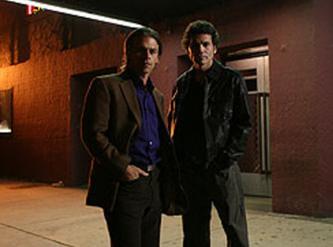
And then there's Intelligence. At first glance, one wonders why I'm bringing this show up on a medieval blog--well, aside from the fact that it's my blog and I can talk about whatever I want, of course. Intelligence is an espionage thriller set in present-day (or immediate future) Vancouver. Local marijuana smuggler Jimmy Reardon (Ian Tracey) gets hold of a briefcase of informant files stolen from the local Organized Crime Unit. Reardon negotiates with Mary Spalding, the OCU's Machiavellian (and I don't use that adjective lightly) director for the return of the files in exchange for information. But Mary (nicknamed "The Queen" by her male colleagues) is trying to gather together a network of informants that would have made Elizabeth I's spymaster Thomas Walsingham proud. And her most powerful and important vassal--sorry, informant--soon becomes Reardon himself.
The medieval/Renaissance parallels are subtle but many. I've already mentioned Mary's conflation with Elizabeth the Great. Reardon, however, is even more feudal in the way that he approaches his illegal empire. He runs it via a group of trusted councilors, including Ronnie Delmonico (who runs the Chickadee, a strip club that becomes Reardon's embattled fortress in season two--complete with guards on the battlements), and Bob Tremblay, Reardon's quiet but scary spymaster and personal bodyguard. Also front and center are Francine, Reardon's disturbed and disturbing ex-wife who possesses the cunning of Lady Macbeth and a determination to reap the spoils of her dead marriage, Reardon's heir apparent, beloved daughter Stella, and Ronnie's Anne Boleynesque girlfriend, Sweet, now pregnant with his child and heir.
On top of this are seigneurial rivals and sometime allies Dante Ribiso (head of the Disciples, a biker gang) and Phan (head of the local Vietnamese gang) and the ongoing diplomatic dance between Canada-England and the behemoth next door, the United States-France, which looks an awful lot like a metaphor for the Hundred Years War.
If you know any history, what comes out of Intelligence is a strong sense of
plus ça change, plus c'est la même chose--the more things change, the more they stay the same. In fact, this show may be a little too good at its history lesson, because CBC seems damned and determined to kill it. So, if you want to catch Intelligence, you'd better watch the season finale tonight at 8pm or wait for the season one DVDs to come out in the U.S. (oh, the irony) next April 29. You may not get another chance.