The Dark Ages is the latest medieval documentary on the History Channel, coming out this Sunday at 9pm ET, 8pm MT. It covers the period between 410 C.E. (except for a little backtracking to the third century) and 1100 (the "renaissance" mentioned in the previews is the Twelfth Century Renaissance, not the later and better-known one). The main events that they use as bookends are the fall of Rome to Alaric in 410 and the end of the First Crusade in 1099. Why, I'm not entirely sure.
I was offered a copy for review, so I figured, what the hey. There's also a Dark Ages
game, which is not bad. It consists of a series of five puzzles with timers, followed by clips from the show and quizzes. Playing the game gives you a chance to enter a sweepstakes, though for what kind of prizes, I'm not entirely sure. The puzzles are actually rather hard due to the short timer (at least for me), but you can play them as often as you want.
The promotion of The Dark Ages is actually pretty good (I like the refillable pen, even if the knight's helmet and battleaxe are far more 15th century than fifth). The trailers, and the opener, however, are quite a bit different than the overall tone of the documentary. I suspect that what they are trying to do is pull in people who think that the Middle Ages are all Ivanhoe meets the Wicked Witch of the West and educate them about a lesser-known part of the medieval period. To that end, they've enlisted a battery of experts, including: Michael Kulikowski from the University of Tennessee, Tom Martin from the College of the Holy Cross, Kelly DeVries from Loyola College, Philip Daileader from The College of William of Mary, Jim Masschaele from Rutgers University, Brett Whalen from UNC, Chapel Hill, Adnan Husain from Queen's University and Bonnie Effros from State University of New York. The sole woman, Effros appears only three times, and is not identified until near the end of the show.
Daileader, incidentally, utters my favorite line of the whole documentary: "Your typical medieval knight had much more in common with Tony Soprano than with Lancelot." [snicker]
The two-hour (an hour and a half without commercials) documentary starts off with an ominous crash of the "dirty barbarians dragging down civilization into the mud" variety. Fortunately, this appears to be only the hook to reel in the video game crowd. Though I should talk, considering how many games of Civilization II I played when I was avoid--I mean, translating--all those cartulary documents for my thesis. But that's neither here nor there. After beginning with the siege of Rome in 410, The Dark Ages settles into a decent summary of barbarian besieger Alaric's previous occupation as a mercenary for the Empire. The documentary then jumps to Clovis in fifth-century Gaul (studiously noting along the way that he was
not a descendant of Jesus Christ--
pace Dan Brown).
It then takes an odd detour into twenty minutes on Byzantium, before moving on to a little dark-age social history of the depresso variety, some very simplistic discussion of St. Benedict and Bede and monastic preservation of knowledge, the battle of Tours and then Charlemagne. By "odd", I don't mean that they should have avoided covering the Byzantine Empire. But its location between Clovis and Charlemagne seems choppy, what with Clovis' Merovingian descendants being the dynasty just before the Carolingians and the Byzantine Empire being the largest empire of medieval Europe. The documentary is a bit dismissive of Byzantium, saying that the Byzantines "claimed" to be the Roman Empire when, well, duh, they were. No surprise, then, that Constantine doesn't get a look-in. Discussing the Roman emperor who founded Constantinople as the new capital of the Roman Empire a century before Alaric's siege of the old capital would have made this dismissal of the Byzantine Empire as a Rome wannabe look silly.
After lingering on Charlemagne and his eighth-century renaissance (as opposed to the twelfth century renaissance that closes the show, so many renaissances), the show naturally rounds out the carnage with an enthusiastic coverage of the Vikings and the First Crusade. Of course. Though I will give the History Channel points for actually discussing the Peace and Truce of God.
Overall, the coverage is simplistic. You get the usual juxtaposition of experts being cut off just when they're about to introduce some analytical greys into the narrative with some voiceover guy making black and white declarations about what are actually vague theories. If anything, the History Channel has improved on that score. But there is still that strange sense that the people who wrote the commentary did so after reading a popular history book of the "Guns, Germs and Steel" level of complexity and somebody else recruited the experts to come in and act as talking heads. So, you get someone like Kulikowski trying to make a complex point about what we do and don't know about the period and being completely undercut by ensuing commentary straight out of "
Horrible Histories". You shouldn't mix the two anymore than you should mix wine with vodka shots and for the same reason.
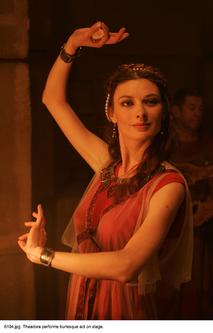
Now, there is some good stuff here. The discussion of the political and socioeconomic situation that led up to Alaric's attack on Rome is surprisingly thoughtful and detailed. I quite enjoyed the coverage of Byzantine Empress Theodora's rise from whoredom to royal power, even if her husband Justinian comes across as a complete wuss and the documentary glosses over the fact that the Byzantine Empire's greatest period of expansion actually occurred four centuries later under Basil the Bulgar Slayer. The reenactment of the Battle of Tours is also interesting in that it demonstrates well the current thinking that this was more of a raid than a battle. Great attention is also paid to making the military and royal clothing and gear accurate, though anything worn by the lower classes tends to come straight out of Monty Python. The History Channel probably consulted Kelly DeVries for the former, since military tech across the medieval board is his specialty.
But the unquestioning acceptance of the idea that the end of the Roman Empire was a period of extreme discontinuity is almost as complete as Henri Pirenne's. Also, the social history is unfortunately not all that well done. You see a lot of slippage into later medieval anachronisms, like the non-discussion of women's status (which started out rather good in Germanic societies and deteriorated toward the end of this period). Would it have been too bloody much to ask to bring in a few more female medievalists? God knows we've got a few from this period.
The middle section about monastic culture and the earlier section about the sixth century
plague in Constantinople are easily the worst parts of the documentary. The Constantinople plague, for example, is declared to be the second-worst ever, killing half of the world's population. Excuse me? Can we really trust Procopius to tell us what was going on in Asia? And who decided that half of the population of the world died in the sixth century when many experts still believe that only a third died in the fourteenth century
Black Death, considered by most experts to be the worst natural disaster in human history?
Also, the documentary glosses over the deficits of the Roman Empire before the fourth century, such as the fact that the agricultural economy of Italy had been a mess ever since Republican times when Hannibal had rampaged all over the place, not to mention Spartacus and Caesar. Just because Rome hadn't fallen in seven centuries didn't mean that Italy had remained prosperous and untouched. The masses in Rome were starving long before Alaric ever showed up.
Should you see The Dark Ages? Let me put it this way--if you're an academic, you'll see it just for the masochistic car-crash potential (don't get me started on Templar documentaries. This is already too long). But it's not as bad as all that. If you're ignorant of the era, you could do a lot worse than watch this. You'll get most of the major highlights of the period and it might just get you interested in finding out more.
The Dark Ages is on the History Channel on Sunday, March 4 at 9pm ET, 8pm MT.