All that you can't leave behind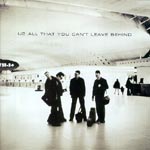
From Rollingstone.com ....An interview with The Edge.
U2 Hope to Reawaken America
The Edge says U2 are happy to strip down
America is undergoing its second outbreak of U2 fatigue. Back in 1987, the Irish quartet could do no wrong on these shores. The blues/gospel/roots inspired album The Joshua Tree, U2's undisputed critical and commercial masterpiece (10 million copies sold on these shores), cemented Bono, The Edge, Adam Clayton and Larry Mullen Jr. in American rock & roll lore. But they soon overstayed their welcome. The film Rattle and Hum and its accompanying soundtrack saw the biggest band in the world getting a bit too big for its britches by, among other things, preaching to us about "NicaraGUA" and trying to steal "Helter Skelter" "back" for the Beatles.
Then, in 1991, faster than we could say "am I buggin' ya," the lads reinvented themselves. The boys traded their hearts on their sleeves for leather pants and Superfly sunglasses, and released the sleek, electronica-seasoned pop sensation Achtung Baby. The world's most earnest band had morphed into glitzy rock stars -- and we loved them for it.
They played the dance card again in 1993 on Zooropa, and then took it to its logical conclusion on 1997's Pop. But the electronic-fueled sound and the swarmy image had worn thin; along with 1980's Boy and 1981's October, Pop is the band's poorest-selling album in the U.S. (one million copies to date). To make matters worse, the band supported the album with the elaborate Pop Mart tour, which mocked American consumerism -- sometimes to less-than-capacity stadiums.
The appropriately titled All That You Can't Leave Behind, which hits our marts on Tuesday, is U2's redemption. The eleven-song collection finds the band returning to past glory simply by being a band. Propelled by Edge's guitar -- something that has been obscured on recent albums -- the album turns up the intensity and turns down the effects. And, as far as Edge is concerned, it's about time.
All That You Can't Leave Behind is something of a return to basics. What inspired the change?
It felt like time had come around again for us to turn our attention back to what we do as a band that is unique. We're always trying to abstract the sound of the band in one way or another, whether it's with the influence of techno and dance music, or hip-hop, or ambient music, or whatever. In this instance, we just kept being drawn back to a really stripped-down sound and feel. I think the vitality of it is what we liked -- the sense of life, the sense of the four individual personalities working together. It was exciting to hear.
Did you have to consciously stop yourselves from tinkering with the songs too much?
I suppose at times certain songs had to be drawn back from being too produced or too overly complicated. The studio sessions were really about us playing a lot in a very small room and perfecting the performance and the arrangement more than to try to generate unusual starting points and unusual soundscapes to build songs off of. There are unusual production techniques involved, but it's always built on a very solid base of a great song played by a great band, I hope.
Was it refreshing to go back to this approach?
In some ways there was more pressure, because there was nowhere to hide. This was all about, "What's the best song you can write? The best guitar part you can come up with? Is this the best performance?" All the pressure was on us up front. The end of the record was so much fun, because all the work was done. We weren't trying to create it in the mix. If you're relying on more experimental studio techniques, often the whole basis of the idea is the use of the recording process itself; you're not really necessarily working with a fantastic tune. In this case we made sure that nothing went on the record that didn't stand up on that basis. And so in the early period we were under a lot of pressure -- our own pressure to deliver something that we were really proud of. But I think of all the records this one got finished with the least sense of panic, which is normal for us at the end of a record.
"Beautiful Day" is less hype-y than your recent leadoff singles. It's really cut from the fabric of the album . . .
Yeah, like it or not, the first single is often used as a way of judging the whole record, or certainly people view it as like an introduction or explanation for where the album's going. For us, it's often an impossible task to find one song that can do that effectively. I feel "Beautiful Day" is a song that has been able to do that for this record. Maybe the last two records we just didn't have a song like that.
Talk about the evolution of "Beautiful Day."
That started out as a real kind of punk rock tune we were working on called "Always" [which wound up as a B-side on the "Beautiful Day" single]. We had a song we were kind of excited about but it wasn't quite what we wanted, and Bono came up with this "beautiful day" lyric. The key to that was the backing vocals idea Danny [producer Daniel Lanois] and myself came up with, and it just took the chorus into this other place. Some of the tunes on the record just came in one go, but "Beautiful Day" was written in stages.
What song are you particularly proud of?
Well, it changes for me. Right now, "Kite" is one that I'm really proud of. It's a slow song, which means it probably won't be a single. I think it's the four of us at our best: Bono, singing his heart out, incredible melody, great lyrics, and I think the band sounds great.
You are at your second major crossroads popularity-wise. After Rattle and Hum, America cooled on U2 a bit, but then you won us back with Achtung Baby. Can you do it again?
I don't know. We're making a big effort to promote this record because we really do believe in it. But in the end, whether America is interested in this particular album or not remains to be seen. I think the atmosphere in Europe is quite different. The governing factor in how your music goes over seems to be what else is happening. In America right now the hip-hop thing is huge still, the synthesis of metal and hip-hop is huge, but the pop is a surprise -- it's so huge. Rock & roll has always been a sort of counterbalance to pop. It's music that acknowledges that everything is not alright, that there's a lot of cause to be dissatisfied with where things are at generally. Whereas pop is like, "Everything's fine. Everything's cool." Pop has had so much of the running for so many years, but it's time maybe for rock & roll to come back, and people might really be interested in what we're doing. So the timing of this record might be very good. In England our single went in at No. 1 the first week, which really surprised everybody, especially since the competition for the No. 1 slot was Robbie Williams and Kylie Minogue doing a duet, which everyone had assumed would be the runaway top single of the week.
After Rattle and Hum, U2 were criticized for being hyper-serious. Now, ironically enough, you might be viewed as not serious enough. Did the band's glitzier image and the circus-like atmosphere of Pop Mart ever undermine the songs?
Yeah, I know what you're getting at, and at times it was a difficult thing to get beyond that surface level. I don't think that we've written songs that have been trivial or throwaway, but what we have done is used humor and irony to disguise the more weighty themes of the songs. And sometimes I think people didn't get past that. They thought the irony and the humor was all there was. I think it comes down to you can only be famous for one thing at one time. So, this record is a more straightforward album. It is what it is. The songs are what they are. I think you get the same sense of what we're up to no matter what way you look at it. It's straight from the hip, so I don't think there's that same potential for misunderstanding that there might have been on the last album or so.
When will we hear you contribute some more lead vocals?
Well [laughs], we have a really good singer in the band. I love singing but I don't want to be singing a tune that Bono could be singing better. So it really comes down to something I can put over with what I have better than he can, and that's not very often I guess [laughs]. Occasionally something comes up and it's just obvious that I should sing it. I think that might happen again.
As much as we've been calling this a "rock & roll" album, there are some particularly playful songs, like "Stuck in a Moment" and "Wild Honey."
We allowed ourselves to write and record some songs that were just wonderful, melodic pieces on this record, and I would say that "Wild Honey" would be the best example of that. It's got a certain kind of joy, and easy quality, which is attractive, and I suppose that's why we went with it for the record -- particularly when we have such intense, dramatic songs like "Peace on Earth" and "When I Look at the World," which are quite tough. So if you're gonna have that kind of harshness and bitterness it's nice to be able to balance it with something that is quite easy and melodic. "Wild Honey" is that. "Stuck in a Moment" is quite a personal lyric about some people that we got to know who ended up becoming complete victims and losing their sight of what life is all about, and going completely under. So it's kind of a heavy theme, quite a heavy song. I suppose when we're working we're often looking for contrasts within the material: lyrics that have an intensity to them that go with music that is joyful, or music that's intense that has a lyric that's joyful. I think a mixture of feelings is one of the hallmarks of what we do.
I understand there's another version of that song with Mick Jagger and his daughter singing backup.
Yeah, they came down to the studio one day, and of course we had to ask them to sing together. We did a rough mix of the song with their vocals, but the song kind of took a different direction, and it didn't seem appropriate.
Was it a difficult decision to leave Mick on the cutting room floor?
No, to be honest, I don't think he expected it to go on the record. I think it would have been wrong of us to put him on the record, because of the spirit in which he sang was not that kind of a thing. It was more of a laugh.
Radiohead seems to be following your career path a bit. They've just released a record that is being touted as "anti-rock," and Thom Yorke has said he is bored of the rock thing. What is your advice for them?
Well, my advice to them is, "Just do exactly what you're doing." Because I really love Kid A. I think there is some real integrity there. As a band you have to follow your own instincts first, and then hope you're right, and that people are interested enough to follow you where you feel like you should go.
How long do you see U2 continuing?
As long as the band is still as hungry as we are and as long as the music is still with us, we will continue. If people lost interest, or lost heart, or just decided that this wasn't really what they wanted to do, that would be it. I don't think we would keep going as a way of getting out of the house or earning a few quid [laughs].
Any desire to make a solo album?
Not serious. Who knows. I wouldn't say never, but right now I am more excited about being in U2 than trying to develop a solo career.
BILL CRANDALL
(October 28, 2000)
(c)2000 Rolling Stone
Back to the Discography
From music.com ....An interview with Larry Mullen Jr.
NO MORE 40-FOOT LEMONS
by Nancy Benecki
U2 has just spent the last past two years in the studio working on their tenth studio album, All That You Can’t Leave Behind, which will be released in the US on October 31. In part one of this two-part feature series, U2 drummer Larry Mullen tells Music.com how a DJ saved the band's life, what it was like working with Brian Eno, and why they won’t be playing small clubs anytime soon.
U2 are getting back in touch with themselves. All you have to do is listen to their new album’s first single, Beautiful Day, with it’s Joshua Tree-era sounding guitar and soaring, melodious chorus to realize that the band has left behind the more electronic and experimental trappings of their last album Pop, a record which left many a fan scratching their noggin.
After Pop, Mullen explains, we realized that we couldn’t do everything that everyone else wanted us to do. That album was unfinished and the arrangements were incomplete. And although there are some really good songs on that album - I really like that record - we went on tour far too early after the release of the record. Pop, wasn’t even on the shelves in stores when the PopMart tour began. The whole thing was kind of wrong and then we went on the road, and we took this 40-foot lemon with us.
It took someone outside the band, DJ Howie B., who had worked with the band on Pop, to point out that things with U2 were overblown. He came down to the (tour) rehearsals, and he said, ‘What are you doing?’ We said this is what we do. This is U2 as a band. He said, ‘You know, when you make your next record, you should really do what you do bass, drums, guitars and vocals because it sounds really original.’
Howie B.'s advice helped the band decide that when they went back into the studio, they would write songs and not come out until the songs were finished. That explains why the band spent two years making All That You Can’t Leave Behind. Everything was different for U2 this time around. They planned everything out and depended on nobody but themselves.
This time around, it was just the band, he said. It was hard to get back to being a band. Being in a room together was kind of odd because we hadn’t done it for long. Danny (producer Daniel Lanois) and legendary artist/producer Brian Eno were brought in as producers. We brought them in because we didn’t want anyone to get in the way. They’ve worked with us before. They weren’t going to be in the way. They were just going to add to the process. They knew when to leave and when to be there.
Mullen explained how the band changed its approach to songwriting for All That You Can't. We (usually) kind of write on the fly, like things would sort of just happen and we’d sort of stumble over things, he said. And with those results were some of that great early U2 music, the things that people go, ‘well, that’s classic U2.’ They were just stumbled upon and Bono would throw a lyric on top of it.
This time around, however, the band concentrated on crafting their songs - rewriting, reediting, and reworking, until the band agreed they were finished. It was simply to go in and write songs that would get on the radio and take what U2 does - take it out of the ghetto and compete with the Britneys and the Whitneys. That’s what great rock and roll music has always done. Rock music has been in the ghetto too long. We wanted to get on the radio, be on MTV or VH1 or compete on that level."
U2, as Mullen explained were determined to make a quality record. "We weren’t leaving until we heard songs that we could call singles and that would connect [with the audience]. That’s what we did. It was the right thing to do, and it was a lot of fun to make.
A few weeks ago, U2 debuted the material from All That You Can’t Leave Behind at the ManRay club in Paris to about 500 people. Although Mullen says it was exciting, he admits it wasn’t exactly a road he’d relish taking again with the band. I’d love to say it was a moving experience and I really want to just go back and play clubs again, he said. It sounded horrible because it’s not a controlled environment at all. The roof was too low, so when I hit the kick drum, the whole stage shook. It sounded horrendous to us on the stage. I believe it was slightly better at the front. When we came off, we all looked at each other and said now we know why we don’t play clubs anymore.
It was alarming, he continued. Every time something went wrong and things went wrong we had to stop and start several times. That was the beauty of it. It was truly a band. Most bands, when they go to stadiums, they’re out of their depth. Here’s U2 in a club, completely out of our depth. We’re at the mercy of 500 people.
As far as a tour for the new album All That You Can’t Leave Behind, Larry Mullen is not in a hurry to make the same mistakes U2 made on the PopMart tour like having the album in stores before they start touring. He promises me that there certainly won’t be a 40 foot lemon this time.
But while he makes it clear that the band will wait and see how things are going before they embark on a tour, he’s not unsympathetic towards the need for stage props. We’re having difficulty getting Bono particularly used to the idea of simplicity, he said, because when you’re a singer you gotta remember I’m the drummer so I’m at the back, I’ve got this kit of drums surrounding me so I’m protected but for him, there is a certain amount of fear with standing in front of an audience and not having anything else. That’s kind of scary.
A U2 arena tour for early 2001 is already in the making (one date in Miami is confirmed so far), but this time the band plans to bring the tour down in scale and hit arenas as opposed to stadiums. But according to Mullen, nothing is set in stone.
Mullen points out that there are, however, certain reference points a guitar sound, vocals that are U2’s essence and which the band will always refer back to. He tells a story about the Edge getting upset while working on guitar parts for Beautiful Day and Walk On in the studio. The guitarist was playing a part that Mullen said sounded very much like classic U2 (Can you say Joshua Tree?). After about two are three hours, Edge turned around and said, ‘I don’t understand. We are U2. I am the Edge. I invented this. If I want to play it, I will!’
For All That You Can’t Leave Behind, rather than continue on with Pop’s electronic sound, U2 decided to take what they learned and incorporate it into their sound. We’re not (rock) purists at all. We come from a punk rock tradition, and we always try to experiment, we always try to do new things, he said. We always want to challenge ourselves and challenge our audience. We don’t make music for our audience. We’re very selfish about our music. We make music for ourselves first. When people enjoy our music, that’s the bonus, but we’re very selfish about it.
Electronica’s influence over U2, however, does rear its head on the new album, only in much smaller doses. For example, Beautiful Day opens with a drum machine, which Mullen explains, was added after the track was finished. I think that we would have not got to the place we are now without going through those things, Mullen said about experimenting with electronic music. They were amazing experiences, and we brought our audience through difficult times. We made them listen to things that maybe they wouldn’t normally have wanted to, he said.
But when you boil it all down, U2 remains in essence a rock band. I loved using the electronica.(but) in the end, when you write and record a song and two days later you go into a room and you can perform it and it sounds not like the record but it sounds like the song on the record, it’s got the same spirit, there’s something really, really very striking about that. We can do that with all the tracks on this album, he said.
When reminded that the band has been together for an astonishing 20 years, Mullen answers with an exasperated, I know. He doesn’t quite have the grand answer that will help other bands achieve U2’s longevity, but he does know what works for them. I just know it’s a street gang mentality. We hang out together and we’re friends and all those things, but we keep our distance. But the other thing is that we’re incredibly hard on each other, and we have to be, he said. We’re four members of the band. And we fight and argue and discuss and hurt each other’s feelings. He describes it as a band ego: We’re all sort of wanting to get to the same place. It’s like family a bit like a dysfunctional family.
So what is it that keeps a chaotic group chugging along for twenty years? We talk about this all the time why do we still do this? There is something else for us, and I don’t know what that is, Mullen concludes almost alluding to some sort of enigmatic higher power. There is something for us to do, and I don’t really know what that is, but I just know that it isn’t finished yet, whatever it is that U2 has to do.
(October 29, 2000)
(c)2000 Music.com
Back to the Discography
From telegraph.co.uk ....An interview with Bono.
Back on song
Bono likes making noise, lots of noise. Whether it's with U2, at the Vatican, on Capitol Hill or in a transsexual bar, he's at the heart of the action. But recently this seemed as if it might come to an end when he nearly lost his singing voice. Report by Neil McCormick
YOU'VE got to stay on your toes to keep up with Bono. In an era when fame is often portrayed more as a burden than a privilege, the 40-year-old Irish superstar cuts a refreshingly fearless figure, unwilling to let little things like mobs of hysterical fans, swarms of paparazzi or over-protective bodyguards impinge on his personal freedom. Indeed, you get the impression that for U2's charismatic frontman, fame is a kind of magic key that can unlock almost any door, from the palace of the Pope to a seedy transsexual dive bar.
The last time we met up was September 1999 in Rome, where Bono led a delegation from the Jubilee 2000 charity to meet Pope John Paul II and help secure Vatican support for a bold initiative to write off Third World debt.
After a long day talking economics and politics with the world's media, we wound up at a street-side restaurant after midnight, with Bono resisting all attempts to persuade him to get some sleep prior to a 6am flight to Washington. 'Sleep is for economists!' he mischievously announced, striding boldly into the middle of the road and holding up a hand to the oncoming cars.
Of course, had it been you or me, we'd have probably just got run over by an irate motorist, but Bono's fame brought the traffic to a complete standstill. Before his local minders had realised what was going on, we were squeezing into the back of a car full of transsexual clubbers. As Bono says, 'I've always seen passing cars as opportunity at the wheel.'
Twenty minutes later, we were seated at a small table in a packed nightclub between beautiful people of indeterminate gender, drinking complimentary champagne and vodka while a scantily clad babe tried to attract Bono's attention by dancing on the table. 'Remind me, what's this rock star thing all about?' Bono mused aloud, puffing on a giant cigar. 'Ah yes. Screaming girls. Fashionable clothes. People playing guitars. Got it!'
If only life were that simple. Bono may be determined not to let his conscience get in the way of having a good time, yet one senses that for him and his colleagues in U2, rock stardom is a complicated business in which the freedom that success has brought them is counterbalanced by responsibility.
Their political activism and commitment to good causes (notably Amnesty International and Greenpeace) have been a constant feature of a career spanning the final two turbulent decades of the last century. But while U2's idealism has never been in doubt, their singer's consuming involvement with Jubilee 2000 has become an increasingly contentious issue within the band, the demands on Bono's time effectively delaying the completion of their new album. Originally scheduled for autumn 1999, All That You Can't Leave Behind is finally released next week.
'It's only a year late,' shrugs Bono, with a comically sheepish grin. Double parking his vintage Mercedes outside the Clarence hotel in Dublin, he hands the car keys to a doorman and secures us a quiet corner of the bar. 'I have some influence here,' he declares. Well, he should. U2 own the hotel. Looking trim, healthy and considerably less weary than when last I saw him, Bono is in ebullient form, clearly relishing his return to the rock frontline. 'I feel like I've been wearing a bowler hat and carrying a briefcase,' he says. 'Now I've found my voice again, and it's an amazing feeling.'
When Bono speaks of finding his voice, he means it both figuratively and literally. For while he was out talking himself hoarse on behalf of the Third World, he was also avoiding confronting his own worst demons in the recording booth. Few outside his closest circle will have been aware, but the man regularly acclaimed as one of the world's greatest rock singers has been concerned about his voice for several years, beset by constant throat problems and a nagging feeling he could no longer hit the heights of yore. 'I've never really felt like a singer,' he admits, displaying uncharacteristic vulnerability. 'It was always difficult for me to hear my voice on the radio. It felt tight, constricted.
At least I always had it live. But I was having a lot of difficulty on the last tour. Everyone was saying it was my lifestyle, on the phone all the time, never going to bed, smoking, drinking too much, so I was making changes but I was just not able to really get there.'
He consulted specialists and even found himself contemplating having to give up the career he loved until his anxieties were assuaged by the discovery that his problems stemmed from allergies. 'It was very hard for me to accept,' he admits. 'It seemed more of a Woody Allen kind of condition.'
By making dietary changes, cutting down his drinking and giving up smoking (admittedly information he imparts over two pints of Guinness, a shot of Jack Daniel's and half a cigarette), he has been rewarded with what feels to him like a new lease of life. Indeed, the first thing you notice about U2's 11th album is that Bono is really singing up a storm. His voice has certainly worn with age but his command of it has never been better. 'There are notes I haven't sung for years and years,' he declares with satisfaction.
The relief he felt manifested itself in other significant ways. 'If you think you may not be able to sing again, you're not going to f*** around. The record was made with a certain kind of boldness,' he insists. Notorious for leaving lyrics to the last minute, a habit that has contributed to U2's reputation for highly stressful recording sessions, this time he reveals he found it easy to write. 'I was looking for intimacies and conversational kind of stuff. I said to myself, "This is no time for poetry, in the arch sense of that word. No time for smart arse. People are busy, the beginning of a new century, it's like: what's on your mind, what's in your heart, and what have you got in your soul that might make a difference in a day?"'
His fellow band members (guitarist Edge, drummer Larry Mullen and bassist Adam Clayton) appear to have been in equally positive and productive form. All That You Can't Leave Behind is an album of big songs on which U2 really play to their strengths. Inventive guitars, anthemic choruses, powerhouse rhythms and an abundance of addictive hooks underpin an uplifting collection.
'When we finished the last album, Pop, I remember Larry saying to me, "You know, we actually should make a pop album," ' laughs Bono. 'I love experimentation and drifting out into the ether, but it's when you bring the results back and turn them into a crystal of four minutes, a little gem that's heard on the radio in Birmingham and Tokyo, that's the moment for me.'
The subject matter, however, is hardly the usual trivia of the hit parade. Themes such as mortality, suicide, sacrifice, illness, mid-life crisis, terrorism and religious disillusionment are eloquently tackled on an album that counterbalances the music's inherent joyousness with an undercurrent of righteous anger.
'If you think you could lose it all then colours come into sharp focus for you, people become really important,' according to Bono. 'But I am not in any way at peace. I still think the world is a really unfair and often wicked place, and beauty is a consolation prize. And it's not enough for me. It just isn't. There's always been a kind of rage in me and it does still bubble up.'
It is early evening, and Bono stands in Dublin's wharfside studio complex, head tipped to one side. 'Do you hear that?' he asks. From somewhere in the distance, a strange, fluid, electronic wailing rises, dips and curls as Edge continues to explore his lifelong fascination with guitar sounds. 'Twenty-five years I've had to listen to that, worming its way through my ear and crawling around my brain. Twenty-five years! And one day I'm just going to snap!' Bono stares, bug-eyed, psychotic, then lets out a hearty laugh.
U2 have indeed been together some 25 years, retaining the same core line-up that I first saw playing Bay City Rollers songs in the Mount Temple school gymnasium in 1975. While precious few bands have maintained careers of comparable longevity, the continued allegiance of these four old school friends to one another seems less unusual when viewed in the wider context of their acknowledged leader's life.
Bono's closest friendships stem from early childhood (notably an unusual duo known as Gavin Friday and Guggi who first gave the young Paul Hewson his now famous nickname). And Bono is married to his school sweetheart, Ali, a vivacious, strong-willed beauty whom he serenades with all the conviction of an old soul man on the new album's most sensuous track, In a Little While. The couple have three children, the latest addition being baby Eli, born last year.
But while Bono's closest confidants remain friends from his youth, there are times when it seems like he knows just about everyone worth knowing on the planet. Over the years he has cropped up in photographic embraces with politicians and pop stars, movie legends and supermodels, and had his praises sung by everyone from Bill Clinton to Tony Blair, Bob Dylan to Salman Rushdie.
'I'm a very loyal and unreliable friend,' Bono laughs. 'First off, I've got to be there for my family, so I lose people along the way. But I seem to find them again. I'm a stray dog. I've always slept on people's floors and eaten at other people's tables. So as we wander around the world now I just keep re-meeting old faces.'
I've known Bono a long time and people often ask me if he has changed. Well, we have all changed but in essence he remains the same. Always a bit of a star even in the school corridor, he seems to have expanded to fill the larger-than-life dimensions his global fame demands, yet he retains the same appealing and very human mixture of bravado and sensitivity, playfulness and passion.
'You know, when you take people's photographs,' muses Bono, 'even some of the most beautiful faces can turn ugly in front of the camera. People can be ruined by self-consciousness. And I think that's true in a wider sense. When you're in the limelight, when people are staring at you, I think maybe you can lose your beauty. Just finding my feet on very unfamiliar territory kind of knocked the fun out of me a little bit, though maybe not as much as it looked like in the photos! But I think in the Nineties I found a kind of mischief that people would associate with me from when I was growing up.'
U2's crusading idealism saddled them with a somewhat humourless reputation in the Eighties following the release of their 30-million selling album, The Joshua Tree. 'Rock stardom was wasted on us,' as Bono jokes. In the Nineties, as the perspective of their lyrics shifted from 'throwing stones at the darkness of the world outside' to examining the darkness within the human heart ('There is nothing seamier than your own plans made in the dead of night,' Bono suggests), the group knowingly overhauled their image.
'We got quite good at being rock stars even if it was only play-acting. But, you know, the leather pants stuck and it was hard to get those goggles off because I found there was a certain freedom in getting rid of all that moral baggage. I think that we successfully chopped down the Joshua Tree.'
Yet, despite appearing in Vogue with naked supermodels, touring the world on a set dominated by a giant lemon and posing for photos as a kind of post-modern caricature rock band, I would venture that there remains a lingering perception of U2 as a bunch of idealistic goodie-goodies.
'I wonder if that's a compliment?' Bono speculates. 'I'd love to think that there was a nagging element to the music. Because all that other stuff is pure packaging. People talk about irony, but that was an amazing piece of disinformation. We were putting on a show. It was fun, but there isn't a shred of irony on any of those records. We've always meant it.'
Bono's mother died when he was 14 years old, something which he has long recognised as a defining moment in his life. It had the effect of pushing him in two directions at once: towards the emotional exorcism offered by rock music and the spiritual solace to be found in Christianity. In some ways, his whole career might be viewed as an ongoing attempt to reconcile the conflicting demands of his faith and his vocation.
Although he will ruminate intensely on religious subjects in private, he has always been reluctant to say too much in interviews, lest he be perceived as some kind of evangelist. 'The belief that there is love and logic at the heart of the universe is a big influence on me,' he admits. 'It's a big subject. If there is no God, it's serious. If there is a God, it's even more serious!'
It is this profound commitment to Christian ideals (which he shares with U2 members Mullen and Edge) that fuels his political activism. 'You're not allowed to write off the rest of the world, you just can't,' he declares with genuine conviction. 'And I can say that when I'm walking around Capitol Hill or Westminster. I can say if 19,000 children were dying every day in New York or Washington or London you'd call it a holocaust, but because it's Chad and Tanzania and Mozambique you don't even call it a crisis. I can really f****** arm wrestle these people on that one, but I also have to arm wrestle myself.'
Although Bono promised his band mates that he would curtail his commitments to Jubilee 2000, less than a month before the new album's release he was still making trips to Washington to bend the ears of congressmen blocking debt relief.
'In between the building of hospitals and schools and the commitment to cancel a hundred billion dollars in debt there is a lot of red tape and bureaucracy,' Bono explains. 'It's of Kafka-like proportions, everyone passing the buck and people hiding in the small print. And we're going after each one of them.'
Bono's growing frustration with his role, however, is all too apparent. 'There must be people more qualified to do this than me,' he insists. 'It is absurd if not obscene that celebrity is a door that such serious issues need to pass through before politicians take note. But there it is. Jubilee can't get into some of these offices and I can. But the idea has a kind of force of its own. I'm just making it louder. And, you know, making noise is a job description really for a rock star.'
Bono insists that he doesn't really want to be known as the man who saved the world. He would much rather be someone who serenades it. 'I think pop music is the greatest. It's the most extraordinary thing. You read a book or see a film once, maybe twice, but you can keep coming back to songs for ever. They're like pieces out of people's lives. When people are screaming in some stadium or arena, they're not screaming at you, they're screaming at themselves and the moment that song represents.'
I am reminded of a moment when I witnessed the astonishing power of song to unite people. It was after a U2 concert outside San Francisco in 1997, when Noel and Liam Gallagher shared a minibus back to the city with Bono and Edge. Noel was pressed next to Bono, clutching the singer's knee, enthusing about U2 songs he admired when, with startling synchronicity, the minibus radio began to play U2's hit, One.
'This is the greatest song ever written!' yelled Noel. And he and Liam commenced to sing it at the top of their voices. Swept away by the brothers' exuberance, Bono and Edge joined in. And as we rolled down a San Francisco highway, long after midnight, I was treated to four of the world's greatest rock stars raising their voices in an impassioned, impromptu rendition of a song of unity and brotherly love. 'We are one,' they sang, 'but we're not the same, we've got to carry each other, carry each other...'
As I recall, we wound up in some drinking establishment owned by one of Bono's many friends, with the U2 singer clambering on to the bar to deliver an operatic aria. Some hours later, he rounded up the stragglers to go and watch the sun rise over the Golden Gate bridge.
'I'm having the best time of anyone I know,' says Bono, chuckling at the memory. 'The only thing I can put up my hand and say is "At least I didn't miss it"... I think that's probably my special talent. If it's going, I'm on that train.'
Back to the Discography