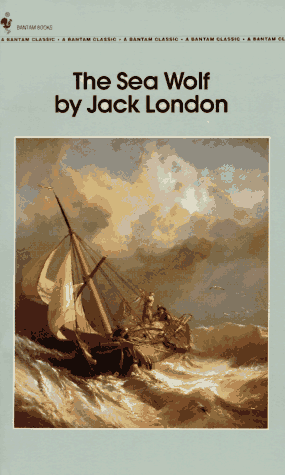
 You've got to be kidding, right? You actually clicked on the image for The Sea Wolf expecting a review of that book? Give me a break! There have been books written about this book so what could I say that hasn't been said before. Ok, it is a book about the sea, sailing, humanity, survival and good and evil written by a man who knew those things as well as any man who ever lived. It is one of the best books ever put to paper by one of the greatest writers in America�s history. By any way that you define the term it is a classic and it is far too deep to cover in one simple review. So I'll only touch, for now, on a few of the things I found most interesting about it.
 The story itself, as is the case with most truly good stories, is not complicated. Wolf Larsen, Captain of The Sea Wolf, a seal hunting vessel, rescues Humphrey Van Dyne after Van Dyne's ship sinks, only to press Van Dyne into servitude in order to make a man of him or, as Larsen puts it, "put some legs under him." To both his and Van Dyne's surprise Van Dyne finds his legs fairly quickly going from a soft, purposeless city dweller to become a fairly accomplished sailor and survivor. Van Dyne believes in God and in the idea that there is a definite Right and Wrong as set down by God. Wolf Larsen believes in himself and nothing more. Brilliant beyond reason Larsen is a physical superman of indomitable spirit who is emotionally and morally bankrupt. He is a man whom a friend of mine would call, "a manly man." and then some; yet he is a man who has found nothing in his life to treasure nor care about and, as a result, his life is a failure. Later Larsen rescues a boatload of survivors from a second wrecked vessel only to find that one of them is a very successful writer and intellectual named Maud Brewster. Brewster,whose work Van Dyne has long admired and whose intellect Larsen quickly comes to respect, soon becomes an object of desire for both men.
One of the most fascinating things to me about this book is how little Larsen has made of his life. Gifted with natural talents that set him above other men he has made no good use of those talents. Though Captain of his own ship; it is a brutal, filthy ship held in very poor regard by all who know of ships and sailing. The Sea Wolf�s crew are men who were too drunk, too inexperienced or too desperate to avoid serving on her. Far from admiring their Captain, these men despise Larsen for his brutality and would mutiny against him if they did not fear him so much. Larsen, knowing how poorly his life has turned out, blames his situation on having been born and raised in a region that was destitute both economically and intellectually. He claims to Van Dyne that no opportunity has ever presented itself to him to allow him to make something of himself. Bull. Larsen is a superior being both physically and mentally and the sea that he fled to could have also given him rise to a career that could have taken him anywhere. Any Navy in the world could have benefited from Larsen�s skills and men with less talent, who began with worse prospects then Larsen�s, made splendid careers and fortunes serving in those Navy�s. However, no one could thrive in any organization such as the Navy without having the strength within himself to rely on others and in this area Larsen was seriously deficit. Basically, for all his abilities, Larsen was a coward. He never had the courage to trust his heart to another, his hand in friendship nor his loyalty, other then in a crude �You watch my back; I�ll watch yours� way to any one and thus receive those things in return. It�s there; not in any lack of opportunity that the responsibility for Larsen�s failure lies. If his heart had been as strong as his mind and body Larsen could have been wildly successful; another Horatio Hornblower, but instead he wound up a failure.
The other thing of interest to me in this book is the relationship between Larsen, Van Dyne and Maud. In many of the other critiques of The Sea Wolf London was criticized for �watering� down the storyline by injecting a romance. These same critics probably regard the story of a family rivalry in Romeo and Juliet as having been �watered down� by the romance element. The introduction of Maud and the developing relationship between her and Van Dyne brought all the preceding story elements into stronger focus in several different ways. For example, Larsen initially dismisses Van Dyne, to some extent justifiably, as a useless fop who has never earned his own way living instead off the bounties of his father�s labor. His low opinion of Van Dyne makes it easier for Larsen to dismiss Van Dyne�s beliefs. Maud however shares Van Dyne�s beliefs, but has earned a very comfortable living on her own; not through her physical labors, but through her mental ones as a respected writer. In part because of this Larsen takes her far more seriously then he originally did Van Dyne. Later, by having a member of the �weaker� sex in the story London expresses his belief in the power of human adaptability. Had Van Dyne escaped Larsen alone, survived being marooned on a small island and later escaped this island in a ship he repaired single handedly it could have been easy to disallow these accomplishments by dismissing Van Dyne as a �hero� or a �manly man� in his own right. But by having Maud, a distaff member of polite society, there to help Van Dyne by working and struggling as hard as he did London was able to show both men and women are adaptable and able to survive almost any hardship if they�re willing to work at it. Another interesting side of the Van Dyne, Maud, Larsen triangle, one worthy of a master�s thesis; if not a small book, is the Father/Children relationship that develops between Larsen, Van Dyne and Maud when Larsen takes ill and is cared for by Van Dyne and Maud.
There are many, many other aspects to this book worth analyzing and discussing that it should be obvious a simple review won�t do. Such as the relationship that exists between Wolf Larsen and his brother and fellow ship�s captain, �Death� Larsen who, though reputed to be more brutal then his brother, appears to be less feared of the two by those who know them. The incident in which Larsen, through an act of cruelty, allows a shark to attack one of his men, but then later takes revenge upon that same shark for following its nature. And, of course, Van Dyne�s development from a useless fop to a man who has his legs firmly beneath him. Like an onion, layers can be peeled away from each of these and other elements of this book only to find a deeper, juicier layer beneath it. It�s not only worth reading once; it�s worth reading again and again and in doing so will never disappoint.
Average Grade: A+


