4"B" 08/12/08
Last lesson of the year. I am still behind with some marking! But some of you are still behind with some HW that I have marked so a truce was declared. No hoiday HW except for those that have bits and pieces to tidy up.
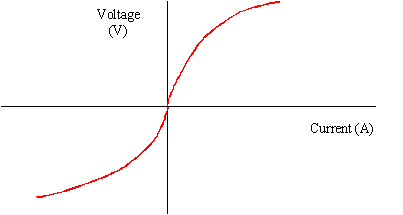
I showed you a thermistor.
Thermistors lose resistance as they heat up. The opposite of a filament bulb.
They do this because extra free charge carriers are released by the thermal energy. They are made of semi-conductors, not metals.
A high current passing through a thermistor will cause it to heat up, just like in a filament bulb, so when a larger voltage is put across a thermistor, its resistance goes down.
The graph curves the opposite way to the filament one.
HW No - as above.
RM = No. You = electricity cover work.
RM = No. You = electricity cover work.
Diodes only allow current to pass through them in one direction. They are normal conductors, obeying Ohm's law in one direction but they have a huge resistance in the opposite direction, not allowing current to flow.
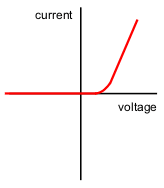
I tried to explain how they workedd, but it is A-level or beyond so don't worry. Read here if interested.
We did some Ohm's law practice questions.
HW Light bulb data worksheet.
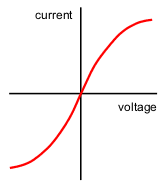
We looked at more current/voltage characteristics. Bulbs gain in resistance as more current is passed through them because they heat up. Greater particle vibrations in the metal get in the way of electrons trying to pass through the filament as it heats up, increasing its resistance.
HW Set of Ohm's Law practice questions.
The resistance of short/long and thin/fat wires.
The longer the wire, the greater it's resistance (more material for the electrons to "scrape" past).
The fatter the wire, the lower the resistance (more room for electrons to flow through.)
Resistors in series and parallel.
Resistors in Series
Simply add them up!
R1 + R2 = RTotal
Resistors in parallel
1/R1 + 1/R2 = 1/Rtotal
This is a little harder, as you have to be able to do some maths. Here is an example:
A 3 Ohm resistor is put in parallel with a 12 Ohm resistor, what is the total resitance?
1/R1 + 1/R2 = 1/Rtotal
So 1/3 + 1/12 = 1/Rtotal
1/3 = 4/12
4/12 + 1/12 = 1/Rtotal
= 5/12
Cross multiplying gives: Rtotal = 12/5 = 2.4 Ohms
Your answer will always be somewhat smaller than either of the 2 resistances in parallel.
HW Yes - Circuit Qs?
We looked at more current/voltage characteristics. Bulbs gain in resistance as more current is passed through them because they heat up. Greater particle vibrations in the metal get in the way of electrons trying to pass through the filament as it heats up, increasing its resistance.
Diodes only allow current to pass through them in one direction. They are normal conductors, obeying Ohm's law in one direction but they have a huge resistance in the opposite direction, not allowing current to flow.
HW Yes - circuit Qs?
The resistance of short/long and thin/fat wires.
The longer the wire, the greater it's resistance (more material for the electrons to "scrape" past).
The fatter the wire, the lower the resistance (more room for electrons to flow through.)
Resistors in series and parallel.
Resistors in Series
Simply add them up!
R1 + R2 = RTotal
Resistors in parallel
1/R1 + 1/R2 = 1/Rtotal
This is a little harder, as you have to be able to do some maths. Here is an example:
A 3 Ohm resistor is put in parallel with a 12 Ohm resistor, what is the total resitance?
1/R1 + 1/R2 = 1/Rtotal
So 1/3 + 1/12 = 1/Rtotal
1/3 = 4/12
4/12 + 1/12 = 1/Rtotal
= 5/12
Cross multiplying gives: Rtotal = 12/5 = 2.4 Ohms
Your answer will always be somewhat smaller than either of the 2 resistances in parallel.
HW Circuits 4 and 5 worksheet.
You built and tested a circuit that can be used to see how the current and voltage across an electrical component vary in comparison to each other.
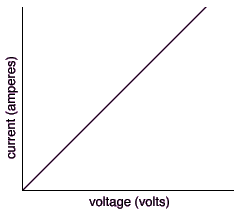
You found that voltage and current were proportional for both the components we tested. These components obey Ohms law: Current is proportional to current, the constant of proportionality is called resistance.
V = IR (Your graph may have had different axes, allowing the gradient to equal the resistance of the component.)
HW Calculate the gradient of your straight line of best fit for each unknown resistor. This should equal the resistance of the components you tested. Complete your conculsion and then attempt the calculations 1-4 and 1-4 from the handout.
No. RM = CCF. You did some work on simple circuit rules no doubt.
Yep. We did an experiment to demonstrate Ohm's law.
You built and tested a circuit that can be used to see how the current and voltage across an electrical component vary in comparison to each other.
You found that voltage and current were proportional for both the components we tested. These components obey Ohms law: Current is proportional to current, the constant of proportionality is called resistance.
V = IR (Your graph may have had different axes, allowing the gradient to equal the resistance of the component.)
HW Calculations 1-4 and 1-4 using Ohm's law from your handout.
We wrote a lot of notes on basic electricity...
Electric current is a word describing moving electrical charges. It is the rate of flow of electrical charge. The unit which is used to measure charge is called the Coulomb. (The numbers of individual electrons moving would be very large indeed.)
Current is therefore measured in Coulombs per second. Another word for 1 Coulomb per second is an Ampere
. Electrical conductors are materials that allow the passage of electric current. In order to do this they must have charge carriers (usually electrons) which are free to move.
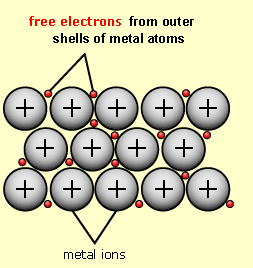
Metals have free electrons as part of their structure which can conduct electricity.
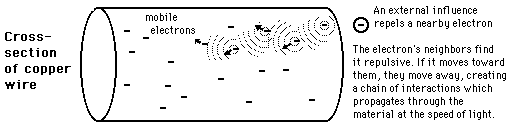
Although electrons move slowly through metal wires, each electron repels its neighbour causing a knock on effect which means that electrical energy is transferred at the speed of light.
Although metals have electrons which are free to move, they don't pass through the material in straight lines when a voltage is applied.
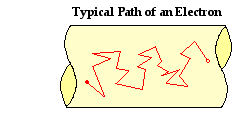
They tend to collide with each other and with the positive ions jostling around within the metal this animation shows the effect more clearly.
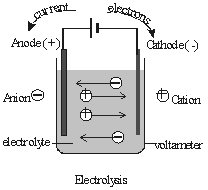
The dissolved ions in a solution are also free charge carriers and so can be used to conduct electricity.
Current: the rate of flow of electric charge (Amps)
1 Amp refers to 1 Coulomb (the unit of charge) of charge flowing past a point in 1 second.
Voltage: the size of electrical "push" trying to cause a current to flow (Volts)
1 Volt refers to 1 Joule of potential energy being given to each Coulomb of charge.
An electrical conductor has charge carriers (usually electrons) which are free to move, thus they allow an electrical current to flow when a voltage is applied to them.
We recalled some simple circuit rules:
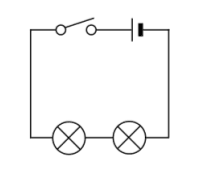
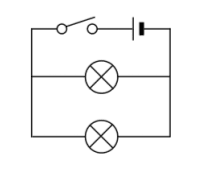
In series, the current is the same at all points.
In series, the battery voltage is shared between all the components in the circuit.
In parallel, each parallel path recieves the full battery voltage.
In parallel, the total current is found by the addition of the currents in each of the parallel paths.
HW P62 Qs 1-3 from the IGCSE text book.
No. RM (and most of you) = CCF. You did a few Qs on electricity. P63 2+3 and P72 Q1.
No. RM (and most of you) = CCF. You saw an interesting DVD on time, I hope.
Electric current is a word describing moving electrical charges. It is the rate of flow of electrical charge. The unit which is used to measure charge is called the Coulomb. (The numbers of individual electrons moving would be very large indeed.)
Current is therefore measured in Coulombs per second. Another word for 1 Coulomb per second is an Ampere
. Electrical conductors are materials that allow the passage of electric current. In order to do this they must have charge carriers (usually electrons) which are free to move.
Metals have free electrons as part of their structure which can conduct electricity.
Although electrons move slowly through metal wires, each electron repels its neighbour causing a knock on effect which means that electrical energy is transferred at the speed of light.
The dissolved ions in a solution are also free charge carriers and so can be used to conduct electricity.
Current: the rate of flow of electric charge (Amps)
1 Amp refers to 1 Coulomb (the unit of charge) of charge flowing past a point in 1 second.
Voltage: the size of electrical "push" trying to cause a current to flow (Volts)
1 Volt refers to 1 Joule of potential energy being given to each Coulomb of charge.
An electrical conductor has charge carriers (usually electrons) which are free to move, thus they allow an electrical current to flow when a voltage is applied to them.
HW P63 Qs 1 and 2 (a) only in your books.
We are nearly done with electrostatics. We did some end of chapter questions which were mainly concerned with the uses and dangers of static electricity.
HW Questions at the end of my revision sheet.
4"B" 07/11/08
We looked at uses and dangers of electrostatics. You need to know about paint spraying, photocopying, inkjet printing and smoke precipitators. Also, how sparks can be a nuisance or dangerous in some situations.
This page has more uses of electrostatics.
HW Yep - complete your notes in your exercise books on: paint spraying, inkjet printers, photocopying and electrostatic smoke precipitators. Also do Q3 P56.
We are nearly done with electrostatics. We did some end of chapter questions which were mainly concerned with the uses and dangers of static electricity.
HW Questions at the end of my revision sheet.
4"C" 05/11/08
Protons are heavy and positive and live in the nuclei of atoms. Electrons are light and mobile and negative and surround the nucleus at some distance, held in by the electrostatic attractive force.
Chemical reactions can cause atoms to lose or gain electrons and become charged. They are then known as positive or negative ions. However, we'll leave them to the chemists. Another way that materials can become charged is by friction.
You must make sure that you always refer to the movement of negative electrons when discussing the charging of an insulator by friction.
Alike charges attract and unlike charges repel.
A charged object will also attract something that is neutral. Think about how you can make a balloon stick to the wall. If you charge a balloon by rubbing it on your hair, it picks up extra electrons and has a negative charge. Holding it near a neutral object will make the charges in that object move. If it is a conductor, many electrons move easily to the other side, as far from the balloon as possible. If it is an insulator, the electrons in the atoms and molecules can only move very slightly to one side, away from the balloon. In either case, there are more positive charges closer to the negative balloon. Opposites attract. The balloon sticks. (At least until the electrons on the balloon slowly leak off.) It works the same way for neutral and positively charged objects.
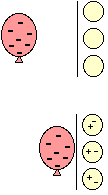
You must also be aware of the attraction of neutral objects to charged objects by induced dipoles.
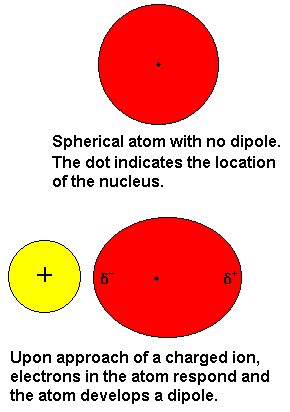
Above shows how it works with an individual atom. The same effect can be seen overall on lumps of neutral matter.
We looked at uses and dangers of electrostatics. You need to know about paint spraying, photocopying, inkjet printing and smoke precipitators. Also, how sparks can be a nuisance or dangerous in some situations.
This page has more uses of electrostatics.
HW Yep - complete your notes in your exercise books on: paint spraying, inkjet printers, photocopying and electrostatic smoke precipitators.
We went through the forces and motion test.
We started electrostatics by looking at 2nd form stuff.
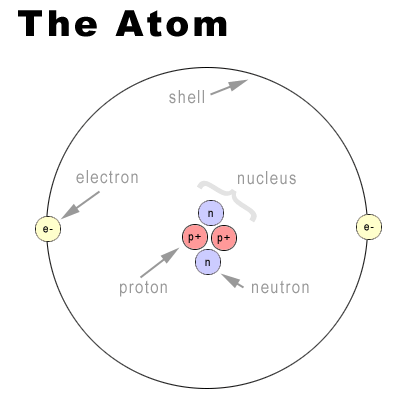
There are 2 types of charge, positive and negative. Negative charge is carried by electrons. Positive charge is carried by protons which live in the nucleus of atoms. Electrons whizz around the outside of atoms and are much lighter and more mobile.
We looked at induced dipoles in electrostatics.
We charged a balloon by rubbing it with a furry cloth and found that we could stick it to the ceiling.
As the charged balloon is brought close to the ceiling, it causes electrons in the ceiling to move creating a small patch of the opposite charge near the balloon. Hence the balloon sticks even though the ceiling is neutral overall.
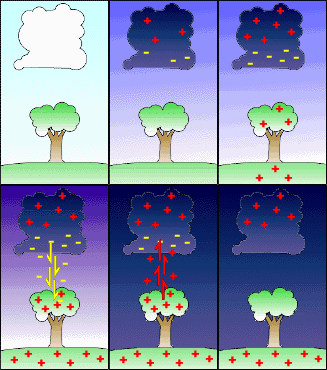
We looked at sparks caused by electrostatic charging. If an object becomes highly charged enough, then it will try to discharge in any way it can. Sometimes, the electrical force has become so large that the air itself becomes ionised, allowing it to conduct. This is when a spark is seen.
Interesting site on electrostatic weather......
I showed you the Van der Graaf generator - it worked rather well. Cold dry conditions help to allow static charge build up rather than leaking away quickly. 10cm sparks were pretty awesome.
Like charges repel, so the electrons have an electrostatic force on them trying to leave the dome of the Van der Graff. The force gets so large that eventually the air itself becomes a viable conducting medium by ionising (turning into charged particles). At this point, a spark is formed and jumps from the dome to the nearest earthed point.
A Van der Graff generator deposits charge (electrons) on a metal bell by friction (Electrons are literally "scraped" from a belt onto the bell. This means that there are more electrons in the metal bell than there are protons, and so it has an overall negative charge.
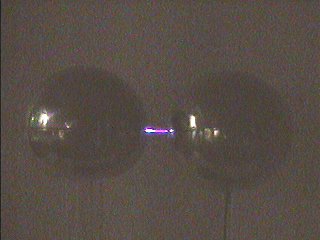
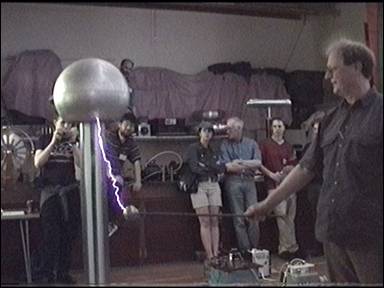
Our sparks were at least this long...
The sparks can only form when the electric field is strong enough to ionise the air between the Van der Graaf dome and a suitable Earthed object.
This site has a good summary of the things you need to know about electrostatics.
This clip shows a trick we didn't do.
This shows a couple we did.
HW No....
We sat the test.
We went through theforces and motion test.
We started electrostatics by looking at 2nd form stuff.
There are 2 types of charge, positive and negative. Negative charge is carried by electrons. Positive charge is carried by protons which live in the nucleus of atoms. Electrons whizz around the outside of atoms and are much lighter and more mobile.
We looked at sparks caused by electrostatic charging. If an object becomes highly charged enough, then it will try to discharge in any way it can. Sometimes, the electrical force has become so large that the air itself becomes ionised, allowing it to conduct. This is when a spark is seen.
Interesting site on electrostatic weather......
I showed you the Van der Graaf generator - it worked rather well. Cold dry conditions help to allow static charge build up rather than leaking away quickly. 10cm sparks were pretty awesome.
Like charges repel, so the electrons have an electrostatic force on them trying to leave the dome of the Van der Graff. The force gets so large that eventually the air itself becomes a viable conducting medium by ionising (turning into charged particles). At this point, a spark is formed and jumps from the dome to the nearest earthed point.
A Van der Graff generator deposits charge (electrons) on a metal bell by friction (Electrons are literally "scraped" from a belt onto the bell. This means that there are more electrons in the metal bell than there are protons, and so it has an overall negative charge.
Our sparks were at least this long...
The sparks can only form when the electric field is strong enough to ionise the air between the Van der Graaf dome and a suitable Earthed object.
This site has a good summary of the things you need to know about electrostatics.
This clip shows a trick we didn't do.
This shows a couple we did.
HW No....
We went through the forces ad motion test.
4"C" 29/10/08
We sat the test. Electrostatics next.
Revision for the upcoming forces and motion test. Spare revision sheets are in my pigeonhole.
We did some questions on Hooke's law and I gave out some forces and motion revision qs for you to practice over half term.
HW Complete those questions. Revision lists can be found in my pigeon hole.
It ws revision-arooney for 4"C" as we prepped for a test to be sat in the first lesson after half term.
HW Revise! Use the materials given to you as a guide to the type of questions.
We performed an experiment to see how the extension of a spring varied as applied larger and larger forces onto it.
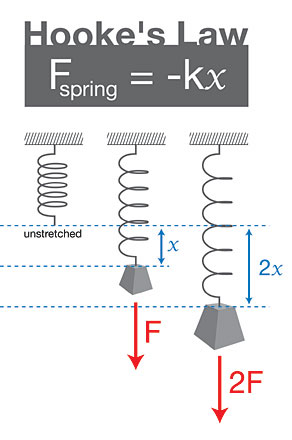
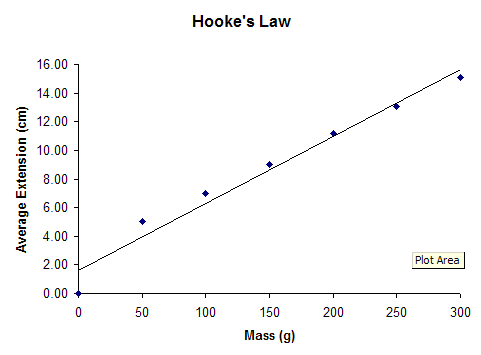
It was found that force was proportional to extension for the most part. The force divided by the extension gives us the spring constant, k of the spring which tells you how stiff it is.
Spring constant(N/m) = Force(N)/Extension(m)
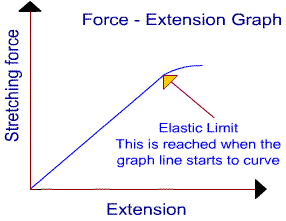
A very large force can permanently deform the spring meaning it has passed beyond its elastic limit. Hookes law no longer applies after the graph has started to curve.
We covered springs in series and parallel. By testing them.
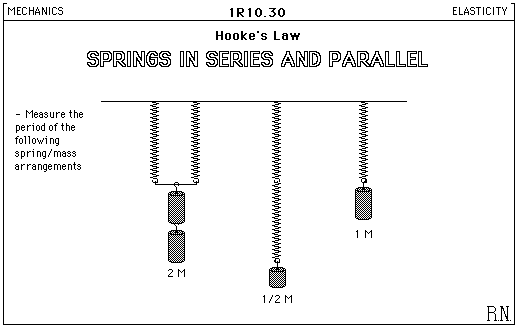
2 springs in parallel extend half as much as one on it's own (the spring constant is doubled). 2 in series extend twice as much (the spring constant is halved).
The Force/Extension graph for an elastic band is not a straight line, showing that it doesn't obey Hooke's law.
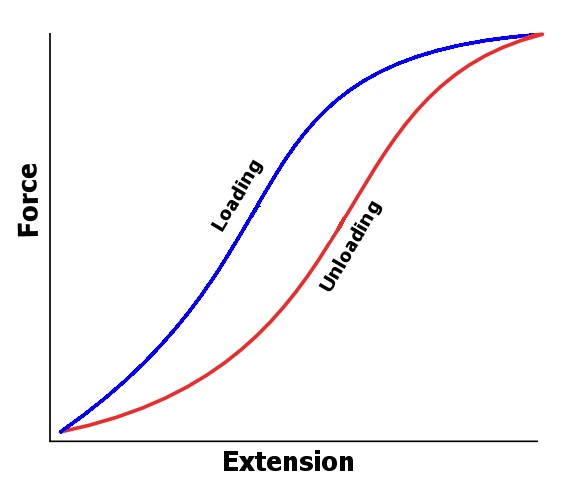
The hysteresis loop shown by the elastic band indicates that not all the energy used in stretching the band is returned when it is unloaded. The area between the 2 lines indicates the energy lost as heat.
HW Finish all graphs, stick them in and write your conclusions in your book. Q9 P22.
We performed an experiment to see how the extension of a spring varied as applied larger and larger forces onto it.
It was found that force was proportional to extension for the most part. The force divided by the extension gives us the spring constant, k of the spring which tells you how stiff it is.
Spring constant(N/m) = Force(N)/Extension(m)
A very large force can permanently deform the spring meaning it has passed beyond its elastic limit. Hookes law no longer applies after the graph has started to curve.
We covered springs in series and parallel. By testing them.
2 springs in parallel extend half as much as one on it's own (the spring constant is doubled). 2 in series extend twice as much (the spring constant is halved).
The Force/Extension graph for an elastic band is not a straight line, showing that it doesn't obey Hooke's law.
HW Finish all graphs, stick them in and write your conclusions in your book.
Freefall.
Without air resistance, all objects fall at the same rate with an acceleration of about 10m/s/s (on Earth). However, air resistance changes the way that some objects fall.
We looked at drag forces.
A speed/time graph of the motion of a skydiver would look like this:
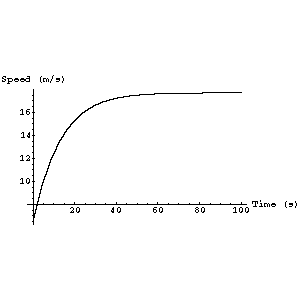
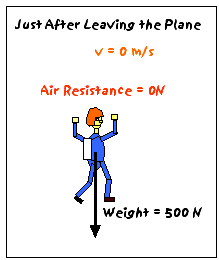
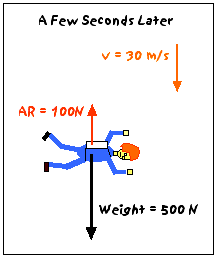
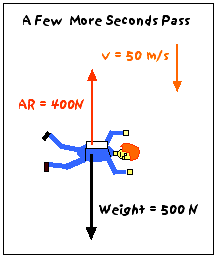
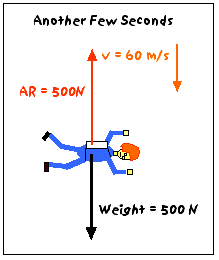
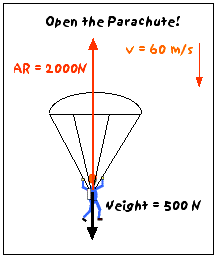
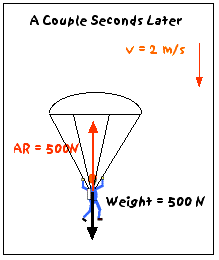
The above shows how a parachutist first accelerates until the air resistance force on him is equal to his weight. He then travels at terminal velocity, a constant speed with balanced forces acting on him. He then artificially increases his air resistance by opening his parachute, so he slows down until air resistance once again equals his weight at a much slower (and safer) speed.
Terminal velocity occurs when the air resistance (sometimes called "drag") force equals the weight iof the falling object. This means that:
heavy, compact, objects will have a higher terminal velocity than light, spread out objects. Therefore, heavy objects will fall faster in air than light objects
HW Sheet 2.5 on freefall. (on paper) and get caught up on any missing HW for the grade deadline.
The distance in which cars can stop is an important factor in road accidents.
First, thinking distance is the distance travelled when the driver has seen a hazard, but is yet to press the brake down.
Braking distance is the further distance travelled by a car as it slows down.
Total stopping distance = Thinking distance + Braking distance
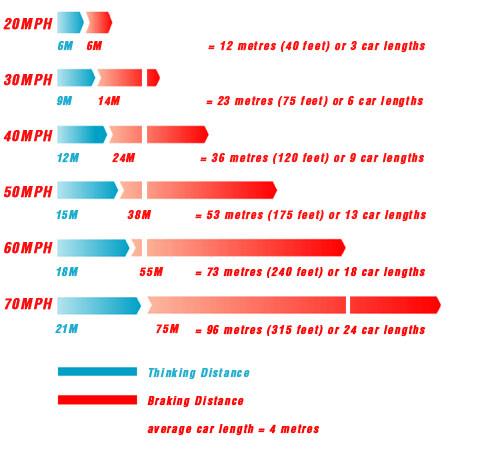
If you double your speed, you reaction time remains the same, but you will have travelled twice as far before you press the brake down.
The time taken to brake to zero will double, and your average speed whilst braking will double. This means your braking distance will increase fourfold if you double your speed.
We also looked at the Physics of crumple zones.
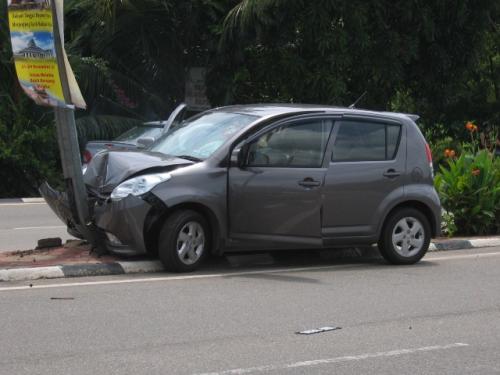
The front of the car crumples when it crashes. Thie increases the time taken for it to be stopped. An increase in time means a decrease in the deceleration that the car undergoes. The people in the car also decelerate at a lesser rate, and so they experience a smaller force (F=ma). A smaller force is less likely to hurt them.
HW Complete sheet 1.4 on frictional forces only please. (On paper - books in.)
We analysed the results from last lesson's practical by trying to show an inverse proportionality between acceleration and mass with a constant force.
We plotted a graph of acceleration vs. 1/mass and got a best fit straight line through the origin. This line had a gradient that was equal to the force you used to pull the trolleys.
HW P32 Qs 1,2,3
The distance in which cars can stop is an important factor in road accidents.
First, thinking distance is the distance travelled when the driver has seen a hazard, but is yet to press the brake down.
Braking distance is the further distance travelled by a car as it slows down.
Total stopping distance = Thinking distance + Braking distance
If you double your speed, you reaction time remains the same, but you will have travelled twice as far before you press the brake down.
The time taken to brake to zero will double, and your average speed whilst braking will double. This means your braking distance will increase fourfold if you double your speed.
We also looked at the Physics of crumple zones.
The front of the car crumples when it crashes. Thie increases the time taken for it to be stopped. An increase in time means a decrease in the deceleration that the car undergoes. The people in the car also decelerate at a lesser rate, and so they experience a smaller force (F=ma). A smaller force is less likely to hurt them.
HW Complete sheet 1.4 on frictional forces only please. (In your books.)
We analysed the results from last lesson's practical by trying to show an inverse proportionality between acceleration and mass with a constant force.
We plotted a graph of acceleration vs. 1/mass and got a best fit straight line through the origin. This line had a gradient that was equal to the force you used to pull the trolleys.
HW Set of Newton's 2nd law questions.
We did another very similar experiment to last time.
This time we kept the accelerating force the same and changed the overall mass of the trolley.
We used the same calculation method to work out the acceleration and found that the acceleration fell as the mass was increased.
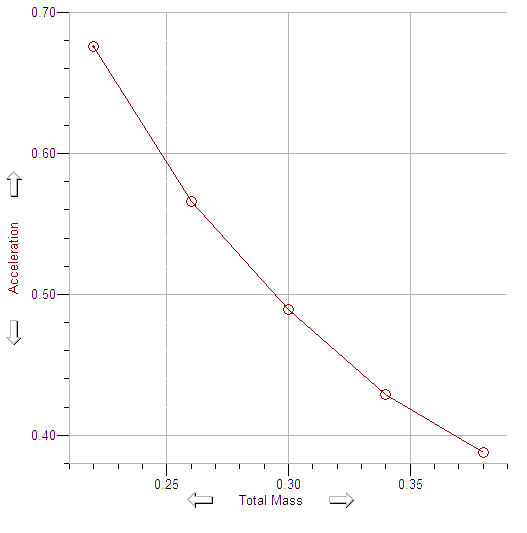
This relationship agreed with the formula postulated last time.
Force = Mass * Acceleration
HW Set of F=ma-questions.
We analysed the results from last time.
We discovered experimentally that the acceleration of an object is proportional to the unbalanced force acting on it.
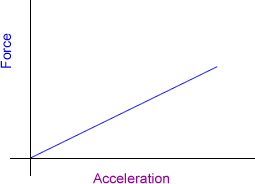
The gradient of the line of best fit for your graphs was about 2 - which was roughly the mass of the whole accelerating system. The mass turns out to be the constant of proportionality between the mass and the accleration in this case.
This led us to our statement of Newton's second law:
Force (N) = Mass (kg) * Acceleration (m/s/s)
Oe of the most basic and important rules of motion.
We tried several little calculations using this equation.
The unit of force, the Newton is actually defined by this law. 1 Newton of force is large enough to give 1kg of mass an acceleration of 1 m/s/s
HW Another set of acceleration questions. More on N2 next time.
We did another very similar experiment to last time.
This time we kept the accelerating force the same and changed the overall mass of the trolley.
We used the same calculation method to work out the acceleration and found that the acceleration fell as the mass was increased.
This relationship agreed with the formula postulated last time.
Force = Mass * Acceleration
HW Long set of acceleration Qs.
We analysed the results from last time.
We discovered experimentally that the acceleration of an object is proportional to the unbalanced force acting on it.
The gradient of the line of best fit for your graphs was about 2 - which was roughly the mass of the whole accelerating system. The mass turns out to be the constant of proportionality between the mass and the accleration in this case.
This led us to our statement of Newton's second law:
Force (N) = Mass (kg) * Acceleration (m/s/s)
Oe of the most basic and important rules of motion.
We tried several little calculations using this equation.
The unit of force, the Newton is actually defined by this law. 1 Newton of force is large enough to give 1kg of mass an acceleration of 1 m/s/s
HW Complete the 1 page GCSE question (5 minutes only!)
Unbalanced forces cause the motion of objects to change. They accelerate in the direction of the unbalanced force.(acceleration is a vector)
We performed an experiment to test how the acceleration of an object varied when we changed the unbalanced force acting on it.
We found that the acceleration was proportional to the force.
The gradient of the graph depended on how hard it was to accelerate the trolley we were using - this depended on the mass. (It is harder to accelerate a more massive object.)
HW Finish your table, completing all calculations of acceleration and plot a graph of accelerating force vs. acceleration. Find the gradient of your straight line of best fit.
We attempted some questions on acceleration, we'll start looking at the effects of unbalanced forces on acceleration next time.
HW Finish the sheet of acceleration calculations for next time.
We used a timer ball to make another measurement of "g". If we assume constant acceleration, the maximum speed of the falling ball will be twice it's average speed. We can then calculate its acceleration. This turned out to be a bit more accurate than as ttt due to less friction.
Unbalanced forces cause the motion of objects to change. They accelerate in the direction of the unbalanced force.(acceleration is a vector)
We performed an experiment to test how the acceleration of an object varied when we changed the unbalanced force acting on it.
We found that the acceleration was proportional to the force.
The gradient of the graph depended on how hard it was to accelerate the trolley we were using - this depended on the mass. (It is harder to accelerate a more massive object.)
HW Finish your table, completing all calculations of acceleration and plot a graph of accelerating force vs. acceleration.
We looked some more at the meaning of velocity against time graphs. Gradient is acceleration. Area under is displacement.
HW Last page only of the velocity/time graph worksheet. Area above the x axis is distance travelled forwards and the area below is distance travelled backwards. Minus one from the other to get the final displacement of the object.
Using tickertape timers, you recorded the motion of a falling object. You used the resulting information to calculate a value for the acceleration due to gravity on Earth of an object. It was noted that this is the same, regardless of what object you are using as long as air resistance can be ignored.
See here for more exxplanation.
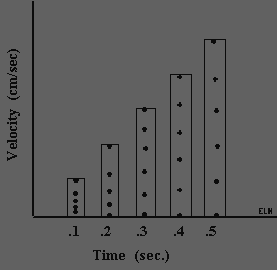
We also used a timer ball to make another measurement of "g". If we assume constant acceleration, the maximum speed of the falling ball will be twice it's average speed. We can then calculate its acceleration. This turned out to be a bit more accurate than as ttt due to less friction.
HW Finish the set of Qs on acceleration in your book.
4"B" 12/09/08
We looked some more at interpreting motion graphs. More on this next time.
Acceleration was re-capped. It is the rate of change of velocity (so direction must be taken into account).
a = (v-u)/t
The acceleration is the gradient of a velocity vs. time graph.
The distance travelled by an object can be found by measuring the area under a speed vs. time graph.
HW Complete both sides of the first page only of the velocity vs time graph sheet. Books came in.
A pre-emptive website entry so that I can go home this weekend...
Using tickertape timers, you recorded the motion of a falling object. You used the resulting information to calculate a value for the acceleration due to gravity on Earth of an object. It was noted that this is the same, regardless of what object you are using as long as air resistance can be ignored.
See here for more exxplanation.
HW Qs 1,3,4,6 from the acceleration worksheet.
Acceleration was re-capped. It is the rate of change of velocity (so direction must be taken into account).
a = (v-u)/t
We then looked some more at interpreting motion graphs. More on this next time.
HW Work on paper was taken in - complete Qs 8, 9, 11 P11 IGCSE text book in your books for next time.
Our second lesson.
We started the motion topic by examining some different methods to measure the average speed of an object. A ruler and stopwatch was rough and ready, but had a large percentage error when a small time was used. Light gates are very accurate but unwieldy. A ticker tape timer is great for the continual updates (every 1/50th of a second) on the speed of an object that it gives you.
We then started to look at representing the motion of objects in graphical form.

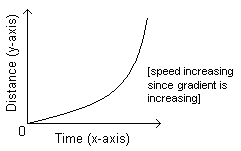
You need to be familiar with how to interpret a distance/time graph and turn infer what it means about how the speed of an object varies over time.
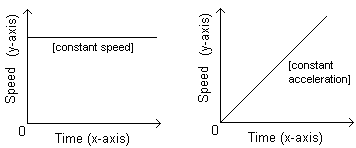
HW Qs 1, 3, 4, 5, 6, + 7 P10 and 11 of IGCSE Physics.
Books were handed out, numbers taken in and the course introduced.
We started talking about movement and position briefly. Distance is measured in metres and is an important basic quantity in Physics. However, to know the position of an object, you must know what distance it is from a known point, and in what direction . The equivalent quantity to distance, which also includes direction is called displacement .
Physicists are interested in how objects change their position over time; the standard unit for measuring time is the second.
The rate at which an object covers distance is called its speed.
The very first formula to learn for Physics is:
Average speed (m/s) = Distance(m)/Time(s)
HW: To have looked at this page! Take your text book number, multiply it by 3 and minus 12 from it. Take this number and find it's square root, to the nearest whole number. Email your answer to [email protected]
Our second lesson.
We started the motion topic by examining some different methods to measure the average speed of an object. A ruler and stopwatch was rough and ready, but had a large percentage error when a small time was used. Light gates are very accurate but unwieldy. A ticker tape timer is great for the continual updates (every 1/50th of a second) on the speed of an object that it gives you.
We then started to look at representing the motion of objects in graphical form.
You need to be familiar with how to interpret a distance/time graph and turn infer what it means about how the speed of an object varies over time.
HW Complete the worksheet handed out by drawing a graph of the data provided and answering all the questions.
Books were handed out, numbers taken in and the course introduced.
We started talking about movement and position briefly. Distance is measured in metres and is an important basic quantity in Physics. However, to know the position of an object, you must know what distance it is from a known point, and in what direction . The equivalent quantity to distance, which also includes direction is called displacement .
Physicists are interested in how objects change their position over time; the standard unit for measuring time is the second.
The rate at which an object covers distance is called its speed.
The very first formula to learn for Physics is:
Average speed (m/s) = Distance(m)/Time(s)
HW: To have looked at this page! Take your text book number, multiply it by 2 and add 17 to it. Write this number on the back page of your exercise book upside down.
