 |
|
|
|
|
|
|
|
|
|
|
|
|
|
|
|
|
|
|
|
|
|
|
|
|
|
|
|
|
|
|
|
|
|
|
|
|
|
|
|
|
|
|
|
|
|
|
|
|
|
|
|
|
|
|
|
|
|
|
|
|
|
|
|
|
|
|
|
|
|
|
|
|
|
|
|
|
|
|
|
|
|
|
|
|
|
|
|
|
|
|
|
|
|
|
|
|
|
|
|
|
|
|
�Crop Circles Explained - The Macroflake Hypothesis� is copyright protected to the Author, November 2003. No part thereof may be copied, stored, or transmitted either electronically or mechanically without the prior written permission of the author: Mr. Richard.A.Patterson. |
|
|
|
 |
|
|
|
Click Here to Return to Main Index. |
|
Postal Address:
P.O. Box 1615,
Preston South, 3072
Melbourne, Vic, Australia. |
|
|
|
|
|
Website: www.geocities.com/rapatterson17 Emails can be sent to the Author Mr. Richard.A.Patterson at: [email protected] |
|
|
|
CROP CIRCLES EXPLAINED |
|
|
|
 |
|
|
|
By |
|
|
|
Richard.A.Patterson |
|
|
|
To a Snowflake.
What heart could have thought of you?-
Past our devisal
(O filigree petal!)
Fashioned so purely,
Fragily, surely,
From what Paradisal
Imagineless metal,
Too costly for cost?
Who hammered you, wrought you,
From argentine vapour?-� |
|
|
|
Francis Thompson |
|
|
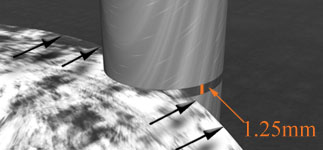
A Macroflake is created when within a crop a layer of dense moist air, only millimetres thick, that has been pooling, centimetres above the ground, quickly expands causing the moisture to evaporate and the layer to supercool. As the supercooled Macroflake expands its frigid air strikes the innermost sides of the plant stem and the liquid in their cells to expand and burst. This cell expansion brings pressure to bear upon the outermost side of stem. This coupled with the weakening of the plant stalk and its own weight makes the plant to bend. This happens to numerous stalks inside the Macroflake, forming a crop circle. As the Macroflake dissipates, radiating outwards, it triggers slightly warmer air about it to cool creating surrounding Macroflakes. Normally the plants inside a Macroflake fall in crop circle patterns characterised by single or multiple circles though less often the shapes exhibit angular sides. These shapes are in close groupings and are usually joined by narrow strips. Crop circles are not always regular but do contain recognisable patterns. Crop circle formation is only possible through the right alignment of particular attributes. By examining these attributes we will not only learn more about how crop circles are made but also why.
|
|
|
 |
|
|
|
Drawing of an expanding Macroflake affecting a thin segment of the plant stem. |
|
|
|
|
The major feature about crops is that they consist of many plants of a few species. Of the about 300,000 plant species in the world only about thirty provide 95% of our food. Eight of these plants consist of grasses or cereal grains such as wheat and corn. A forest or wild prairie has a multitude of botanical species growing in a random manner at different stages of maturity. In contrast to this crops are single species that are typified by their uniformity, growing in a grid at the same stage of maturity. This ordered growth is what allows a Macroflake to form so evenly. Since crops are so evenly spaced and of near the same height the joint or node of the plants are also the same height. The node bulge presents a natural barrier to the coalescing cold air layer making the node more likely to be affected by a Macroflake when it forms. Many crop circles are reported in fields of either wheat or corn this is because not only do these plants present precise conditions for a Macroflake to form they are also so widespread, being the world�s most grown grains. The Earth produces 600 million tonnes of each annually. In terms of food production wheat is the world's major crop and contributes to about a quater of the caloric intake of people in over 60 countries. Wheat is grown over a total area of 2.5 million square kilometres. (That's the size of the Australian mainland!)
Crops have been grown for many thousands of years, but it is comparatively recently that uniform crop farming has been on a large scale and mechanised. This change took place during what historians call the agricultural revolution. This was the widespread systemisation of farming techniques that followed scientific principles of farming aimed at producing increased wield. These techniques included the adoption of sowing seeds in straight rows. This was done primarily to control weed growth as farmers could use the furrows in between the plants to have access to the weeds. The new method of seeding was further advanced by Jethro Tull�s invention of the Seed Drill in 1701. Before Tull�s invention farmers would plant their seeds by throwing them from a bag they carried as they walked up and down the field. Seed drills were used before Tull�s, the first in Europe was Camillo Tortello�s patented drill in 1566, but Tull�s seeder was the first that could be drawn by a horse. His device consisted of a grain bin with a hole at the bottom where a wheel driven ratchet distributed the seed.
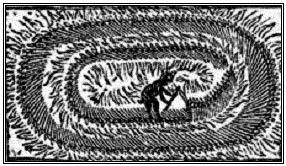
It was in the 17th century, the same era of the agricultural revolution, that the public became aware of Crop Circles. The phenomena had probably existed for as long there have been crops, and there is some argument that they are mentioned in the Bible but a wider awareness was possibly triggered by the growing popular interest in rural farming reform, including the new thinking of planting crops in regular rows. The media of England at the time was leaflets printed from wood engraving. It in one such leaflet published in 1678, in Hertfordshire, England, that the phenomena was recorded, though to the Puritan and religious Englander it was not UFO�s that were seen as the cause but a more sinister apparition. The leaflet titled �The Mowing Devil�, tells: |
|
|
|
�Being a true relation of a farmer, who bargaining with a poor mower, about the cutting down of three half acres of oats, upon the mower�s asking too much, the farmer swore that the devil should mow it rather than he, and so it fell out that very night the crop of oats showed as if it had been all of a flame*, but next morning appeared to neatly mowed by the devil or some infernal spirit that no mortal man was able to do the like. Also how the said oats lie now in the field, and the owner has not power to fetch them away�
*Descriptive phrase for healthy and ready to harvest |
|
|
 |
|
|
|
|
|
To families who have farmed cereal grains for generations crop circles have been long known. They have been reported in every decade of the 20th century. During WWII airmen often saw crop circles, but due to secrecy laws in force during the war it was not until wars end that photos were produced. For much of crop circle history formations have been single circles of about 20 to 30 metres in diameter and less often twin circles. Most people assumed that these simple shapes were caused by some freak tornado-like winds, but in 1978 this became less plausible with the discovery of a quintuplet formation in a wheat field in Hampshire, England. Since then very intricate crop circles have appeared. This increase in crop circle intricacy parallels the 20th century�s transition from animal drawn ploughs and seeders to automotive machinery, a change that was at its most rapid in the 1950�s and 60s. In short the greater the precision of crop planting then the more stable will be the conditions that allow crop circles to form and hence the more intricate the circle. The universe works as a constant interplay between the forces of chaos and order. Absolute order or chaos cannot exist on its own and environments undergo fluctuations between the two. Crops present a highly ordered formation covering large expanses of area. This type of uniformity has no parallel in nature, the scattering of stars, where a raindrop falls, when a bough breaks, all display a subtle merger of order and randomness. In a crop, an extremely ordered formation, nature�s attempt to restore harmony between chaos and order is more obvious. All things are subject to change and if a field of crops, which is essentially rows upon ordered rows, were to change then it would be to lose its orderliness. This is nature imposing chaotic randomness on a crop to restore a balance between order and chaos. Through the Macroflake it breaks up the ordered lay of the crop, but since the crop is not truly ordered (the plants are precisely, but not perfectly aligned) the final effect of crop circles is pseudo-random meaning the areas affected no longer resemble the ordered grid of the crop before the meteorological change but neither are the areas completely random and instead exhibit patterns of their own. (To better see how and why consult Fractals, Chaos Theory & Entropy & in the Appendix.)
Because crop circles are formed by the laws of nature it comes as no surprise that they display patterns that follow these law in systems such as sacred geometry, mathematics, astronomy, physics and chemistry. This mimicking inevitably leads people to believe that crop circles must have origins in intelligent design. Hoaxers who contrive to build crop circles in all sorts of patterns and �messages� only confuse matters further.
|
|
|
|
To understand how conditions cause a Macroflake it helps to have a closer look at the environment of crops. Normally when we speak of climate we are talking about what most meteorologists do, namely whether conditions in large areas spanning thousands of kilometres wide and many kilometres high. The study of microclimates concerns itself with the climate near the ground where plants and animals are. The microclimate is very different to the climate only a few meters above it. It is in the first few centimetres above the soil that temperature and humidity can change dramatically. Wind speeds are reduced sharply in the microclimate as energy is transferred to the surface; temperature and humidity are also influenced by soil surface properties. In the Microclimate plants form a natural barrier between it and the climate where the atmospheric is more stable and less susceptible to rapid change.
Cereal crops, like other plants, are held upright by their cytoskeletons. As the name suggests it is like our human skeleton, but unlike our bones plants use �vacuole� to remain hard. All cells in a plant have vacuole, which makes up from 90% to 95% of the cell. A vacuole is a sack filled with liquid under pressure. The lining of this sack is called tonoplast and is almost waterproof. As well as storing vital dissolved sugars, salts, proteins, and other nutrients the liquid pressure in the vacuole causes what is known as 'turgor pressure'. When a plant loses this turgor pressure the plant will undergo plasmolysis. (It wilts) It is these vacuole that burst when the plant freezes. The type of freezing which form crop circles is called sublimation. Normally solid matter when heated becomes a liquid and then a gas, or a gas becomes a liquid and then a solid when cooled. Sublimation is when vapour becomes solid ice, or vice versa, without passing through the liquid stage. Frost is caused by sublimation and can come in many forms. The most severe is called black frost, or killing frost. It is a dry freeze where the internal structure of the plant is affected and gains its name because of the blackened leaves and stalks of the affected plant. Normally black frost will kill the plant, but because Macroflakes can be as thin as a sliver the damaged plants will usually recover. |
|
|
|
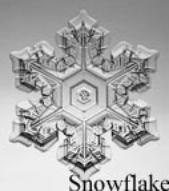
Although formation of a Macroflake is not by the exact same way as how a snowflake forms there are certain similarities. The first of these are that they both can exhibit complex shapes both can display branching properties. Snowflakes are formed by water molecules travelling through the air and then condensing onto the growing snow crystal. If the edge of the snowflake has any debris on it such as a particle of dust the approaching water molecules reach the debris sooner and can attach to the snowflake faster and more easily. This causes a spike to form on the snowflakes edge and as more molecules reach this crystal spike it grows outward. This is called branching instability and causes tree-like growth. Snowflakes, unlike Macroflakes, consist of crystallised ice and because of crystal faceting, are limited to displaying six sides. A Macroflake on the other hand is not limited by crystal faceting and so is able to manifest many different shapes. |
|
|
 |
|
|
|
|
|
|
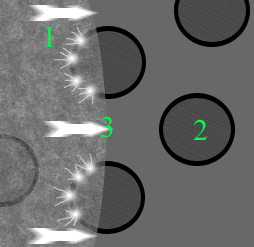
The formation of a Macroflake would explain why no semicircular crop circle has been found beside a roadway, but are always at least several meters within the field, or near the centre. This is because a road would have a different temperature to the field and what is needed for a Macroflake to form is a uniformity of temperature. One feature of crop circles is that the nodes of the plant stems often show expulsion cavities. These are small holes that could have been caused by the expanding vacuole as it freezes. These cavities resemble frost blistering, a common result of frost damage to the plant stems where the outer layers of the plant break away from the pericarp. As already mentioned a still night with the presence of moisture would present ideal conditions for a Macroflake to form. The presence of moisture and lack of wind was inferred by a Lancashire Tractor driver named John Salisbury who discovered a crop circle. He found it in the beginning of June, 1947, in a field of potatoes and later told: |
|
|
|
This image represents a magnified view of the expulsion cavities 1 and how they might burst at the innermost edge of the plant stem 2 as the Macroflake 3 spreads outwards. |
|
|
|
|
|
 |
|
|
|
|
|
�the first thing I saw was the large flattened area almost in the centre of the field� I could see it was a huge circle, almost fifty yards in diameter, with all the plants swirled in a clockwise direction and almost as though they had been plaited�There was quite heavy dew on the plants and my trousers were wet, through walking in the crop�I went back to the farm to report it to Mr Clark, the farmer, and he came back with me to the field and he too was mystified but declared that he thought it must have been a freak whirlwind. The rest of the employees were all elderly men and weren't really interested but all agreed that the weather conditions did not fit the theory.� |
|
|
|
Another usual feature of crop formations is that they occur above underground water supplies which would present conditions to allow moisture to be present. Bryce Bond and Arthur Shuttlewood who witnessed a crop circle forming in Warminster, England on the night of August 12, 1972 corroborate the absence of wind: |
|
|
|
"Suddenly, I heard a noise. It seemed as if something pushed down the wheat. That night the air was completely still. I looked around. The moon had just appeared, shining brightly. In front of my eyes I could see a great imprint taking shape. The wheat was forced down in a clockwise direction." |
|
|
| The frequency of Crop circle formation is seasonal peaking during the summer months of June, July and August. This is can be explained by that fact that it is during this time that there are more crops. Even summertime could allow conditions for a Macroflake to form as summer frosts, although rare, do occur, and perhaps crops are then at their most vulnerable to frost damage. The type of summer conditions that might allow a rapid drop of temperature near the ground and Macroflake to form would be a still night, with moisture present. The following eyewitness report of a crop circle verifies just these conditions. |
|
|
|
as ic(member jan schwochow was on the isle since the previous Tuesday he was able to observe also the present weather-conditions. Again we had what we think to be "perfect conditions" for new crop circles to appear: two days before the formation was discovered the area was covered by rainy weather and in
the night of the formation �s appearance the sky has turned again bright with nearly no wind. |
|
|
|
Andreas Mueller. 'icca-the international crop circle archive' |
|
|
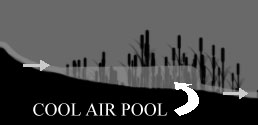
| This hypothesis, featuring the uniform pooling of cold air, explains why crop circles often occur on flat ground rather than on slopes. Cold air being heavier than warm air flows downhill and tends to pool in the basins of hilly land FIG 1. Because of this a crop circle can appear on a slope since the frigid Macroflake that forms actually rests on the flat surface of pooled cold air. Vegetation on a slope can also act as a barrier against the downward flow of cold air causing cold air it to collect within it and form an even flat surface FIG 2. |
|
|
|
 |
|
 |
|
|
|
FIG 1 |
|
FIG 2 |
|
|
|
|
|
|
|
The Macroflake hypothesise explains why crop circles habitually appear where people and animals are absent, for the heat and movement of a person or animal would disrupt the stillness of air and the uniform cold temperature. It would explain why crop circles occur only in temperate regions and not in the tropics regions. It explains why there is nothing heard from a distance, as the bursting vacuoles are microscopic and so would at the most only cause a high-pitched sound to be heard. It also explains why crop circles can seem to appear so instantly because a Macroflake would appear and disappear in a matter of moments leaving only the crop circle as evidence of its existence. |
|
|
|
��God was my shaper.
Passing surmisal,
He hammered, He wrought me,
From curled silver vapour,
To lust of His mind:-
Thou could�st not have thought me!
So purely, so palely,
Tinily, surely,
Mightily, frailly,
Insculped and embossed,
With His hammer of wind,
And His graver of frost.� |
|
|
|
APPENDIX |
|
|
|
FRACTALS |
|
|
|
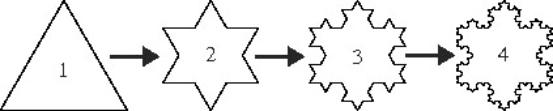
A fractal is a shape that repeats itself in a smaller scale. Nature shows this iteration when it makes things such as clouds, galaxies, coastlines and snowflakes. One of the pioneers in Fractal geometry was the Swedish mathematician Helge von Koch who theorised in 1904 on what is now called the Koch snowflake. As can be seen from viewing the stages of Koch�s snowflake the increase of detail of the image is all through triangles repeating. |
|
|
|
 |
|
|
|
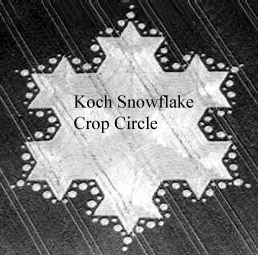
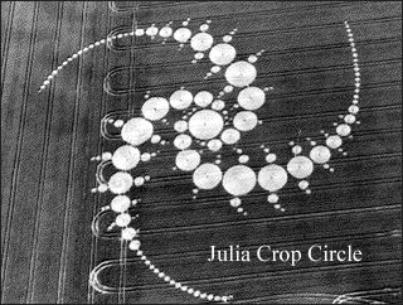
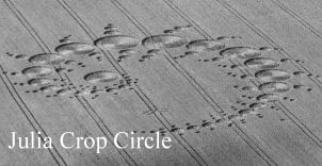
Theoretically this curving process can be repeated indefinitely to produce a shape that has a perimeter of infinite length. In 1918 Algerian born Gaston Maurice Julia advanced Koch�s experiment when at the age of twenty-five he published his work �M�moire sur l'it�ration des fonctions rationnelles,�. This thesis extended Koch�s studies of iteration and contained the Julia set, a series of equations that attempted to analyses how interactions would be affected if some equations were bounded while others were allowed to extend to a hypothetical infinity. For a time Julia�s work was much respected but by the end of the 1920�s his work became largely forgotten this was partly due to the fact that the Julia Set required a lot of mathematical calculations to be properly analysed. Since this sort of number crunching proved too difficult, what was required were the as yet to be invented computers. |
|
|
 |
|
|
|
|
|
|
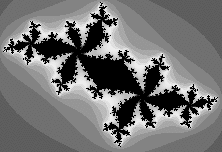
Another pioneer of Fractal Geometry is the Polish born Mathematician Benoit Mandelbrot who began to experiment with the Julia set in the 1970�s. Mandelbrot was then working at IBM's Watson Research Center, using the most advanced computers of the time where he re-created the Julia Set. |
|
|
|
 |
|
|
|
Computer Generated
Julia Set. |
|
|
 |
|
|
|
|
|
|
|
|
|
|
 |
|
|
|
|
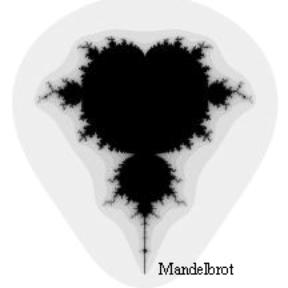
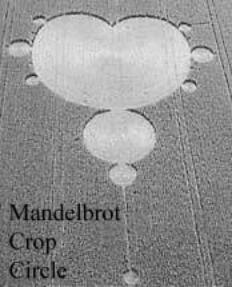
| While working for IBM Mandelbrot was also studying the price of cotton when he discovered that despite world wars and the great depression the price of cotton had remained constant. Although there had been many so called random changes in the price, the sequences of change were uncannily similar showing evidence of a pattern where none before was thought to have existed. Mandelbrot figured that there must be some overriding pattern within the chaos through his research he arrived at the Mandelbrot set. This set is a sort of super-set that although consisting of comparatively simple equations, contains within it not only the Julia Set but countless others. In 1967 Mandelbrot published his �How long is the coast of Britain?� in which he explained that it is impossible to define the length of the coast of Britain because every curve and inlet of the coast when magnified shows even more detail and irregular edges. Mandelbrot coined the word �fractal�. from the Latin word �fractus� meaning fractured, to describe these shapes that have the same features no matter how magnified. |
|
|
|
 |
|
|
|
 |
|
|
|
� the general theory of which he [Mandelbrot] had provided, was present almost universally in Nature. What he saw was that the overwhelming smoothness paradigm with which mathematical physics had attempted to describe Nature was radically flawed and incomplete. Fractals and pre-fractals once noticed were everywhere. They occur in physics in the description of the extraordinarily complex behaviour of some simple physical systems like the forced pendulum and in the hugely complex behaviour of turbulence and phase transition. They occur as the foundations of what is now known as chaotic systems. They occur in economics with the behaviour of prices�They occur in physiology in the growth of mammalian cells. Believe it or not ... they occur in gardens. Note closely and you will see a difference between the flower heads of broccoli and cauliflower, a difference which can be exactly characterised in fractal theory.� |
|
|
|
(Peter Clark�s 1999 address at the University of St Andrews awarding an Honorary Degree of Doctor of Science to Mandelbrot) |
|
|
|
Big whorls have little whorls,
Which feed on their velocity;
And little whorls have lesser whorls,
And so on to viscosity. |
|
|
|
Lewis Richardson, 1922, Mathematician who studied weather prediction |
|
|
|
CHAOS THEORY |
|
|
|
Fractals are related to chaos because they are complex systems that have definite properties. Interestingly the science of Chaos Theory has its origins far away on the planet Neptune. The discovery of Neptune in 1846 through the study of how the orbit of Uranus deviated by an unknown body spurred renewed interest in planetary motion. Hence in 1889 when King Oscar II of Sweden and Norway held a contest in which he asked mathematicians to answer one of four mathematical puzzles one of these questioned was on the stability of orbiting planets. King Oscar wished to know if there was a system to predict where the planets would be at any time in the future. Henri Poincar�, with his �The Three Body Problem�, argued that there could be no true answer submitted the winning entry. As the motion of just three moving bodies would lead to complicated patterns and that even chaotic motion would be possible. Part of Poincar�s calculations were soon proved wrong and his prize was taken away from him, nevertheless Poincar� main assertion remains true and thus he is now known as the Father of Chaos Theory.
The next step in Chaos theory occurred in 1963 when Edward Lorenz was running his computer to determine ways to better predict the weather. His program simulated three mathematical equations upon the rate of change of temperature and wind speed. Usually Lorenz used six decimal places in the figures he would input at the program�s start. By chance he happened to round the figures up to three decimals and was startled to see that the outcome seemed totally different than before. What he found was that even the slightest deviation at the start of the program would cause hugely different outcomes. This is became known as the Butterfly effect. |
|
|
|
"the wing movements of a butterfly in Peru may
later through an extremely complex series of unpredictably-linked events
magnify air movements and ultimately cause a hurricane in Texas". |
|
|
|
(Edward Lorenz) |
|
|
|
|
|
ENTROPY |
|
|
|
The term Entropy, from the Greek word entrope �to change� was first coined by Rudolf Clausius in 1865. Simply put Entropy is derived from the laws of thermodynamics that state that everything is always proceeding toward a state of greater disorder. This is the case in a closed system where energy loss and gain occurs without outside influence. In a close system all energy be it chemical, physical or electrical eventually is changed to heat. The reverse cannot happen unless it is subject to outside influence. |
|
|
|
�Entropy is not purely a physics term. It can also be applied to everything from gardens to societies. Gardens, for example, which are extremely ordered, i.e. all tomato plants, are highly susceptible to disorder simply because one tomato bug could do in the whole garden. But when the garden has a multitude of different plants, then there is greater stability. Less order implies greater stability. More order implies greater instability� |
|
|
|
(Dan Sewell Ward, Library of Alexandria website. http://www.halexandria.org/dward145.htm) |
|
|
|
REFERENCE |
|
|
|
http://www.bltresearch.com/index.htm
http://home.clara.net/lucypringle/index.html
http://www.lovely.clara.net/homepg.html
http://www.invisiblecircle.org/ser/d2002/d200207281-uk.html |
|
|
|
Website: www.geocities.com/rapatterson17 Emails can be sent to the Author Mr. Richard.A.Patterson at: [email protected] |
|
|
|
Postal Address:
P.O. Box 1615,
Preston South, 3072
Melbourne, Vic, Australia. |
|
|
|
�Crop Circles Explained - The Macroflake Hypothesis� is copyright protected to the Author, November 2003. No part thereof may be copied, stored, or transmitted either electronically or mechanically without the prior written permission of the author: Mr. Richard.A.Patterson. |
|