Fluid Mechanics
Fluid flow is one of the most interesting topics that we dealt with in the third semester at IIT Madras. We learnt how using rather simple mathematics we could describle some simple laminar flow patterns.
The stream function is an interesting tool that I used in this to simulate flows on the computer.
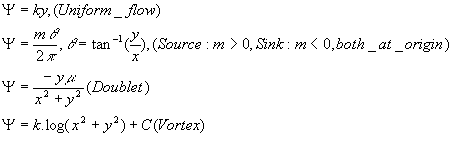
Common steam functions have been enumerated here:
How does a source look like? Here’s a souce of arbitrary strength (or a sink, direction does not matter).
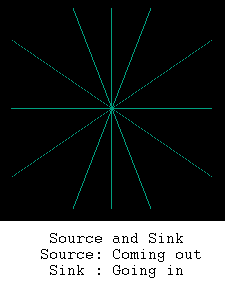
The above diagram shows a hydrodynamic source or a sink. Both the cases are the same.
So, if you superimpose a source and a sink then what do you get? You get patterns. Want to see?
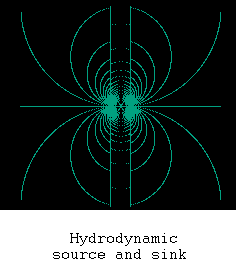
What you see here is a source and a sink located close together. There is no external fluid involved in this system as they are of equal strength. However, in the following case, external fluid is indeed required. We have all read about Rankine half bodies and how to do problems about them, and practised a lot in AM253. (It’s a pity that we did not get any questions in the quizzes regarding these things
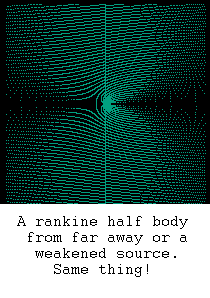
.
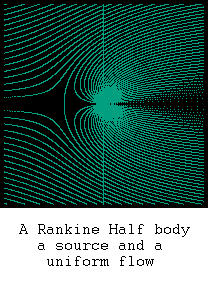
When a source is superimposed with a uniform flow, we get rankine half bodies. And when you have a source and a sink along with a uniform flow, what do you get?
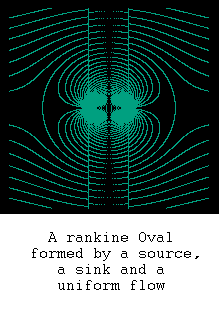
The source and sink are of the same strength. Or else, you would end up with an unholy picture like the following.
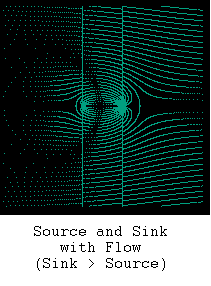
Here the sink and the source are of different strengths. As a matter of fact, the sink is twice as strong as the source. Note how the fluid is almost paralell when it comes to the source. Note how the fluid from the flow is forced to the sink. This is a hybrid between the Rankine half body and the Rankine full body.
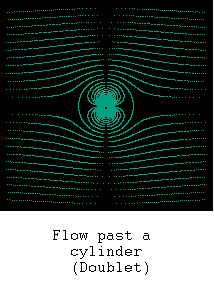
And now, when a source and sink (equal strenghts) approach each other, the distance decreasing and the strength increasing, in order to keep (x0.m) a constant. At almost zero separation, the strength tends to infinity. The limiting case is called a doublet. So, when the distance between the source and sink tends to zero, the rankine half body tends to a cylinder. This can be shown analytically, and has been done so in many text books. A doublet is used to demonstrate the flow past a circular cylinder.
You can see the flow past a doublet. Forget about the lines inside the cylinder. They come when we feed in the equation, if you want to visualise a cylinder.
A vortex is something that imparts a rotatory motion to the flow. We could visualise a source and vortex. Guess what we get in this case. The answer is:
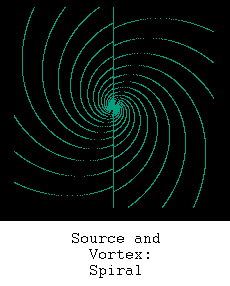
Convinced?
A vortex is a handy thing. All the pictures that we saw were symmetrical. Except the last one. And now, we will deal with more assymmetric patterns. Vortices are quite important. They are the key to the lift generated in Aeroplanes, and other things where lift is generated.
Let us first see how a Rankine half body is distorted by a vortex.
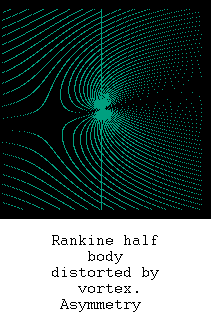
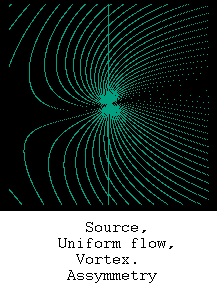
The above picutures are essentially identical. The picture to the right gives you a better idea of the assymmetry. Now, we understand that a vortex messes up the symmetry.
How does a Doublet look when it has a vortex acting too? We all remember reading about the Magnus effect (and I remember getting 0/5 when I had to draw this in a quiz.) Now, I'm wiser!
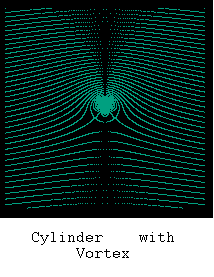
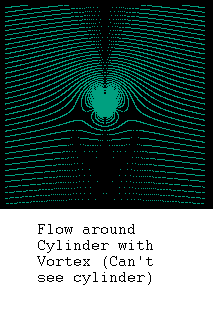
The above two images show flow past a cylinder with circulation. These pictures can also help understand and appreciate the Magnus effect, which deals with the lift force generated.
The Bernoulli Theorem says that the pressure is less where the velocity is more. So, there is a region of low pressure that is developed on top of the cylinders shown in the picture. There is concequently a force developed tending to push the cylinder upwards. This is the lift force, and is developed only due to the assymmetry induced by the vortex about the horizontal axis. The earlier cylinder had uniform lines above and below, which meant that there was no lift force.
That's all folks!
All pictures came out of my computer, and cannot be found anywhere else on the net, so no need to look around. You can use these pictures just as you want, I don't care. Just hand me over 10% of your earning, should these pictures ever earn you anything. If you want contours generated for any function F ( x, y, z) = 0, send me a mail at
If you want to know how I plotted these things, visit this page.