
Zeph 3:14-20
| Prophet active early in the reign of Josiah (640-609 BCE) |
| The call to sing in v 14 assumes that the restoration promised in 3:8-13 has taken place. "Daughter Zion" is a term of endearment. The enemies who have been the vehicles of the wrath of God are turned away. |
| Yahweh is the "king of Israel" in v 15. When Yahweh is in Israel's midst, there is no need to fear the future. Zion's sentence has been commuted. In OT thought, the promise of the messiah is the assurance that God still reigns. The announcement that God has commuted the sentence of humanity is central to the theology of both testaments. |
| The words "Fear not" in v 16 usually accompany an assurance of God's presence to save. |
| In v 17 the images are in creative tension: The warrior God is in your midst and he will renew you in his love (The translation of this last clause is very uncertain: He will quiet you with his love [NIV]). "A warrior who gives victory" might be translated as "a warrior who saves." Salvation in the OT has a connotation of victory. Yahweh's "loud singing" in this verse echoes the exhortation for Jerusalem to sing aloud in v 14. Yahweh rejoices over Jerusalem as Zion itself had been exhorted to rejoice. |
| Many scholars believe that vv 19-20, which conclude the book, are a post-exilic addition. However that may be, they speak of restoration and return for the oppressed, the lame, and the outcast. |
| The promise in v 20 to restore the people's fortunes "before your eyes" is a promise that they will see it for themselves, they will be eyewitnesses to God's salvation. |
| Joy is the key to unlocking the message of God to Israel, to the nations, and to all of us today....It is the faithful who rejoice and--perhaps most shocking--it is the God who commutes judgment sentences who also rejoices among those who have been released to live another day and in another way. NIB 7, 703. |
Micah 5:2-5a
This passage describes the birth of a new ruler from Bethlehem and therefore is one of the important messianic passages in the Old Testament (though it does not use the word "messiah"). The verse numbers in the Hebrew Bible are one less than in English. Hence Mic 5:2 in the English Bible = Mic 5:1 in the Hebrew Bible.
| Ephrathah includes, or is in the vicinity of, Bethlehem (cf. Ruth 4:11). Ephrathah was originally a Judahite clan named after its matriarch which settled in and around Bethlehem (ABD 2:557-558). Bethlehem, of course, is the hometown of David. |
| Bethlehem-Ephrathah is identified as one of the little clans of Judah and therefore this implies that the status of the new ruler (not king) stems from divine election. Since the ruler comes from Bethlehem, and not from Jerusalem, he will be in a sense a new David (his origin is from of old, from ancient days) and he will be the recipient of promises made to David (2 Sam 7:16-17). |
| The metaphor in v 3 seems to refer to the painful present experienced by the people, who have perhaps already gone into exile. This will be followed by the joyful return of people to the land. Cf. Mic 4:9-10. Israel is to wait, like an expectant mother, knowing that there will be happiness after pain. |
| The ruler in v 4 is a shepherd king. The source of his power and authority lies in the strength of Yahweh and the majesty of the name of Yahweh his God. Note he will be "for me" (God) according to v 2. |
| The ruler in v 5 is a person of peace, reflecting not only the absence of war, but the presence of the bounty and abundance implicit in the word Shalom. The promises are for this world and relate to contemporary experiences. |
| When Matthew cites this passage, the chief priests and scribes describe Bethlehem as "by no means least among the rulers" of Judah, and this reflects two major shifts from the meaning of the Hebrew text of Micah and makes the fulfillment greater than the promise itself. |
| Like ancient Israel, we wait for deliverance from present distress, knowing that God's final word to his people will always be "yes." And that promise of ultimate vindication becomes accessible to us through the one born for us in Bethlehem, whose death sealed God's promise. |
The Psalm for the day: Psalm 80
1 Sam 2:18-20, 26
| The gospel for the day is Luke 2:41-52--The Twelve-year old Jesus in the temple, and this is apparently the reason for choosing as the Old Testament lesson a text about Samuel serving at the shrine at Shiloh. |
| Samuel's faithful service contrasts with the wicked behavior of Eli's sons (vv 12-17). The ephod worn by Samuel was a kind of apron or loincloth. It is to be distinguished from the oracle-producing device, also called ephod, which could be carried and used to determine God's will (1 Sam 2:28; 14:3; 22:18; 23:6, 9; 30:7). Hannah brought young Samuel a new robe every year. |
| Samuel is the child "obtained by request" and also the one "dedicated" or "lent" to Yahweh (cf. 1 Sam 1:17, 20, 27, 28--all punning on the same Hebrew word). According to v 21 Yahweh gave Hannah five additional children, bringing the idyllic family picture to a most happy conclusion. |
| The omitted verses--vv 21-25--contain Eli's ineffective rebuke of his wicked sons. |
| Verse 26 brings the reader's attention back to Samuel. Samuel was continually improving in the opinion of Yahweh and of people, just as Eli's sons declined (v 24). The gospel notes similar approbation for Jesus (Luke 2:52): He increased in wisdom and in years, and in divine and human favor. |
| "To preach this text is to acknowledge that moral choices as leaders in God's community do have something to do with life and death. Relationship to God is demanding and dangerous. Those who would serve God place themselves under both God's grace and God's judgment--not just under God's grace." New Interpreter's Bible. |
The Psalm for the day: Psalm 124
Isa 43:1-7
| This lesson comes from Second Isaiah (Isaiah 40-55), composed between 547-540 BCE (after the rise of Cyrus and before the fall of Babylon) |
| The form of this passage is an Oracle of Salvation. These oracles were originally gave as a liturgical response to lament Psalms, indicating God's favorable response to the person's prayer. This form is among the most tender in the OT ("your savior"; "you are precious in my sight"; "I love you.". This passage consists of two such oracles: vv 1-4 and 5-7. |
| The parts of these oracles are |
|
Introduction v 1a Assurance of salvation: "Do not fear" vv 1b and 5a Nominal substantiation: "you are mine" "I am with you" vv 1b and 5a Verbal substantiation: "I have redeemed you; I have called you by your name" v 1b. Outcome: vv 2-4; vv 5b-6 Goal: v 7 |
| Among the promises made in these oracles: a safe new Exodus; God
gives Egypt, Ethiopia and Seba to Cyrus as a ransom payment for Israel; the
gathering of Israel from the four corners of the earth. There is a
close connection throughout Second Isaiah between creation (e.g. v 7) and
redemption. The psalm for the day: Psalm 29 |
Isa 62:1-5
| Commonly assigned to Third Isaiah, dated after the return from exile, this passage promises a glorious restoration for God's people in Jerusalem. |
| The prophet models insistent prayer by vowing now to keep silent until Jerusalem's vindication and victory are clear. The words "vindication" and "victory" are literally "righteousness" and "salvation." These words are frequently used in parallelism throughout Second and Third Isaiah. |
| Jerusalem's vindication will take place publicly, before the nations and kings of the world. |
| As in several other OT passages, a new name denotes a new status. Sarai and Abram become Sarah and Abraham when the covenant of circumcision is given in Genesis 17. Elsewhere the new names of Jerusalem include "The Lord is the source of our vindication" (The Lord is our righteousness) in Jer 33:16 and "Yahweh is there" in Ezek 48:35. |
| Jerusalem is presently called "Abandoned" and the land is called "Desolation." |
| The new names will be Hephzibah ("My delight is in her) and Beulah ("married") |
| The etiology of these names is that Yahweh delights in Jerusalem and the land will be "married." |
| The ideal relationship of Israel to Yahweh is described under the metaphor of marriage. A literal translation of v 5a would be: "Just as a young man marries a virgin, so your sons will marry you." This might refer to the repopulation of Jerusalem. The NRSV and many modern commentators emend the word "your sons" to "your builder" (this only requires a change in the vowels, not the consonants). With this change, both halves of the verse refer to the marriage of Yahweh and Jerusalem. |
The psalm for the day is Psalm 36:5-10
Neh 8:1-3, 5-6, 8-10
| The verses selected from Nehemiah 8 record Ezra's reading of the "law," perhaps a nearly finished copy of the Pentateuch, before the post-exilic assembly. The initiative for reading the law came from the people, not from Ezra himself. Nehemiah 8 continues the story of Ezra from Ezra 10, now interrupted by the Nehemiah story in Nehemiah 1-7. This is the first public recognition of the authority of the Pentateuch. The Torah includes both the story of Israel and its ancestors and God's instructions or laws that make for a wholesome and joy-filled community. |
| The public reading took place on what would be called New Year's Day in modern Judaism. The Water Gate was on the east side of the city, outside of the temple area, perhaps near the Gihon spring. This non-sacral area permitted participation by lay people as well as clergy. Men, women, and even some children (those who could understand) participated in the assembly. |
| Ezra read for about six hours, during which the audience gave their undivided attention. When Ezra unrolled the scroll (codexes or "books" were not used in pre-Christian times), all the people stood in reverence. |
| The interpretation of v 8 depends on the translation of the word rendered "with interpretation" in NRSV and "making it clear" in NRSV. Other suggestions: "with pauses between verses"; "distinctly"; and "paragraph by paragraph." The suggestion that the word connotes extempore translation into Aramaic has fallen into some disfavor. This verse may summarize vv 4-7: Ezra and his lay companions read from the book, paragraph by paragraph, or sentence by sentence. The Levites, moving through the crowd, interpreted and applied the law, and the people understood it. |
| Ezra urged the people not to mourn or cry and also to send food portions to those who had not had the opportunity or wherewithal to prepare for this celebration. Joy in the Lord is the best antidote for grieving. We do well to note the theme of joy in this chapter, since we often connect law to legalism or to accusations against us. Reading the Torah was a time for celebrating and banqueting and thinking generously about those who were not in attendance. Is it our joy in the Lord that is our strength? Or is it God's own joy in us that gives us strength? Both interpretations are possible. |
| Many elements of the later synagogue service are present here: assembly of the congregation, procession with the scroll, opened book with people standing, recital of a blessing, the double Amen, the explanation of the sacred reading, and the dismissal. The Gospel (Luke 4:14-21) has Jesus participating in a synagogue service. |
The Psalm for the day is Psalm 67
Jer 1:4-10
| The call narrative in Jeremiah should be compared to other prophetic calls (Isa 6:1-13; Ezek 1-2; Exodus 3-4). The initial word of assignment is often followed by an objection by the prophet and a word of reassurance by Yahweh that gives further details about the prophetic call. The reassurance often is accompanied by a specific sign. |
| Jeremiah's call was pre-natal (v 5), which clearly indicates that the call is Yahweh's idea and not based upon the behavior or merits of the prophet. St. Paul's call was also pre-natal and he too was sent to the nations (Gal 1:15-16). Paul's call, therefore, is modeled after that of Jeremiah. |
| It is not immediately clear why Jeremiah is called a "prophet to the nations." He does have oracles against foreign nations and his message has validity for the nations, but he is not sent on missionary journeys as was Paul. The "nations and kingdoms" mentioned in v 10 refer first of all to Judah. |
| Like Moses, Jeremiah protests that he is unable to speak, basing this on his youth: "I am a teenager." In Jeremiah's "confessions" he continues to wrestle with and object to the idea that he is called (see e.g., 20:7-18). |
| Jeremiah's authority according to v 7 does not lie in his age (or lack thereof) or his ability to speak (or lack thereof). Rather, Yahweh has sent him and commanded him what to speak, and that is the basis of his authority. Jeremiah is highly dependent here and elsewhere on the book of Deuteronomy (18:15-22); it is usually said today that his words have undergone deuteronomistic editing. Jeremiah is a prophet like Moses. |
| Jeremiah is commanded not to fear because Yahweh is with him to save him. This verse (8) is explicitly identified as an oracle of Yahweh. In both testaments, the expression "I am with you" is one of the clearest and most profound expressions of the gospel. |
| The sign in v 9 has Yahweh stretching forth his hand and touching the mouth of Jeremiah and assuring him that Yahweh himself has put words in his mouth (cf. Jer 15:19). |
| Verse 10 announces the dual character of Jeremiah's message. On the one hand, his words of judgment will "pluck up and tear down, destroy and overthrow." But they will also be part of Yahweh's "building and planting." God's final word to his people is always "Yes"! |
| The gospel for the day is Luke 4:21-30, where Jesus articulates the contours of his own call, much to the displeasure of his audience. |
The Psalm for the day is Psa 71:1-6.
Isa 6:1-8 (9-13)
| Isaiah's call took place in the year Uzziah died, ca 735. Uzziah and his contemporary Jeroboam II in the northern kingdom reigned over a time of great, but unequal prosperity. Social abuses are criticized by Amos in the north and Isaiah in the south. |
| Isaiah's vision takes him to Yahweh's heavenly temple. The deity was surrounded by six-winged seraphs: one pair was used to cover their faces and one pair to cover their feet = genitals. With one pair they flew. |
| The antiphonal heavenly choir affirmed two things about Yahweh: 1. Yahweh is completely separate/transcendent (holy); the fullness of the world is God's "glory." "Holy" is what God is in Godself; what we see of God is called God's glory. |
| Isaiah confesses his and the people's uncleanness (note that he does not have a "holier than thou" attitude). Their lips are unclean because of what they have eaten or what they have said. Isaiah is aware of this uncleanness because he has seen Yahweh. |
| In vv 6-7 a seraph takes a hot coal from the heavenly altar and cauterizes Isaiah's lips. He is thereby assured of forgiveness. |
| In the midst of the heavenly council Yahweh asks who will go for "us" (the members of the heavenly council). Isaiah responds, "Here am I, send me." |
| In the supplementary verses, not included in the standard OT lesson, Isaiah is instructed to deliver a message that will keep people from repenting. Is this hyperbole? Does this describe the result of Isaiah's call, but is read back into the commission itself? |
| In response to Isaiah's question about the length of his commission, Yahweh replies that this should continue until the land is utterly destroyed and until Yahweh has sent everyone away into exile. |
| Verse 13 seems to continue this devastating picture. Even if only one tenth remains (the southern kingdom after the northern kingdom is destroyed in 722?), it too will be destroyed, just as one burns a stump of a tree that has been cut down. |
| The last sentence is often identified as a gloss, in which the remnant (the holy seed) is identified with the stump. That is, a remnant will survive and be the basis for renewed growth and hope. |
The psalm for the day is Psalm 138
Jer 17:5-10
| The poem is very similar to Psalm 1, which is the Psalm assigned for this day. Verses 5-6 describe those who trust in mere mortals (they are the wicked) and compare them to a shrub in the desert. These people may just as well be a juniper in the Arabah, which will fall under a curse in bad times because it cannot wait for the rains to come (Lundbom in the Anchor Bible). |
| Contrasted with them, in vv 7-8 are those who trust in Yahweh. These righteous are compared to a tree transplanted by an abundant source of water. |
| Verse 9 ascribes devious motivations to the human heart--it is desperately sick. Jeremiah is generalizing about every heart, including his own. |
| Verse 10 asserts that Yahweh tests the mind and the heart and applies appropriate rewards and punishments to the righteous and wicked respectively. |
| The Gospel, Luke 6:17-26, pronounces great reversals. The poor, hungry, and sorrowful will receive good news while the rich, the full, and the happy will find their good times turned into bad. There is a healthy tension between these two passages. The passage from Jeremiah urges people of faith to live ethically; the Gospel warns against making a one-to-one equation between prosperity and piety. People could misuse the OT lesson to support self-righteousness; people could misuse the NT lesson to advocate cheap grace. The truth lies in the tension between the two passages. |
The Psalm for the day is Psalm 1.
Gen 45:3-11, 15
| The Joseph story is often called a "Novella" (little novel) and is the longest continuous story in the book of Genesis. Joseph's disclosure of his identity follows the moving speech by his brother Judah, which shows his loyalty to his father Jacob and his defense of Benjamin (see below). Judah is in many ways the hero of the Joseph story (see also chapter 38 and the great blessing to the tribe of Judah in 49:10-12) |
| The Joseph story is told in modern fashion, without explicit divine intervention. But looking back, Joseph can detect clearly the hand of God: "Do not be distressed, or angry with yourselves, because you sold me here; for God sent me before you to preserve life." v 5. "So it was not you who sent me here but God." v 8. See also 50:20: "Even though you intended to do harm to me, God intended it for good, in order to preserve a numerous people, as he is doing today." We may not experience miraculous interventions by God into our lives, but often we can look back over the years and see God's secret providential hand. |
| As a result of Joseph interpreting Pharaoh's dreams, he has been made second in command with the assignment of storing up grain for the coming famine. Those seven years of storage are past and Egypt had already completed the second year of the famine. |
| The Joseph story "explains" how Israel wound up in Egypt, and there is a four hundred year gap between the end of the book of Genesis and the beginning of Exodus, when a pharaoh arose who did not know Joseph. So when Joseph urged his brothers to bring his father to Egypt quickly, the outcome in the long run was not positive. |
| The lectionary omits vv 12-14, which describe Joseph's relationship to his full brother Benjamin, who had been brought down to Egypt at Joseph's insistence and then arrested when a silver cup had been hidden in his sack. Judah's offer to be a slave in Benjamin's stead (44:33) had demonstrated the change of heart among the brothers. |
| The gospel for the day, Luke 6:27-38, reflects similar concerns. "Love your enemies, do good to those who hate you." "If anyone strikes you on the cheek, offer the other also." "Do to others as you would have them do to you." |
The psalm for the day is Ps 37:1-12, 39-40
Exod 34:29-35
| The passage reports how the face of Moses shone when he came down from receiving the law on Mt. Sinai. Moses had received a second copy of the law after he had destroyed the first copy when he discovered the worship of the golden calf. |
| Verse 29 tells us that Moses did not know that the skin of his face "shone" because he had been talking with God. The Hebrew word for "shone" is qaran. In the Qal pattern, it only appears in this pericope. The ancient versions (Septuagint, Peshitta, Targum) suggest the meaning "shone," which is followed by Noth, Childs, and other modern commentators. It could also be a denominative verb formed from the noun qeren, which means "horn." Verse 29 might then mean that Moses did not know that the skin of his face "showed horns." Jerome followed this line of reasoning in the Vulgate (cornuta), leading to the fact that Moses in medieval and much modern art is shown with horns, as in the famous statue by Michelangelo. |
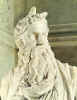
| The shining face of Moses frightened Aaron and the other Israelites (v 30). When Moses spoke with them, however, this seemed to allay their fears and Moses reported to them the laws he had received (vv 31-32). |
| From then on Moses put a veil on his face, presumably to keep his shining face from frightening the Israelites. But when he would go to talk directly to God, he would remove the veil. |
| In the gospel, Luke 9:28-36, the appearance of the face of Jesus changed, and his clothes became dazzling white. Moses and Elijah, representing the Law and the Prophets, also appeared with him. |
| St. Paul interprets the incident in Exodus in a quite unique manner. He suggests that the reason for Moses wearing a veil was that the "glory" of his face was gradually fading (2 Cor 3:13). He accuses the Jews of his day of hardening their hearts and keeping the "veil" between them and the reading of the old covenant. Only in Christ is this veil put aside. Paul states that to this very day, whenever "Moses" is read, a veil lies over their minds (2 Cor 3:14-15). Contemporary preachers will not want to use this interpretation uncritically. |
The psalm for the day is Psalm 99.
Deut 26:1-11
| This pericope includes a creed that was recited at the festival of First Fruits. Gerhard Von Rad included this among his "small historical creeds" (cf. Deuteronomy 6 and Joshua 24), which he believed were quite old and the kernel from which the Pentateuch grew. More recent investigation has denied their antiquity, but the creedal character of this passage is still clear. |
| The creed itself begins in v 5. The believer confesses that his or her ancestor Jacob was a "wandering Aramean" or an "Aramean about to perish" when he and his descendants went down to Egypt. Verse 5 reports Israel's population explosion in Egypt; verse 6 tells of their enslavement and harsh treatment by Pharaoh. |
| In response to the people's prayer in v 7, Yahweh heard their voice and saw their affliction, toil, and oppression. Verse 8 presents Yahweh in military posture--with mighty hand and outstretched arm. Sometimes conditions are so bad that only a use of force can effect freedom. Verse 9 recounts Israel's entry into the land flowing with milk and honey. |
| Von Rad made much of the fact that in this "ancient" creed there was no mention of the Sinai experience. He believed that there were two great tradition streams in Israel--one dealing with Yahweh's saving acts and the other dealing with law and covenant. In Von Rad's opinion, the J source in the Pentateuch was the first place where these two traditions were brought together. |
| In response to God's benefactions, the worshipper brings a thanksgiving offering of the first fruits of the soil. The festive celebration includes the marginalized--the aliens and the Levites. |
The psalm for the day is Psa 91:1-2, 9-16