
(Note: For an inexplicable reason, I shall refer to linked ring coats as "Maille", whereas Tolkien refers to the same item as "Mail". Do not worry, we are speaking of the exact same thing)
However, even though Tolkien's armour descriptions - whether Rohirric or otherwise - are singular and fairly uniform, in "actuality" (how funny that sounds) his troops would have looked little different than your regular dark-age armies.
Now then, before we begin hypothesizing about how we should properly envision the Rohirrim, let's have a look at Tolkien's quotes on the subject.
(Warning - I'm reading into the text almost more than is practical or even author-intentioned. I'm jumping on omissions that to Tolkien would have been meaningless, and stressing points he wouldn't - this is because we are working at different purposes. Tolkien was writing a literary masterpiece, whereas I'm looking for basic archaeological hints, to stress points that probably didn't exist in Tolkien's mind. Ah well, six of one, half-dozen of the other...)
Legolas: Yellow is their hair, and bright are their spears. Their leader is very tall. (The Riders of Rohan, TTT). Not much at first glance to go on in this first quote, but one odd thing: at several leagues distance, Legolas can clearly see the hair of the riders - this may show that in the majority of the eored, a camaille attached to the helm was not popular.
Of Eomer and the eored: �After him they rode: a long line of mail-clad men, swift, shining, fell and fair to look upon.
Their horses were of great stature, strong and clean-limbed; their grey coats glistened, their long tails flowed in the wind, their manes were braided on their proud necks. The men that rode them matched them well: tall and long-limbed; their hair, flaxen-pale, flowed under their light helms, and streamed in long braids behind them; their faces were stern and keen. In their hands were tall spears of ash, painted shields were slung at their backs, long swords at their belts, their burnished shirts of mail hung down upon their knees. (Riders of Rohan, TTT) There's a lot here - ash spears (ash is obviously an indigenous tree in the Mark), light helms (not covering the front of the face, but rather with a nasal), knee length maille coats, and painted shields. Note that the shields mentioned only say "painted", not necessarily emblazoned with a badge, but certainly not plain wood. It also doesn't specify round, or any shape at all, save that they could be slung on the back.
Pippin on the eored: �riders away eastward were already level with the Orcs, galloping over the plain. The sunset gilded their spears and helmets, and glinted in their pale flowing hair.(The Uruk-hai, TTT) I've used this quote only to hammer in what has already been said in the previous quotes - and to point out one thing. The helms reflect the sun, therefore, the helms of the professional Eotheod, not only being light caps, are also made completely of steel. Whether spagen (made in four sections), or otherwise remains in the hands of conjecture.
To note, all of these quotes above have been about a certain social rank of warriors, the professional eored of Eormer, also called by him "the men of my household" (Riders of Rohan, TTT). These are men who have time to burnish maille so that they shine with the sun, and are in a position where arms, equipment, and drill are of prime importance. Not only are every man of them covered in maille, but Tolkien goes out of his way to point out the apperance of "long swords" in addition to spears. This is not, not the levied warriors who muster in the fields.
Now we shall look at other soldiers of the Mark, the gate guards and the door-wardens of Meduseld.
The Gate-guards of Meduseld: There sat many men in bright mail, who sprang at once to their feet and barred the way with spears. (King of the Golden Hall, TTT) The only thing of note here is the stress on spears, and no mention of sun-glintered helms (which as the maille was "bright", if the helms were all steel, they would also have been bright).
Of the Door-wardens of Meduseld: There sat other guards, with drawn swords laid upon their knees. Their golden hair was braided on their shoulders; the sun was blazoned upon their shields, their long corslets were burnished bright, and when they rose taller they seemed than mortal men.(King of the Golden Hall, TTT) Here are the true elite of the Mark, the personal guard of the King. Spears are not mentioned, and not needed by them, as they are not charging warriors like Eomer's Eored, but rather body guards, who would hold back from the main fight and only engage when the king's person is in danger. Thus swords, always drawn, and no spears. They also have the same emblazon on their shields (not personal blazons): the sun in splendor. This is quite reminiscent of the Yorkist guards of Richard III, and might be where Tolkien got his inspiration.
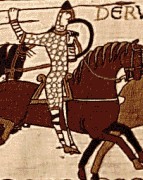
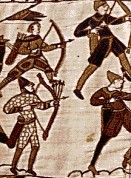
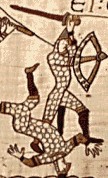
As the last clincher of a quote, Tolkein begrudgingly discribed the Rohirrim in Letter 211 as follows: "The Rohirrim were not 'mediaeval' [ie, 13nth cen onwards - Web Dude], in our sense. The styles of the Bayeux Tapestry (made in England) fit them well enough, if one remembers that the kind of tennis-nets soldiers seem to have on are only a clumsy conventional sign for chain-mail of small rings.
This little quote should not promote thoughts of a Eo-Norman connection: Tolkien's disdane for the invasion of 1066 and the destruction of Anglo-Saxon culture are well grounded. Moreover, whether Tolkien refers to the Normans of the Bayeux or the Saxons of the Bayeux is both unspecified, and unnecissary: they are dressed fairly alike.
The Mark has its back right against the White Mountains, most likely an idea source for iron deposits. We can guess due to the amount of maille in the ranks of the eoreds and guards that the Rohirrim made it themselves, but like the rest of their society, it is probably not the equal to its southern cousins in Gondor. This we can guess at using a vital clue from the Two Towers, where Theoden remarks of his weapon hoard: I will offer such things as may be found in my armoury. Swords you do not need, but there are helms and coats of mail of cunning work, gifts to my fathers out of Gondor. (TTT, King of the Golden Hall) That he goes out of his way to mention Gondorian craftsmanship is a clue to the superiority of Gondorian maille. The main difference probably lies in "cunning work", the fact that Gondorian maille was most likely fitted (yes, maille is just like any cloth, and can be pieced to make a perfect fit), whereas Rohirric mail was probably a single piece with sleeves, making it quicker to make, and therefore less expensive and more available to the warrior of adequate means.
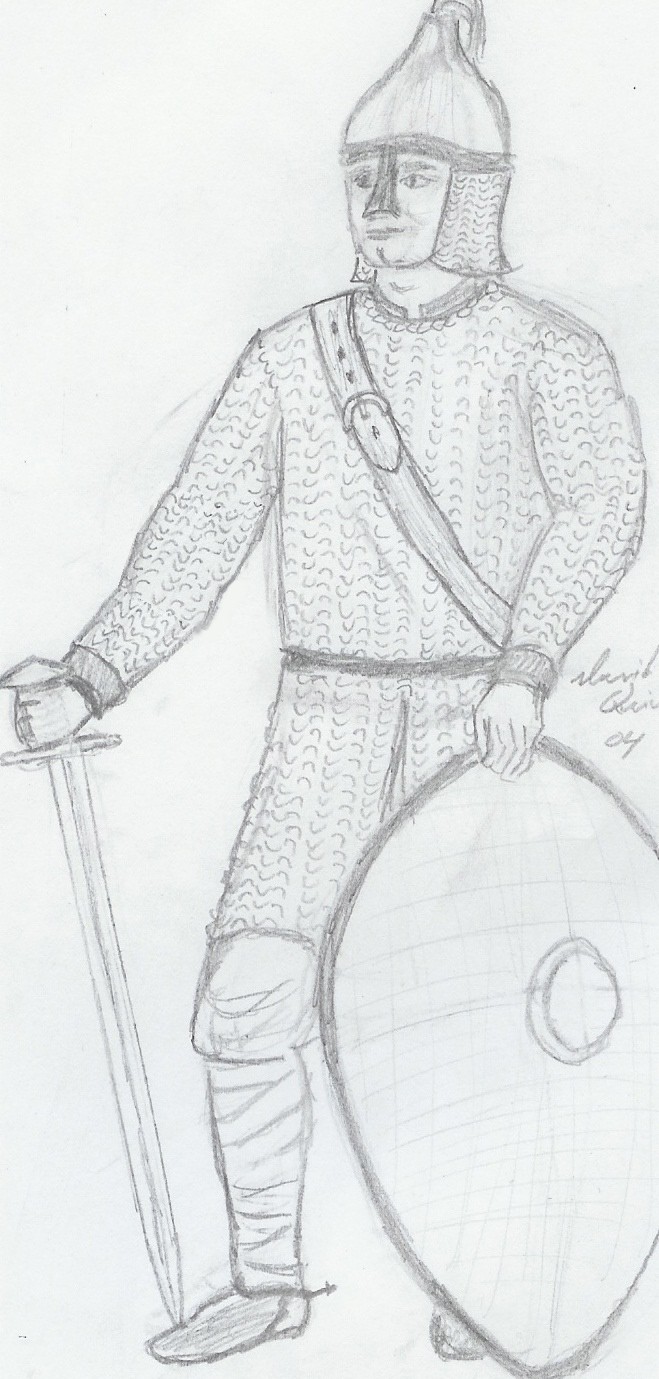
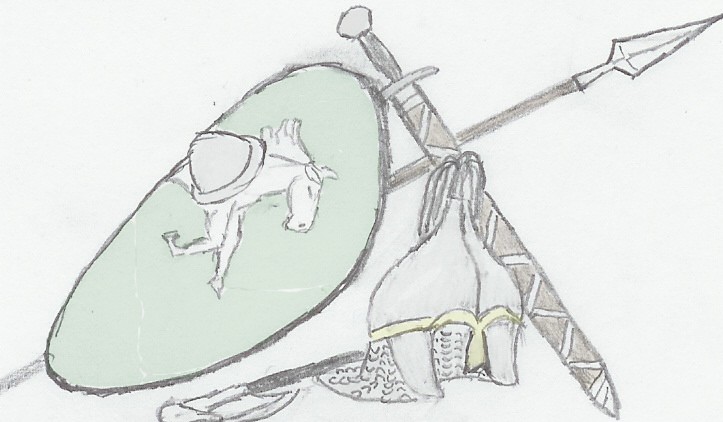
The shield is not completely round - for a hose based society, relying on round shields into the turn of the Fourth Age seems unlikely - a more elongated shape, and curved to cover the contours of the body would have most likely been developed fairly quickly. The shield is made of oak and ash (two trees we know for certain to be indigenous) "plywood", glued together for strength and then steamed and bent into a concave. It is then covered in linen (which we also know was readily available) and painted.
The helm is steel, of two pieces welded in the middle, and shaped into a crest - a display of wealth equal to the fact that he wears maille and has a sword. There is a camaille attached to the helm, but it could easily be replaced with cheekguards, or nothing at all.
The sword is long and straight as described by Tolkien, with a simple pommel in what is today known as "Brazil nut".
Modern riding boots, or even knee length boots of any kind are unlikely, in my opinion, and maille chausses would have been more of a hinderance in riding, so this warrior has simple woolen "putees" wrapped about his slightly baggy woolen hose (trousers) Greaves of leather are also a possibility. Shoes are ankle length, with simple prick spurs buckled on.
When Eowyn arms Merry on the muster field, it is with 'a stout jerkin of leather, a belt, and a knife.' (Muster of Rohan, RotK) Leather armour, then, is not only available, but packed along in the traveling armouries to arm those without - as these were the Royal armouries as well, the presence of leather jerkins might say that spare coats of maille are fairly few. Leather, however, is not the only thing available, nor is it even the best material in lieu of maille. For ages, levied troops have relied upon cloth to keep them warm and safe, and a quilted jack, made of layers of linen stitched between linen canvas, affords remarkable portection for a very reasonable price.
The helms of the professionals are steel, and the king's own helm is described as "high", hinting towards a conical preference in eored helms. But what of the helms of the common levied rider? Here we must turn to Gimli in his search for a stout helm.
�[Gimli] chose a cap of iron and leather that fitted well upon his round head; and a small shield he also took. It bore the running horse, white upon green, that was the emblem of the house of Eorl.
�May it keep you well!� said Theoden. �It was made for me in Thengel�s day, while still I was a boy.� (King of the Golden Hall)
Here it is not the helm that Theoden is thinking of, but the shield. The helm probably represents the a common type - iron and leather can only mean a "spagen" construction, and note that it is round and not conical. The shield is most likely the same as the painted shields of the eored, although archaeological finds in the Nordic countries show that the poorer soldiers made shields out of slats of wood instead of ply, so that is also an option. Spears are highly probable for every man, as the spear is what is mentioned throughout the texts for every armed rider.
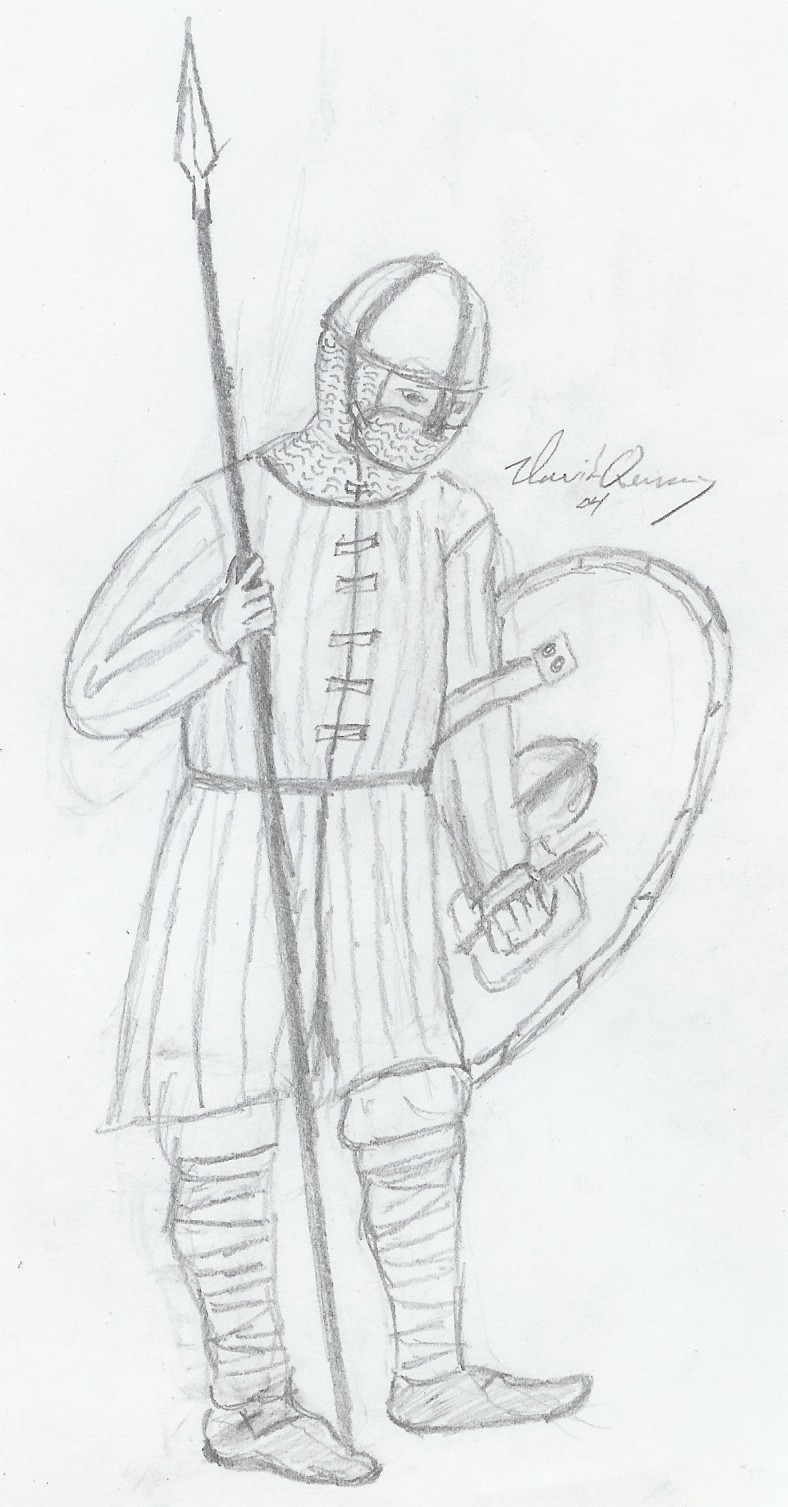
His helm is round, of iron and leather in spagen construction, and no crest. There is no camaille attached to it, although that is a possibility, as are cheekguards. Instead, this particular fellow has a coif of maille similar to that recently found in a church in Gotland, Sweden, from 300 AD. His mouth and chin are protected by a seperate piece of maille that buckles from one cheek to the other - the presence of the maille speaks probably of the "last piece found in the weapon hoards", which he grabbed up and donned.
His ash spear is in his right hand, and on his left arm is a shield of the same construction as the one held by the eored warrior above. It is edged with rawhide, to keep the shield from splitting, and is set up with straps to work both on horseback and on foot.
His shoes, putees and hose are the same as the eored warrior, with the same options available.
The only other weapons mentioned by Tolkien other than the spear and the sword was the bow - A few of the riders appeared to be bowmen, skilled at shooting from a running horse. Riding swiftly into range the shot arrows at the Orcs that straggled behind. (The Uruk-hai, TTT) The bow was most likely short in the belly, with a long draw, and could even be akin to the composite Mongol bows of the early middle ages.
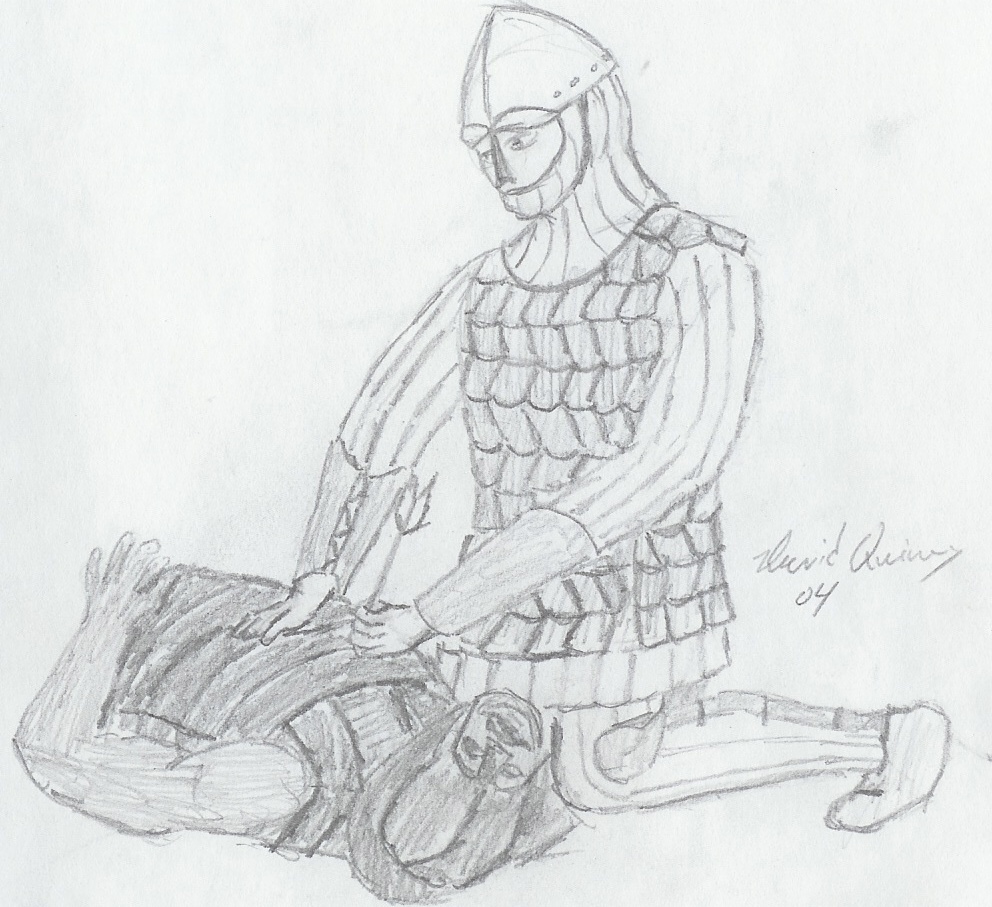
His helm is in the area between the rich crested helm of the eored warrior and the simple spagen of the levie - it's a two peice conical with nasal guard. On his head is a padded linen coif, of the same construction as the padded jack underneath his lamellar coat.
The lamellar coat shows the years of eastern influence which have impacted the Rohirrim for many years in the Third Age - it is made of leather plates (or sometimes iron plates) stitched in an overlaping pattern, providing good flexibility and protection.
Over his woolen hose more padded linen has been strapped, providing good protection without impeding his movement.
The Eotheod at Celebrant were a scattered people living in the Vales of the Anduin, with only a few established cities and outposts, and more than likely producing little in the way iron body protection. Years of ruthless guerilla warfare in the Mirkwood forests made civil outposts a danger, and therefore metalurgy advancements suffered. However, 500 years of social development and the new way warfare was conducted in the open Rohirric plains doubtless made for improved construction, if not design, in the weapons and armour of the Rohirric (although the tried and true tactics changed not at all).
The only artifact of pre-Mark armour is from the description of Baldor in the Dunharrow caves, and this is not the armour of the common warrior!
Before him were the bones of a mighty man. He had been clad in mail, and still his harness lay there whole; for the cavern's air was dry as dust, and his hauberk was gilded. His belt was of gold and garnets, and rich with gold was the helm upon his bony head (Passing of the Grey Company, RotK).
The harness of a king's son - too much gold for even an eored warrior!