 |
|
|
|
|
|
|
|
|
|
|
|
|
|
|
|
|
|
|
|
|
|
|
|
|
|
|
|
|
|
|
|
|
|
|
|
|
|
|
|
|
|
|
|
|
|
Arms and Armor
of the Anglo-Saxons |
|
|
Reenactor pictures courtesy of Regia Anglorum |
|
|
|
|
|
|
 |
|
|
|
|
|
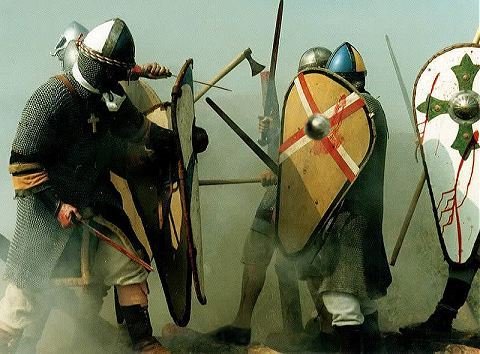
The sword was not a common item among either Anglo Saxons or their Viking raiders at that time. Swords were expensive, and were only carried by leaders or nobles. The axe and the spear were what you would find the common soldier carrying into combat. In an age where steel grades were not high enough to fully develop the arts of thrusting, the axe was a powerful and deadly weapon. The great Anglo Saxon two handed axe, according to legend, could cut a horse in two. That is probably not true, but when one takes a look at one of the great axes, one can see that a blow from such a weapon would easily take a man�s life. |
|
|
|
The spear was the main offensive weapon of the time. A shield wall bristling with spears could turn even the fiercest charge. Spears were also ranged weapons, and could be thrown quite easily and inflict great damage. The opening moves of battle at the time almost always started with an exchange of spears, those that did not find their mark through a warrior�s body often being used as extra ammunition, and thrown back to the side from which they came. In addition to the long spear, the warrior, chiefly the Vikings, also had a short stabbing spear in their armory. The broad blade could stab deep into chain mail when stabbed with sufficient strength, and its shorter length made it ideal in the close quarters of hand to hand combat. |
|
|
|
Swords were, as previously stated, used only by men of high rank. Sword blades were made in the folded steel, or �Pattern-welded� style (NOT the term widely and wrongly used - Damascus). A portion of iron was smelted into steel, and bars of iron and steel were heated together in the forge. The bars, when heated, were hammered together, welding them tight. The joined bars were then twisted, to make the blade even stronger. It was then hammered into the proper shape. The edges of the sword usually contained more steel, so as to take a hard, sharp edge. |
|
|
|
The sword of the Anglo Saxon was slightly top heavy. This is because the technique of the �cut and thrust� style of sword play had not yet been fully developed. The sword was used more in the style of an axe, striking the opponent heavily with the point of percussion (about six inches from the tip of the blade) at targets like the head and shoulders. Even if it didn�t cut through mail, which was likely, such a blow would shatter bone. In those times it was muscle and endurance, rather than skill that one battles! |
|
|
 |
|
|
|
 |
|
|
|
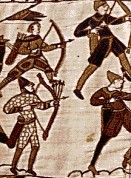
The bow was not considered quite the thing, and we indeed hear comparatively little about it. It was the weapon of the common man, but it could still inflict heavy damage on the field of battle! We know from the text of the Battle of Maldon, that �scferth �did not hesitate at that war-play,
but he often sent forth arrows abundantly�
We also know from the famous Bayeux Tapestry that the Normans employed archers against the Anglo Saxons, and that they were quite effective. |
|
|
|
|
|
The bow came with quite a variety of ammunition to choose from.
1) Barbed heads were used for both the hunting of game and the hunting of armed men.
2) Swallowtail broad heads were only useful for hunting. They were the preferred weapon against large game, because of the deep, broad wound they made.
3) Straight broad heads were useful in taking down game, men and horses, and are the commonest early head.
4) Non-barbed Bodkins: These are the true weapons of warfare, capable of making deep wounds and punching through even plate armor. One common type of these heads was the Needle head Bodkin. It was expressly designed to penetrate mail armor, and tests have shown that it will go right through a modern bullet-proof vest! |
|
|
|
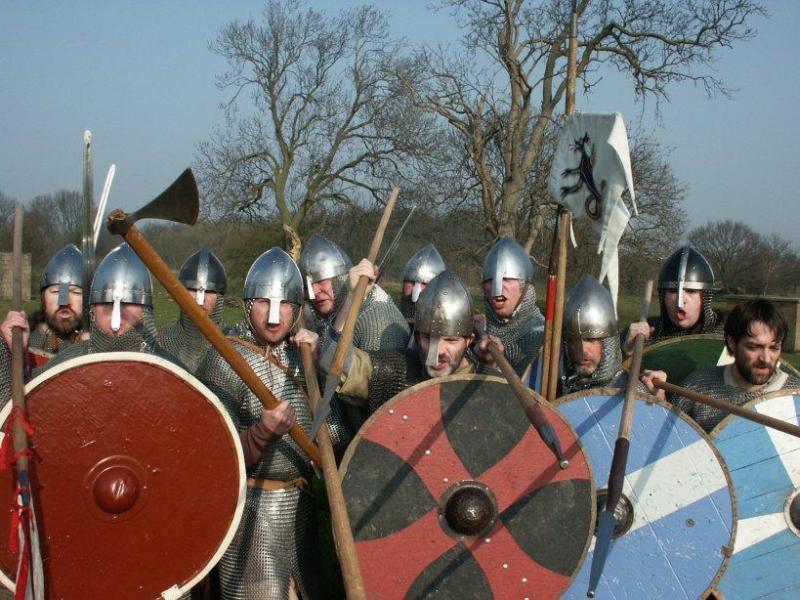
So, with all these various weapons coming at you, what did you have to defend yourself? The primary defensive item of the time was the shield.
The common round shield was made from Lindon wood. Many thin layers of wood were glued together, making a very strong solid ply that presented no seam to the incoming weapon. Before the glue dried, shields could also be curved, allowing blows to glance off and dispersing the shock of impact. Although none of these solid shields have been known to survive, some examples of the common slat shields remain intact. The slat shield, which could be made quickly by even an unskilled craftsman, was merely several slats of wood held together with an iron or wooden bar. |
|
|
|
The shield of the time was round, anywhere from 16� � 38� in diameter, with a center metal cap, or boss. The boss was designed to cover and protect a section that had been removed for hand to grasp a metal rod in the center of the shield. Wielded in such a manor, the shield was quit mobile and could easily deflect most blows. |
|
|
|
 |
|
|
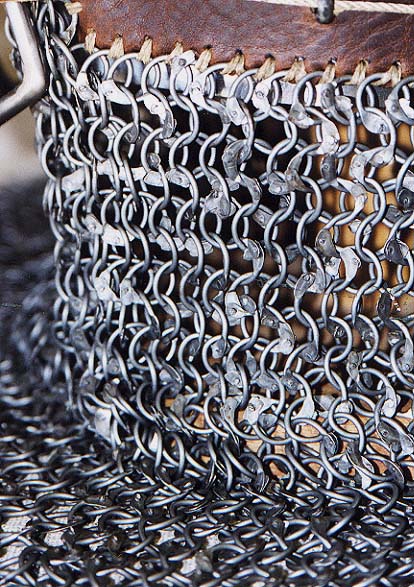
Body armor at the time could range anywhere from a woolen tunic, a padded leather gambeson, or a riveted mail hauberk, depending on the rank and wealth of the wearer. Mail was a set of linked steel rings � usually with one ring hooked to four others (four to one), although sets of eight to one are known. The links were not butted up together as you see in most modern mail. If you give a butted mail hauberk a good, stiff thrust, you�ll see that the rings will immediately separate. Each individual ring of mail was riveted by hand; making a closer that was even more effective than modern welding! |
|
|
|
|
|
|
Iron grades were not yet of enough quality for effective plate armor to be made that would withstand the heavy weapons of combat at that time. The old Roman Lorica Segmentata was just too thin to hold up to the axes and broadswords. Still, the one bit of plate was the helm. Helms came in all sizes, styles and shapes � from the single piece Roman construction, to the Germanic Spangenhelm style. Early Norse and Anglo-Saxon helms that have been found at places like York and Northampton, all have a stout nose guard and long cheek guards. Some helms were of boiled leather, some of iron. The Sutton Hoo helm is of iron construction with small, bronze decorative plates riveted to it, a style also found in the Valsgarde helm. Later styles abandon the cheek guards, and the familiar �goggles� can be seen. And of course, we know of the infamous �Norman� style helm which was so popular among both the defenders and the attackers at Hastings at the end of the Anglo-Saxon period. What protection the helms offered is hard for us to judge, using the modern materials that we have today. The lads at Higgins Armor Sword Guild did a nice little video where they gave a modern Norman Helm a good thwack. The result was a large dent and a hairline slit. But the force of the blow alone looks as if it would have given the wearer a very bad shake, if not breaking his neck! When I find the link to the video, I�ll post it. |
|
|
|
 |
|
|
|
 |
|
|
|
 |
|
|
|
 |
|
|
|
|
|
|
|
|
|
|
|
Links: |
|
|
 |
|
|
|
Angelcynn: Anglo-Saxon Weapons and Armour
The Shields
Hurstwic: Viking Age Arms and Armor
Regia Anglorum |
|
|
|

|
|
|
|