| Englisc |
| The language of the Anglo-Saxons has quite a history, finding its form, phonology and vocabulary through various invasions of various cultures. The earliest Briton was first influenced by those Germanic peoples fleeing the Roman invasion. Their fragile society was broken up by the Roman invasion and occupation of 43 AD, when the language took on a more Romanesque flavor. The next stage of change came with the Saxon invasions of 450 and the crowning of Aella as Bretwalda (overking) in 490, giving the language it's very guttural Germanic flavor that can scare the modern English reader. Another change was brought about with the Danish invasion and occupation of the area around York and Lincoln. Although fairly similar to the Danish (now known as Old East Norse) in basics, both invaders and invaded had to change their tongue so as to understand each other fully. An example of this would be the phrase "Have you a horse to sell?", in which the Englisc phrase was "Haefst thu hors to sellenne?", and in the Norse was "Hefir thu hross at selja?" The last and greatest change came from the invasion of the Normans in 1066. This gave to Englisc it's French flavor that is still obvious today. Englisc, as a language, died out with the occupation of the Normans. It ceased to be preserved in written form (Norman and of course, Latin took over area), fell out of use at court, and gradually turned into the pre-Chaucarian "Middle English", from which our modern tongue has it's real roots. Yet even now, there are still many, many modern words that have their source straight from the words men like King Alfred would have spoken. |
| How did the Anglos write their language? The average Anglo (when I say average, I refer to the period of 900 AD) did not know how to read or write - that was a luxury only available to the Church and those who could afford to be taught by the Church. In earlier times, merchants and craftsmen employed the use of Runes (or Futhork, as it was known at the time) to write. Runes were made up of vertical and diagonal slashes. The reason for the absence of horizontal and rounded cuts is because at that time the writing implement was the knife or chisel, and the "paper" was wood or stone. Curved marks are too hard to make in a hurry, and horizontal marks were easily lost in the grain of the wood. Some runes were said to contain magical powers, and were often inscribed on weapons and armor. Contrary to what might be thought, the wide use of runes, both by the Anglos and in the Continent, would seem to show that most people had at least a rudementory knowledge of their local Futhork. |
| During the reign of the French emperor Charlemagne in late 700 however, the use of the Latin script, the Caroline minuscule, became the common script used by the Church, and with the spread of Christianity, the Futhork died out, and was only kept in use by such "pagen" countries as Norway, Sweden and Daenmark. But although short phrases might be written down in ease using runes, longer accounts such as the Sagas and the various histories and mythologies were quite tedious to write in runes. And it is very hard to read a long story from a piece of wood by the fireside. Thus most sagas were passed down by word of mouth in the form of poetry and song, only to be writen down later by post-Christian Anglos and Norse, such as the likes (in Norway) of Snorri Sturlson and (in England) King Alfred. Englisc has a very melodious sound, and it was often spoken in everyday use to an internal rhythm. Of course, this process of verbal history led to many historical inaccuracies by the time monks and others who could wield a pen came to writing them down. |
| Min Hlence: (my links) |
| There are two basic ways to look at linguistics. The first is Synchronic linguistics, that is, the study of a language merely as a system operating at a certain time, focusing mainly on its anatomy and physiology. The other way is Diachronic linguistics: studying the changes and devolpments in languages through transformation in use. By nature, I focus on the Diachronic aspect of languages, considering its phylogeny and otogeny. Anglo Saxon is one of those languages with a large history, and therefore is a language that changed from time to time due to invasions. Taking this into account, when one hears of someone learning Anglo-Saxon, one's first question should be, "which era of Anglo Saxon?". To help one along, I have written out a small and very general (containing most likely quite a few inaccuracies) history of the Anglo Saxon language. |
| The first known use of written scripts would be when the Irish missionaries brought their version of the Insual round script to the British Isles in the 560s, much like the script below: |
| This rounded script evolved quickly into the more common Insular pointed script; the oldest document in which it is written dates from the 730s. |
 |
 |
 |
 |
 |
 |
 |
 |
 |
 |
 |
 |
 |
 |
|
 |
 |
 |
 |
|
 |
 |
| Acknowledgements Webmaster bio Other page |
 |
| Join Rohan today! |
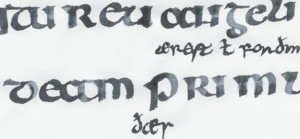 |
| The above is folio 18v (or left hand page) of the Lindisfarne Gosple, with notes in a slightly later and informal script [copy of original by webmaster] |
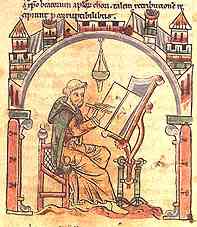
| To write using the Caroline minuscule script, which employed many small curves like English alphabet today, was almost impossible when using wood and stone and metal. Ink was called Encaustum in the Latin, and was made from oak galls crushed in rainwater, and thickened with gum arabic. Iron salts and natural pigments gave the desired color. What did they use to write on? Paper, made from wood pulp, was not stable at that time, and crumbled into dust very quickly. Scribes used the hide of a sheep, scraped thin and smooth, to write upon. This was called vellum, and all the surviving documents of the time were written upon it; from religious works and songs, to dry legal documents and popular tales like the Beowulf saga. |
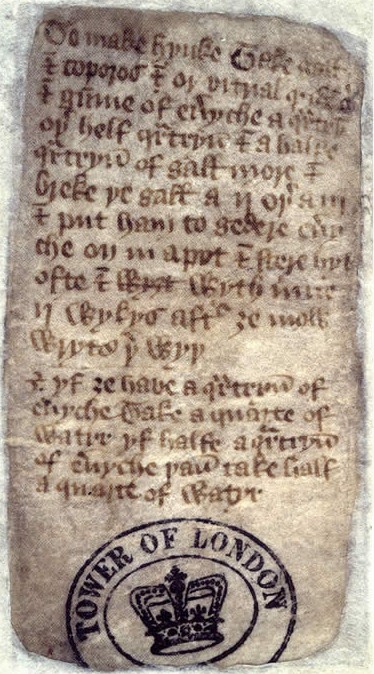 |
| Right, so it's not Anglo Saxon, but rather Middle English - but to the left is a small recipie for ink, ca 1483, which I thought readers might find interesting. It translates as thus: "To make ink. Take (oil) and copperas and or vitriol (quarter) and gum of (clyche) a quarter or half quarter and a half quarter of gall more and break the gall a 2 or a 3 and put them together every the one in a pot and stir it often and within 2 weeks after you (mol) write the (wyr) and if you have a quarter of clvyche take a quarter of water if half a quarter of cliyche then take half a quarter of water." |
| Note: The Webmaster has a large collection of manuscript scans - feel free to email him for more on manuscripts |
 |