If you want to buy the project management book mail
[email protected] for
more details or call any of our book shops MUMBAI-22078296/97/022-22070989,
KOLKATA-22826518/19 HYDERABAD-24756967,24756400,BANGALORE-25587923,
25584641,AHMEDABAD-26421611,BHATINA(PUNJAB)-2237387,CHENNAI-28410796,28550491,DELHI/NEWDELHI-23254990/91,23325760,26415092,24691288.If
you want to write to the author directly email at
[email protected]
Note: - In CD we have provided “FunctionPoints (Accounting Application).xls” , which is used in this example to make TPA calculation easier.
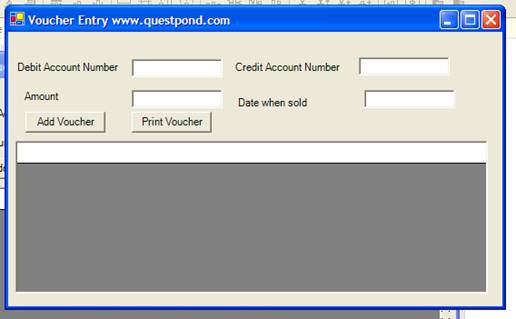
In order to really answer this question let’s do one complete estimation practically for a sample project. Below is a simple accounting application developed for http://www.questpond.com (that’s my official website) website to track its sales. The first screen is a voucher entry screen. It’s a normal simple voucher entry screen with an extra functionality to print the voucher. The second screen is a master screen to add accounting codes.
Figure: - Accounting application
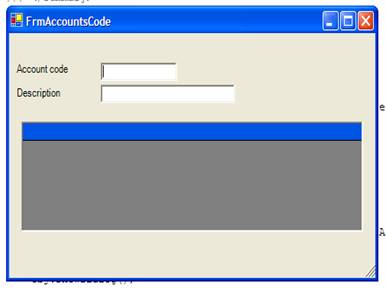
Figure: - Account code description
Below are point wise requirements gathered from the end customer:-
1) The account code entered in the voucher entry screen should be a valid account code from the defined chart of accounts by the customer.
2) User should be able to add, delete and modify account code from the chart of account master (This is what exactly the second screen defines).
3) User will not be able to delete chart of account code if he has already entered transactions for the same in vouchers.
4) Chart of account code master will consist of account code and description of the account code.
5) Account code can not be greater than 10.
6) The voucher data entry screen consists of debit account code, credit account code, date of transaction and amount.
7) Once the user enters a voucher data he should be able to print the same in future any time.
8) The dr & cr a/c are compulsory
9) The Amount value should not be negative
10) After pressing the submit the value should be seen in the grid
11) Amt is compulsory and Amt should be more than zero.
12) The debit and credit account should be equal in value.
13) Only numeric and non-negative values are allowed in amount field.
14) Two types of entry are allowed i.e.sales and commission.
15) Date, amount and voucher number is compulsory.
16) Voucher number should be in serial wise and system should auto increment the voucher number with every voucher added.
17) No entry allowed one month before.
18) Users should be able to access data from separate geographical location. For instance if one user is working in India and the other in China , then both user should be able to access each others data through their respective location.
Now that we have all the requirements lets try to estimate how we can use TPA to do get the actual man days. Below figure shows our road map how we will achieve the same using TPA. There are in all ten steps to achieve the same.
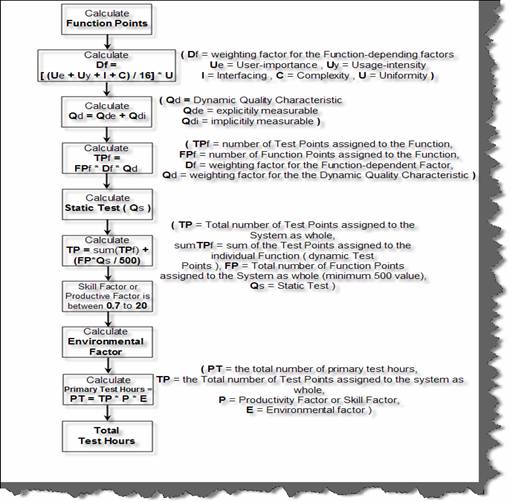
Figure: - TPA steps.
Step 1- Calculate function points
Note: - You will not able to follow this if you have not read the function points explanation previously.
EI calculation
Below are the EI entries for the accounting application. Currently we have two screens one is the master screen and one is the voucher transaction screen. In the description we have also described which DET’s we have considered. For the add voucher screen we have 7 DET (note the buttons are also counted as DET) and for the Account code master we have 4 DET.
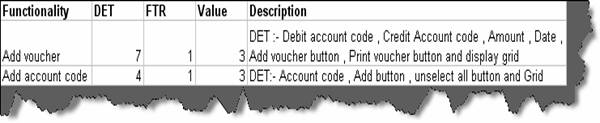
Figure: - EI for the accounting application
EIF
There are no EIF’s in the system because we do not communicate with any external application.

Figure: - EIF for the accounting application
EO
EO’s are nothing but complex report. In our system we have three complex reports Trial balance, Profit and loss and Balance sheet. By default we have assumed 20 fields which makes it a complex report (When we do estimation some times assumptions are fine).

Figure: - EO for the accounting application
EQ
EQ’s are nothing but simple output sent from the inside of the application to the external world. For instance simple report is typical type of EQ’s. In our current accounting application we have one simple print that is the print voucher. We have assumed 20 DET’s for the same so that we can move ahead with the calculation.

Figure: - EQ for the accounting application
GSC calculation
As said in the FPA tutorial previously GSC factor defines the other factor of the projects which the FP counting does not accommodate. For the accounting application we have kept all the GSC factors are 1 except for two GSC factor Data communications and performance. We have kept communication as 2 because one the requirement point is that we need application data to be accessed from multiple centers which increases the data communication complexity. Other GSC factor we have considered a bit complex is the performance because one of the requirement of the end customer is that performance should be averagely good. Below figure shows the GSC entries.
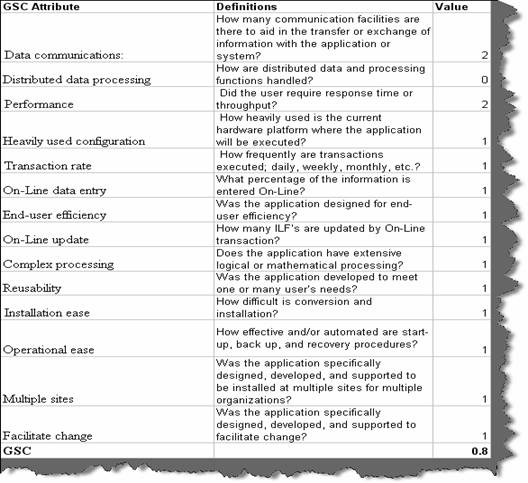
Figure: - GSC factors for accounting application
Total calculation
Now that we have filled in all the details we need to calculate the total man days. Below is the image which will explain us how the calculations are done. The first five rows i.e. ILF, EIF, EO, EQ and EI are nothing but total of the individual entries. A total unadjusted function point is the total of ILF + EIF + EO + EQ + EI. We get the total adjusted function which is nothing but Total Un-Adjusted function points multiplied by the GSC factor. Depending on organization base line we define how much FP can be completed by a programmer in one day. For instance for the below accounting application we have put 1.2 FP per day. Depending on the FP per day we get total man days. Once we have got total man days we distribute these values across the phases. One of the very important thing what we have just got is the total execution time. So we have assigned the total man days to the execution phase. From the execution phase man days we distribute 20 percent to requirement phase, 20 percent to technical design and 5 percent to testing.
Note :- We will answer a small and sweet answer in this mid of the explanation.
If you want to buy the project management book mail
[email protected] for
more details or call any of our book shops MUMBAI-22078296/97/022-22070989,
KOLKATA-22826518/19 HYDERABAD-24756967,24756400,BANGALORE-25587923,
25584641,AHMEDABAD-26421611,BHATINA(PUNJAB)-2237387,CHENNAI-28410796,28550491,DELHI/NEWDELHI-23254990/91,23325760,26415092,24691288.If
you want to write to the author directly email at
[email protected]