If you want to buy the project management book mail
[email protected] for
more details or call any of our book shops MUMBAI-22078296/97/022-22070989,
KOLKATA-22826518/19 HYDERABAD-24756967,24756400,BANGALORE-25587923,
25584641,AHMEDABAD-26421611,BHATINA(PUNJAB)-2237387,CHENNAI-28410796,28550491,DELHI/NEWDELHI-23254990/91,23325760,26415092,24691288.If
you want to write to the author directly email at
[email protected]
Home
XP development cycle consists of two phases one is ‘Release
Planning’ and the other is ‘Iteration Planning’. In release planning we decide
what should be delivered and in which priority. In iteration planning we break
the requirements in to tasks and plan how to deliver those activities decided in
release planning. Below figure ‘Actual Essence‘ shows what actually these two
phases deliver.
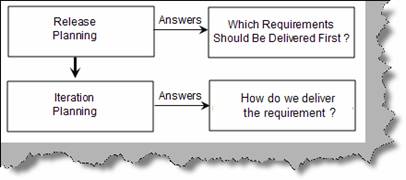
Figure: -
Actual Essence
If you are still having the old SDLC in mind below figure
‘Mapping to Traditional Cycle’ shows how the two phases map to SDLC.
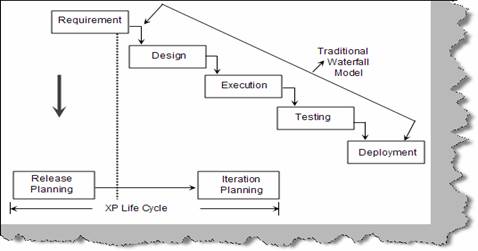
Figure: -
Mapping to Traditional Cycle
So let’s explore both these phases in a more detailed
manner. Both phases “Release Planning” and “Iteration Planning” have three
common phases “Exploration”, “Commitment” and “Steering”.
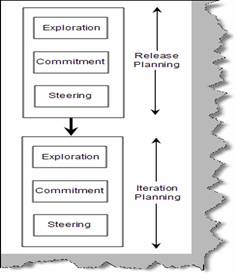
Figure: - XP
Planning Cycle
Release Planning
Release planning happens at the start of each project. In
this phase project is broken in to small releases. Every release is broken down
in to collection of user stories. Now let’s try to understand the three phases
in release planning.
- Exploration: - In this phase requirement
gathering is done by using user story concept (Please read the previous
question on user story to understand the concept of user story). In this
phase we understand the requirement to get higher level understanding.
Please note only higher level. User story card is size normally 3 X 5 inch,
so you can not really go detail in that size of card. We think it’s
absolutely fine rather than writing huge documents it sounds sense to have
to the point requirement paragraphs. So here is a step by step explanation
of how the exploration phase moves :-
- So the first step is user writes the story on the
user card.
- Once the story is written the developer analyzes
it and determines can we estimate the user story?. If the developer can
not estimate then it’s again sent back to user to revise and elaborate
the user story.
- Once the user story is clear and can be estimated,
ideal day or story (read about story point, ideal day and estimation in
the coming questions) are calculated.
- Now its time to say the user, ok we can not
deliver everything at one go, so can you please prioritize. So in this
phase the end user gives ranking to the user stories (In the next
section we will deal with how a user story is ranked).
- Once the user is done with story prioritization,
its time to calculate velocity determination (In the coming section we
have one complete question on velocity determination).
- Agile is all about accepting end customer changes.
In this phase we give a chance to the end user to decide if they want to
change anything. If they want to change we again request the user to
update the story.
- If everything is ok we go ahead for iteration
planning.
Below figure “Release planning” shows the above discussed
steps in a pictorial format.
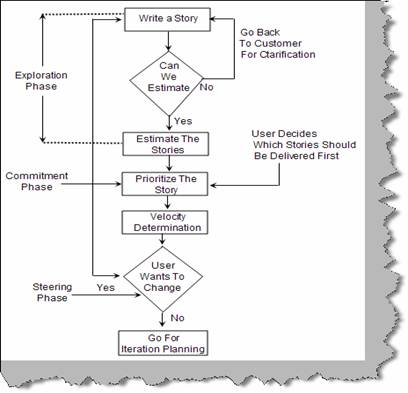
Figure: -
Release Planning
Iteration Planning
Iteration planning is all about going deep in to every user
story and breaking the same in to tasks. This phase can also be termed as
detailing of every user story. Iteration planning is all about translating the
user story in to task. Below are the steps in details for iteration planning:-
- User stories which need to be delivered in this
iteration are broken down in to manageable tasks.
- Every task is then estimated. The result of the
estimation is either ideal hours or task points (we will discuss about task
point and ideal hours in the coming section).
- After the tasks are estimated we need to assign the
task to developers. Each programmer picks a task and own responsibility to
complete the task.
- Once he owns the responsibility he should estimate the
same and commit to complete the same.
- In XP on any development task two developers should
work. In this phase the developer makes partner of his choice for developing
this task.
- In this phase we do designing of the task. We should
not make lengthy and comprehensive design plans; rather it should be small
and concentrated on the task. In traditional SDLC we have full devoted phase
for designing and the output is a lengthy and complicated design document.
One of the important characteristic of a software project is that as we come
near execution we are clearer. So it’s best to prepare design just before
execution.
- Now that you and your partner are familiar with the
design plan its time to write a test plan. This is one of the huge
differences as compared to original traditional SDLC. We first right the
test plan and then start execution. Writing test plans before coding gives
you a clear view of what is expected from the code.
- Once the test plan is completed its time to execute
the code.
- In this phase we run the test plan and see that if all
test plan pass.
- Nothing is perfect it has to be made perfect. Once you
are done with coding, review the code to see if there is any scope of
refactoring (Refactoring is explained in more depth in the coming sections).
- We the run the functional test to ensure everything is
up to the mark.
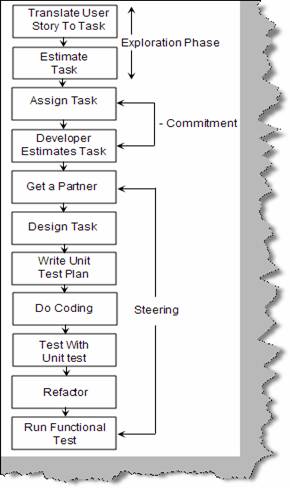
Figure: -
Iteration Planning
One of the important points to realize is project is broken
down in to set of releases à which
is further analyzed using short user stories
à user stories are further broken in
to task ,which is estimated and executed by the developer. Once one release is
done the next release is taken for delivery. For instance the below project
shown in figure ‘Release, Stories and Task’ has two releases one and two.
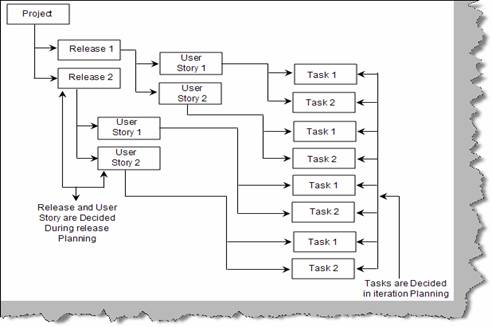
Figure: -
Release, Stories and Tasks
If you want to buy the project management book mail
[email protected] for
more details or call any of our book shops MUMBAI-22078296/97/022-22070989,
KOLKATA-22826518/19 HYDERABAD-24756967,24756400,BANGALORE-25587923,
25584641,AHMEDABAD-26421611,BHATINA(PUNJAB)-2237387,CHENNAI-28410796,28550491,DELHI/NEWDELHI-23254990/91,23325760,26415092,24691288.If
you want to write to the author directly email at
[email protected]
Home