If you want to buy the project management book mail
[email protected] for
more details or call any of our book shops MUMBAI-22078296/97/022-22070989,
KOLKATA-22826518/19 HYDERABAD-24756967,24756400,BANGALORE-25587923,
25584641,AHMEDABAD-26421611,BHATINA(PUNJAB)-2237387,CHENNAI-28410796,28550491,DELHI/NEWDELHI-23254990/91,23325760,26415092,24691288.If
you want to write to the author directly email at
[email protected]
COCMO (Constructive Cost Model) is a parametric estimation model. It is not a size measurement methodology. On the contrary its takes in size and then applies non-functional characteristics of a project. When we say non-function characteristic we mean by:-
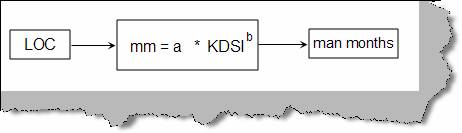
The above things can not be measured. So what COCOMO does is it take size as a parameter and applies these non-functional aspects of the project. In short it is a formula. The size input is LOC and the effort output is in man months. Below figure shows how COCOMO works. It takes LOC and gives the effort in man months.
Figure: - Basic COCOMO
Before we go in depth of the above formula, let's understand the principle on which COCOMO works. COCOMO says that any software has two aspects to be considered for estimation. One aspect is the complexity of the software and the other project development mode.
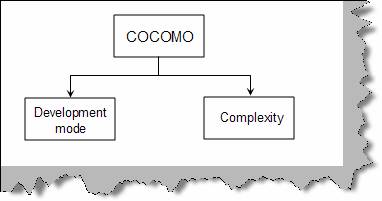
Figure: - COCOMO Estimation view
Complexity Aspect
COCOMO views two types of complexity in a software project, one is the multiplicative complexity and the other is the exponential complexity. Exponential complexities of a project are those aspects, if they change slightly the estimation changes in a very huge manner. Multiplicative complexities are those aspects if they change only a proportional changes happen to estimation. For instance a changing customer issue is an exponential factor while a new technology is a multiplicative factor.
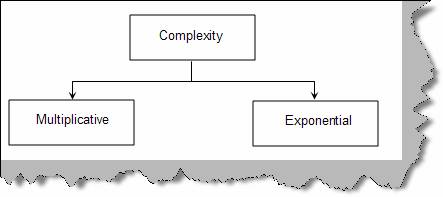
Figure: - COCOMO Complexity
Below is the formula for COCOMO.
a: - This coefficient represents multiplicative complexity.
b: - This coefficient represents exponential complexity.
KDSI: - KDSI is the delivered source instruction. In short they are physical lines of code.
MM: - Man month i.e. one month of effort by one person or one staff.
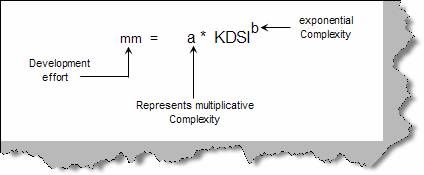
Figure: - COCOMO Formulae
Project development mode
The above two coefficients 'a' and 'b' depends on project development mode. Below figure ‘Development mode table’ shows the different development mode. There are basically three development modes which are decided on basis of size, innovation, how is the deadline and the development environment. Depending on the same we have given values for 'a' and 'b'. There is one more coefficient introduced 'c' which will be used to calculate development time.
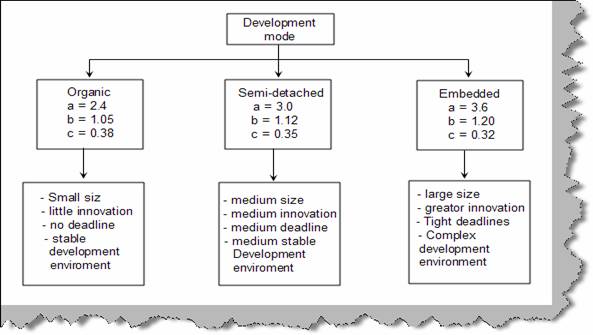
Figure: - Development mode table
To calculate development time below is the formulae. So from the first formula we need to calculate the MM (man month) which is then fed in the below formula effort and development time.
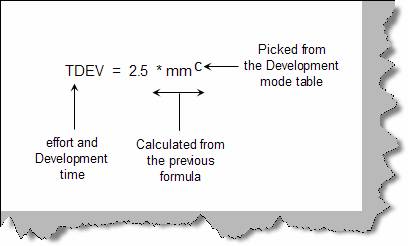
Figure: - Effort and Development time
Let's try to understand COCOMO with small sample. Below figure ‘Sample Calculation’ explains the same in a more detailed manner. We have considered development mode as organic and 1000 lines of code. There are two steps first we get the "MM" and then we use the same to calculate ‘TDEV’. For coefficient value 'a','b' and ‘c’ we have referred the figure 'Development mode table'. As we have considered organic so a=2.4, b=1.05 and c=0.38. So MM is 3390 and using the same we calculate TDEV which comes around 54 man months.
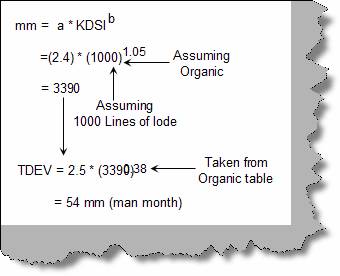
Figure: - Sample Calculation
If you want to buy the project management book mail
[email protected] for
more details or call any of our book shops MUMBAI-22078296/97/022-22070989,
KOLKATA-22826518/19 HYDERABAD-24756967,24756400,BANGALORE-25587923,
25584641,AHMEDABAD-26421611,BHATINA(PUNJAB)-2237387,CHENNAI-28410796,28550491,DELHI/NEWDELHI-23254990/91,23325760,26415092,24691288.If
you want to write to the author directly email at
[email protected]