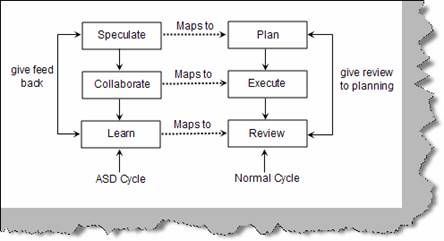
ASD (Adaptive Software Development) accepts that change is a truth. It also accepts in principles that mistakes can happen and it’s important to learn from those mistakes in the future. Below figure ‘ASD Cycle’ shows three important phases in ASD.
Figure: - ASD Cycle
Let’s understand all the three phases in a detail manner.
Speculate (nothing but planning):- This is the planning phase of ASD cycle. Below figure ‘Speculate’ shows in detail what happens in this phase.
Define Project Scope: - This is the first phase in the main speculate phase. In this we set the main goals and what’s the scope of the entire project.
Set Time for Scope: - Timelines are decided for the scope identified in the previous phase.
Decide the number of iterations: - Depending on the time lines and the scope we identify how many iterations will the project have.
Break Scope to tasks: - In this section we break the scope in to tasks. Tasks are nothing but development activity which a developer has to do to complete the scope.
Assign task to developers: - Assign those task to developer.
Now that we know who will do what task, its time for coding / execution.
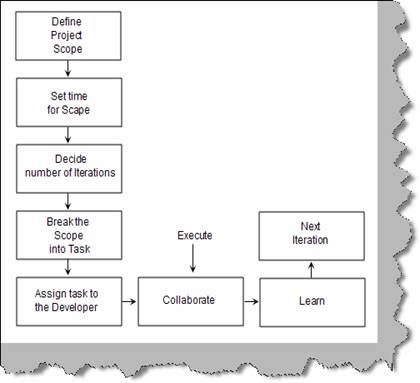
Figure: - Speculate
Collaborate (coding / execution):-Execute as per the task and test it.
Learn (Review and give feedback to planning):- At the end of iteration see what lessons we have learnt and apply the same for the next iteration.
Note: - From all the methodologies shown above, XP is the most used for Agile. One of the important points to be noted about all the XP methodologies described above is that every body believes in accepting change. Principles of all the agile methodologies are more or less same. So do not get confused just understand what every methodology concentrates on. For instance FDD plans around features, Scrum uses product owner and catalog for describing a project, DSDM gives importance to RAD. So understand the main theme of the methodologies but yes the common acceptance is every one believes on ‘Accepting Changes’.
Dear readers we must have surely left out something. If you think any question or section which is not attended in this book please email us at [email protected] , we will try to cover the same in the second edition.
Below are some more books which we have written for IT industry, if you are interested in buying any one of them please contact [email protected] for more details.