Fertilisers feed plants, but the soil itself is not as healthy as it might be, the chemicals we put on our soils can adversely affect beneficial organisms such as worms. Organic gardeners believe in feeding the soil, not the plant. A well-structured fertile soil produces healthy, disease resistant plants, reducing your need to resort to further chemicals later in the season.
Producing your own compost or leaf mould, are the best ways of improving your soil. Peat gives structure but no nutrients, fertiliser gives nutrients but no structure. Compost does both. You can regulate exactly what goes into the compost heap but best of all IT'S FREE!! You'll be reducing your impact on the ever decreasing bogs and moors of the UK and Ireland by using alternatives to peat, and will need to water your garden less often as the compost will retain moisture for you.
Garden centres offer an increasing range of alternatives to peat for mulching, and many local authorities are able to supply recycled organic waste. In the New Forest area, the Forestry Commission is supplying a very good peat substitute in the form of composted bracken. See the chart inside for other peat alternatives.
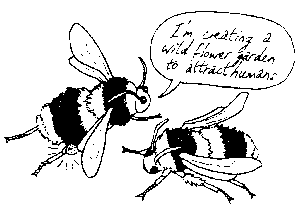
Many garden visitors help our in the garden
Companion planting is used to encourage the growth of particular plants in your garden. An example is attracting beneficial insects for pest control of aphids by using poached egg plants to attract hoverflies. Other plants repel insects which may harm some of your crops, others embody natural toxins that can be transmitted to the advantage of specific neighbouring plants. Refer to the table inside this leaflet for specific advice on companion planting.
If you have room for a few beds, crop rotation will help to avoid a build-up of pest and diseases. Old tricks such as planting legumes to provide a nitrogen enriching experience for the soil still work as well as they ever did, (as well as providing a tasty crop of peas!) Preventing the spread of disease is always better than curing it.
The important point is to use your imagination - use a shelf for a bird table and create miniature habitats in pots.
Weeds, left unchecked, will obviously compete with your crops for nutrients and moisture but, even with these, a little judicious tolerance may well pay dividends. Some weeds can be said to be wild flowers' in the wrong place! Red campion and groundsel are both appreciated by bees, whilst clovers, chickweed and plantain (which contains a free supply of potassium, magnesium and calcium) might be left as overwintering ground cover before being dug-in or composted in the early spring. If you want to encourage butterflies, patches of stinging nettles, kept within bounds in bottomless buckets, are almost a must. Trim them back frequently to encourage new growth, and use the leaves steeped in water and then strained, as
a nitrogen-rich liquid feed.
This leaflet is far too small to give all the advice needed to 'go organic' The Henry Doubleday
Research Association (HDRA) produces many leaflets on the subjects covered in this leaflet.
If you wish to receive more information, please contact the UWP office or HDAR direct on
01203 303517. We have free copies of the 'Go Organic' pack and other leaflets from HDRA
which contain a wealth of invaluable information.