In 1965, Gordon Moore was preparing a speech about computer memory. When he was looking at a graph of the capacity and complexity of memory chips, he noticed a pattern forming in the graph. He noted that each chip had about twice the capacity of the previous chip, and was released within a 18 to 24 month period of each other. He noted that if this trend were to continue, computing power would increase exponentially over a relatively short period of time. This trend became known as Moore's Law.
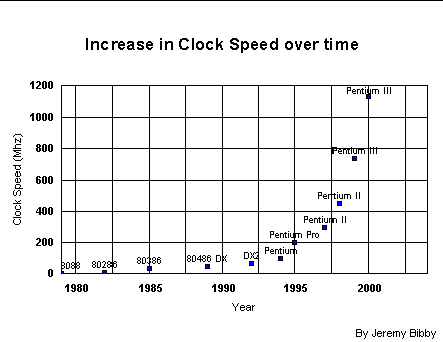
The trend predicted by Moore still continues today in all areas of computing, especially in the areas of the CPU, and in memory. For example, the maximum clock speed of microprocessors has increased dramatically from 102 kHz in 1971 with the Intel 4004, to 1.13 gHz in 2000 with a Pentium III (with the Pentium 4 suspected to have a clock speed of at least 1.4 gHz when it is announced later this year (see Acrobat presentation)), an increase of over 11,000 times (or 13,750 times with the P4). Here is a graph showing the increase in clock speed from the 8088 to the Pentium III 1.13 gHz.