Nuclear Energy
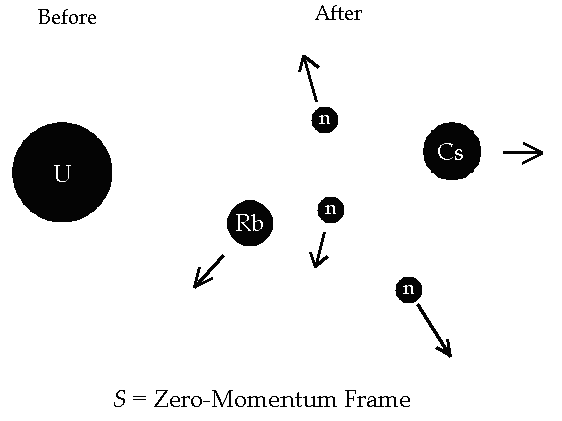
The relationship between mass and energy can be understood more readily by considering the energy released in nuclear fission. Consider the spontaneous fission show below, which takes place in frame S.
Note - The nucleus is at rest prior to fission and therefore the frame S is the zero-momentum frame.
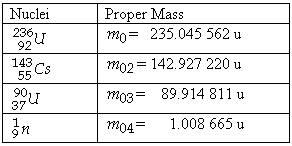
Note: 1 u � 931.48MeV/c2
Mi � initial mass of system
Mf � final mass of system
M0i � Total (i.e. sum of) initial rest mass of system
M0f � Total (i.e. sum of) final rest mass of system
U = Energy released from fission = Potential energy associated with fission fragments in the initial bound state
Mass is conserved during such a process of the same reason that energy is conserved. Therefore the initial mass of the system must equal the final mass of the system
Mi = Mf = m0 = 236.045 562


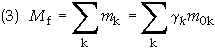
where
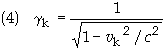
vk = speed of the kth particle, mk = gk m0k = mass of kth particle. Since mass is conserved it follows that Mk = Mf. Therefore we can equate Eq. (2) and (3) to give
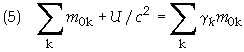
Solving for U gives
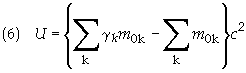
The Q of a reaction is defined as

Therefore the Q of this reaction is

The energy of a free moving particle is the sum of its kinetic energy and its rest energy. Therefore

K � total kinetic energy (i.e. sum of kinetic energies). Solving for K gives

Therefore the Q of the reaction is the total kinetic energy of the fission fragments.
Note: If any photons are produced during nuclear fission then they are treated as particles with zero rest mass. The energy is treated as kinetic energy).