Michelson-Morely Experiment
It appears to have been Descartes who first introduced the “ether concept. The ether was something that was thought to be a material medium that filled all of space and was the transmitter of otherwise inexplicable actions, such as the action of a magnet on iron fillings. Newton at one time thought of the ether as that which communicated the action of gravity through the space between bodies. Newton’s contemporaries, e.g. Hooke and Huyghens, imagined that it was the ether that supported the propagation of light through space. Later on, when he had formulated the theory of electromagnetism and predicted that light was an electromagnetic wave, Maxwell resurrected the idea of the ether to be, that which was doing the “waving” to support the propagation of electromagnetic waves. This medium was had also come to be called the “luminiferous ether”. It was with respect to this medium that light moved.
In 1879 Maxwell wrote in a letter that experiments to detect the speed of light through the ether were possible. Albert Michelson had come to learn of this letter and took it as a challenge to devise just such an experiment. He was determined to measure the speed of the Earth relative to the ether. During the winter of 1880-1881 Michelson went to work in Germany to study in the lab of Hermanm Helmholtz. During this visit Michelson invented an optical amplitude-splitting interferometer that has become known as the Michelson Interferometer.
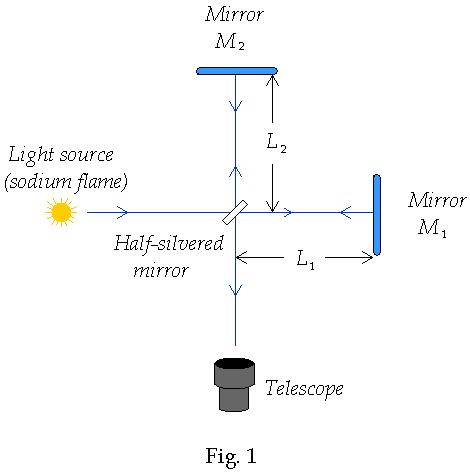
An optical amplitude-splitting interferometer is a device that splits a light wave into two beams by a beam splitter. As observed in the rest frame of the interferometer, one portion of the wave travels straight through the beam splitter, reflects off of a mirror, M1, and travels back to the beam splitter where it is again reflected into a telescope. The other portion of the original wave is reflected by the beam splitter wherein it travels to another mirror, M2, where it is reflected and returns along its original path. Part of the returned wave travels straight through the beam splitter and also enters the telescope. Due to the wave nature of light, when the beams recombine an interference pattern will be seen, through the telescope, that corresponds to the difference in propagation times between the two waves. This time difference results in a phase shift that is observed through the interference pattern. No time difference, no phase shift, no interference pattern. A schematic diagram of the Michelson’s interferometer is shown below in Fig. 1
In 1885 Michelson took a position at what is now called Case-Western University. There he met the chemist Edward Morley and the two of them started working on what has become known as the Michelson-Morley experiment [1]. In June 1887 the experiment was carried out over a 5-day period. The experiment is described as follows: Assume the luminiferous ether exists and the interferometer is moving through it with speed v to the right that will be referred to as the +x direction. There will be ether wind present which moves from right to left with speed v. Light that passes straight through the beam splitter, i.e. the beam moving from left to right in the above diagram, will move with an effective speed c+ = c - v after the light passes through the beam splitter. Upon striking mirror M1 the light will be reflected and will then move in the -x direction the with speed c- = c + v. The total round trip time T1 from beam splitter to M1 and back to beam splitter will be

We now choose the rest frame of the ether to find an expression for the round trip time, T2, second beam that travels perpendicular to the motion of the interferometer. In the ether frame the interferometer is moving to the right with speed v. The light is observed to travel in a triangular path as shown in Fig. 2
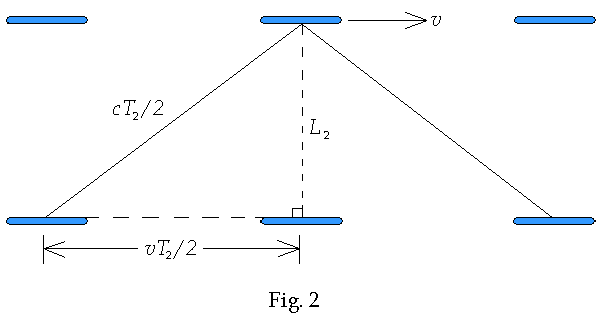
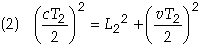
Using the Pythagorean theorem we can read off the following relation from the diagram
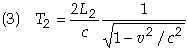
Solving for T2 gives
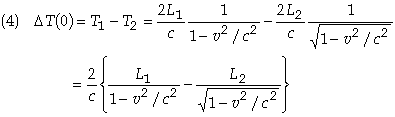
The difference in these time intervals is then found to be
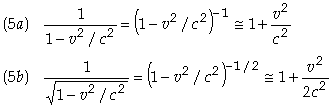
If we assume that the ether wind is much less than the speed of light, i.e. v << c then we can make the following approximations using the relation
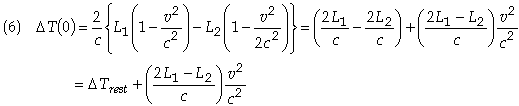
The first term on the right side of Eq. (6), i.e.
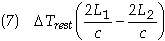
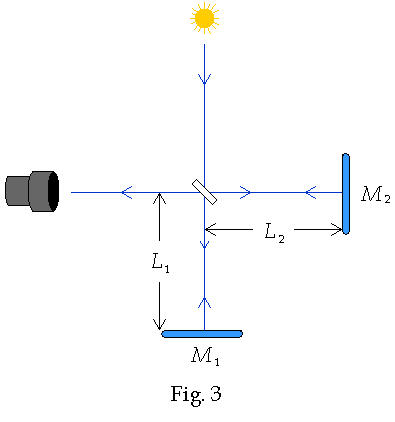
is the time difference when the interferometer is at rest with respect to the ether. The time difference DT(0) in thus seen to depend on two factors. The second factor is a function of the speed of the interferometer through the ether. Thus a non-zero ether velocity will result in a time difference. However, since the first factor is a function of the difference in lengths of the interferometers two arms the time difference will be non-zero for a zero velocity ether wind simply because the lengths of the arms are not the same length. Michelson and Morley circumvented this problem by placing the interferometer on a rotating platform and rotating it such that arm 2 is parallel to the velocity of the ether and arm 1 is perpendicular to the velocity. See Fig. 3
To find the new time difference use the procedure above. This amounts to replacing L1 with L2.
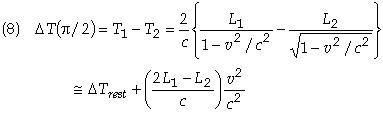
The difference between these two differences is now found.The DTrest term cancels out leaving

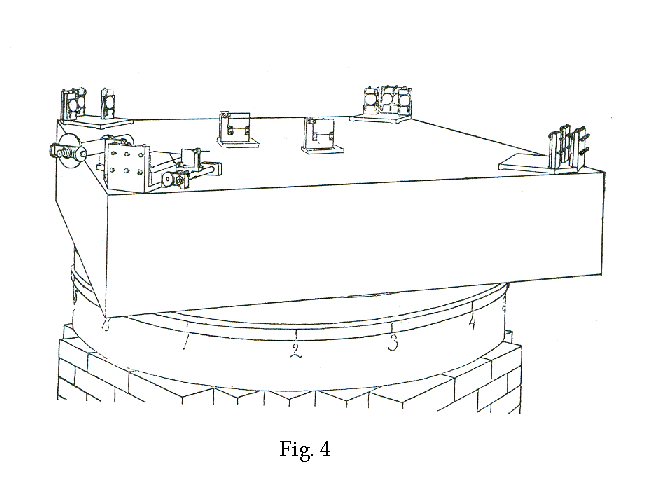
DT is much less sensitive to differences in arm lengths and thus when the interferometer is rotated a shift in frequencies, and hence a change in the interference pattern formed as a result, will be easily measurable. The actual interferometer is shown below in Fig. 4
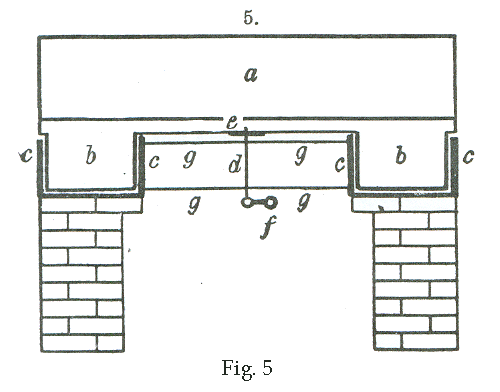
In their first experiment, Michelson and Morley encountered two difficulties. The first difficulty was optical distortions that were produced as a result of rotating the platform on which the interferometer rested. The second problem was due to the extreme sensitivity to vibration. The first problem was resolved by placing the apparatus on a massive stone that was then floated on a pool of mercury. See Fig. 5
The second difficulty was overcome by increasing the optical path length by repeated reflections as shown below in Fig. 6
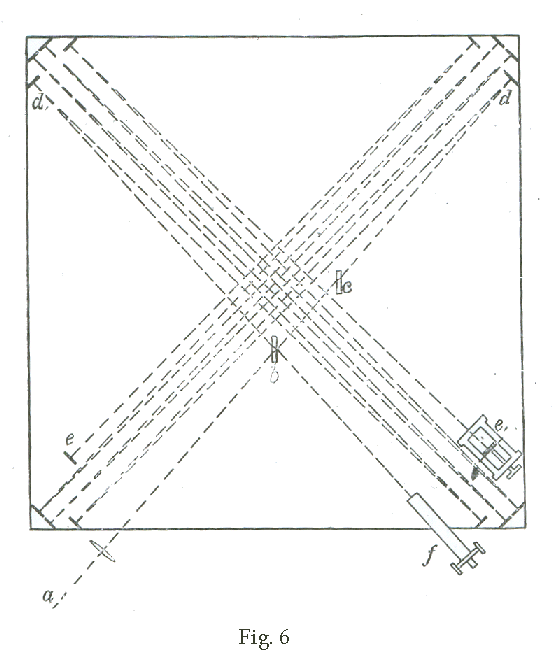
If it is assumed that the solar system is at rest in the ether then the speed of the Earth moving through ether is v = 29,750 m/s. The effective optical path length of each arm is 11 m. This gives a DT of 0.3x10⁻¹⁵ s. This corresponds to a wavelength of 100 nm. The wavelength of the light from the sodium flame is 590 nm. Therefore the effect they were looking for was well within the sensitivity of the interferometer. However no fringe shift was found! The experiment was repeated later in the year when the Earth was in a different position in its orbit. There was still no shift detected.
[1] On the Relative Motion of the Earth and the Luminiferous Ether, Albert A. Michelson, Edward W. Morley, American Journal of Science - Third Series, Vol. 34, No. 203, Nov. 1887.