where m
is the inertial mass of the particle and p it’s 3-momentum. Let the
components of P be represented in the two inertial frames S and S’,
respectively, as
where m
is the inertial mass of the particle and p it’s 3-momentum. Let the
components of P be represented in the two inertial frames S and S’,
respectively, as Conservation of Mass
The 4-momentum of a particle is defined as where m
is the inertial mass of the particle and p it’s 3-momentum. Let the
components of P be represented in the two inertial frames S and S’,
respectively, as
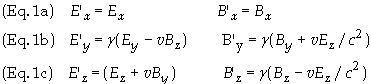
As observed from S and S’ consider a system of particles that interact at a single event (or a small region of spacetime) and which don’t interact otherwise, or at most through contact forces. Let there be n particles prior to the interaction and p particles after the interaction. It is postulated that the total 3-momentum p = mu is conserved in all frames, in S and S’ in particular. Since p is the spatial portion of P the conservation of momentum in S and S’ takes the forms (assuming that all particles move speeds less than or equal to the speed of light)
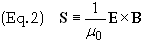
For each particle j
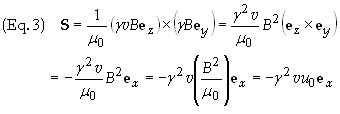
L represents the Lorentz transformation from S to S’. Substitute Eq. (3) into Eq. (2b) to give
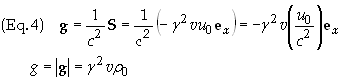
Eq. (2b) implies that Eq. (4a) and Eq. (4b) can be equated to yield

Eq. (5) can be arranged to give

According to Eq. (2) the right hand side of Eq. (6) vanishes. Since each side must hold in general this implies that

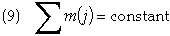
Since P0(j) = m(j)c it follows that Eq. (7) can be written as

Eq. (8) states that the total mass of an isolated system, as observed from an arbitrary inertial frame S, is conserved, i.e.