Lorentz
4-Vectors
Back to Physics World
Back to Special Relativity
The
Position 4-vector as Prototype for the Lorentz 4-Vector
Recall
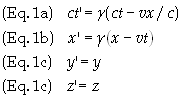
the Lorentz transformation,
Eq.
(1a) has been multiplied through by c so as to conform to standard
notation thus giving all terms on the left side of Eq. (1) units of distance.
Note that the spatial coordinates for these coordinate systems are Cartesian
coordinates i.e. the spatial location of the event is denoted as (x, y, z)
where the spatial coordinate axes form an orthogonal coordinate system.
The set of coordinates (ct, x, y, z), when chosen to represent an
inertial frame of reference, are called Lorentz coordinates.
X º
(ct, x, y, z) represents an event in spacetime.
In special relativity (where spacetime is flat) it is also known as the position
4-vector which serves as the prototype for the Lorentz 4-vector. From
herein when the term 4-vector is used unqualified it will refer to a
Lorentz 4-vector. The position 4-vector is the displacement of an event from an
event chosen as a reference event known as the origin of the coordinate
system. A useful way to write the components of 4-vectors is by using
a kernel letter as the base symbol and let both superscripts or subscripts in S
have no over-bar while in S’ have an over-bar. In terms of coordinates in S
the event X can be expressed as X = (x0,
x1,
x2,
x3).
In this case the kernel is the letter x. x0
º
ct, x1 º x, x2
º
y, x3 º z. In terms of coordinates in S the
event X can be expressed
 .
.
Definition:
A 4-vector A º
(A0,
A1,
A2,
A3),
is defined as any object whose components transform in the same way as the
components of the position 4-vector X
= (x0,
x1,
x2,
x3).
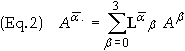
I.e. A is a 4-vector if and only if the components of A map from
the Lorentz coordinates in S to Lorentz coordinates in S’ such
that
Note:
The kernel in this case is the letter A.
Definition:
Einstein’s summation convention: When indices that appear twice
in a term, once as a superscript and once as a subscript, then one sums over all
values that the index can take on. If the index is a Greek letter then the
values are 0 to 3. If the index is a Latin letters then it takes on the values 1
to 3. Therefore we can express Eq. (3) as

4-Vectors
in Matrix Form
Let S’ be a Lorentz coordinate system which is moving in the +x
direction relative to S with speed v. In such cases the frames S
and S’ are said to be in standard configuration. Then in S’
components are
 . Thus the Lorentz transformation maps the components of an event from one
Lorentz coordinate system, S, to another, S’. In this example
the kernel is the letter x. Eq. (1) can be expressed in a more compact
form using the three matrices
. Thus the Lorentz transformation maps the components of an event from one
Lorentz coordinate system, S, to another, S’. In this example
the kernel is the letter x. Eq. (1) can be expressed in a more compact
form using the three matrices
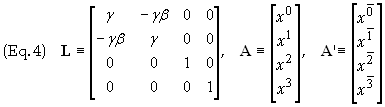
It is to
be noted that A’ does not represent a different 4-vector than A.
Rather it represents the same 4-vector with the only distinction being
that the components are represented in the coordinates of S’. The
matrix L is known as the Lorentz transformation matrix. We can now
express Eq. (1) in terms of the terms defined in Eq. (3). The result is

Example:
4-momentum
For a
particle moving a speed v, the free-particle energy/inertial-energy,
often denoted by the symbol E, is defined as the sum of the particle’s
inertial energy and kinetic energy, i.e. E = Inertial Energy + Kinetic
Energy = E =
m c2=gm0c2
+ K where
 where b
º
v/c. The m is called the inertial
mass of the object (i.e. that property of an object which resists
changes in momentum). m0
is called the particle’s proper mass (aka rest mass). The value of the proper mass is
defined as
where b
º
v/c. The m is called the inertial
mass of the object (i.e. that property of an object which resists
changes in momentum). m0
is called the particle’s proper mass (aka rest mass). The value of the proper mass is
defined as

It was Einstein and others, such as Planck [1], Tolman [2] and Lewis [3],
who demonstrated that the energy of a free object is related to its inertial
mass by E =
mc2
= gm0.
It is noteworthy to mention that many recently published physics
textbooks as well as relativity textbooks, the symbol m is used to refer
to the particle’s proper mass, which the author’s simply denote as mass.
As such the relation with these symbols becomes E
=
gmc2.
The transformation
equations , used for transforming mass/energy and momentum from one inertial
frame S to another inertial frame S’ moving in the +x
direction with speed v, are
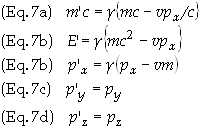
Eq. (2)
is in the form of a Lorentz transformation. It
maps the energy, E, and 3-momentum, p, of a free object
from S and S’. The coordinates of the 4-momentum are
therefore defined as P º
(mc, px,
py,
pz)
= (mc, p) = (P0,
P1,
P2,
P3)
where p º
(px,
py,
pz)
is the linear momentum 3-vector.
Definition:
A 4-vector, A º
(A0,
A1,
A2,
A3),
is defined as any object whose components transform in the same way as the
components of the spacetime event X
º (ct,
x, y, z) = (x0,
x1,
x2,
x3).
I.e. A is a 4-vector if and only if

where
Einstein’s summation convention is used: indices which appear twice in a term
are to be summed over all values that the index can take on. If the index is a
Greek letter then the values are 0 to 3. If the index is a Latin letters then it
takes on the values 1 to 3.
Magnitude
of a 4-vector
Using
Eq. (3) it is easy to show by simple substitution that

With this equation in mind
the magnitude of a 4-vector is defined as

In terms of the metric
tensor, h,
Eq. 10 can be expressed as

where
hab
are the components of the
metric tensor in Lorentz coordinates. When the spacetime is flat and
represented in a Lorentz coordinate system then h
is called the Minkowski Metric.
Scalar
Product of two 4-vectors
The
scalar product of two 4-vectors is defined as

In terms
of the components of the Minkowski metric Eq. (12) can be written more compactly
as

The
scalar product of two vectors is invariant as will now be demonstrated. Consider
the 4-vector defined as C = (A + B)·(A
+ B) . The square of the C is given by

It was
shown above that the magnitude of C2
is invariant. Since A2
and B2
are also invariant then if follows that A·B
is also invariant.
[1] Das Prinzip der
Relativitat und die Grundgleichungen der Mechanik, Max Planck, Verhandlungen
der Deutschen Physikalischen Gesellschaft, 4 131, 136-141 (1906).
[2] Non-Newtonian Mechanics: The mass of a moving body, R.C. Tolman, Philosophical
Magazine, 23, (1912), pg. 375-380.
[3] The Principle of Relativity and Non-Newtonian Mechanics, R.C. Tolman
and G.N. Lewis, Philosophical Magazine, 18, (1909), pg. 510-523.