Four-Vectors
Lorentz Four-Vectors:
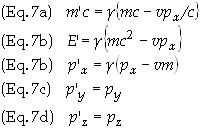
For a particle moving with a speed v relative to the inertial frame S, the free-particle energy (aka inertial energy) Ef, is defined as the particle's kinetic energy K and he rest energy E0 and can be expressed in terms of the mass m as Ef, = mc2 where m is the particle's inertial mass and has the value m = gm0 where m0 is the particle's proper mass. As stated above Ef = K + E0. The transformation equations used for transforming mass, energy and momentum from one inertial frame S to another inertial frame S' which is moving in the +x direction are
where  ,
b º
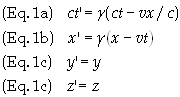
v/c. Eq. (1) has the form of the Lorentz
transformation, the transformation which maps the coordinates of an event, X
º
(ct, x, y, z), in the inertial frame S to the inertial frame S'.
This transformation gives
,
b º
v/c. Eq. (1) has the form of the Lorentz
transformation, the transformation which maps the coordinates of an event, X
º
(ct, x, y, z), in the inertial frame S to the inertial frame S'.
This transformation gives
This can be rewritten in terms of b and g as

The differential version of this is found simply by replacing the variable by its differential. I.e. replace x by dx. Eq. (3) can be expressed in a more compact form using the three matrices
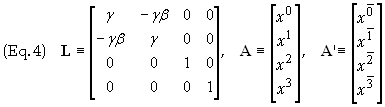
It is to be noted that X' does not represent a different event than X but that it represents the same event as recorded in a different coordinate system. The matrix L is the Lorentz transformation matrix. The Lorentz transformation, Eq. (3) can now be written as

where the usual rules for matrix multiplication apply. In component form Eq. (3) is

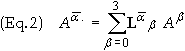
A Lorentz 4-vector, A º (A0 ,A1 ,A2 ,A3 ), is defined as any object whose components transform in the same way as the components of the spacetime event X º (ct, x, y, z). I.e. A is a Lorentz 4-vector if and only if
where Einstein's summation convention is used: indices which appear twice in a term are to be summed over all values that the index can take on. If the index is a Greek letter then the values are 0, 1, 2, 3. If the index is Latin then it takes on the values 1, 2, 3. Using the differential form of Eq. (3) it is relatively easy to show by a simple substitution that

The spacetime interval, ds2 , is defined as

where hab are the components of an object h known as the metric tensor. These components are defined, in matrix notation, as hab = diag(1, -1, -1, -1). This remains unchanged upon a Lorentz transformation. Also introduced in Eq. (8) is he notation dxm º (dx0 ,dx1 ,dx2 ,dx3 ) = (cdt, dx, dy, dz). Comparing Eq. (8) with Eq. (9) it is clear that the spacetime interval remains unchanged by a Lorentz Transformation. Such a quantity is called a Lorentz scalar or an invariant.
E