
Step Potentials
The transmission
and reflection coefficients are defined in terms of the probability current, J,
also known as current density
Consider a
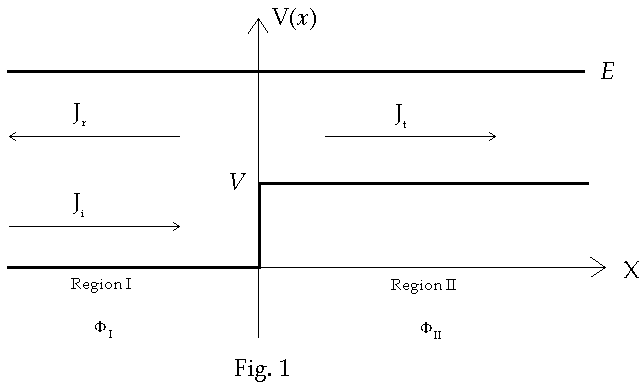
one-dimensional a beam of particles that are plane wave states. The beam is moves in x-direction
and impinges on a barrier as shown in Fig. 1 below
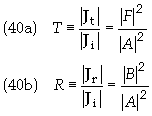
The transmission
coefficient T and reflection coefficient R are defined in terms of the
components of the probability current. Let Ji represent the incoming current, Jt represent the incoming transmitted current,
and Let Jr represent the reflected current

General Case of Step Potential for
E > V
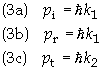
where, in general,
k1 � k2. The potential is constant for x <
0 and for x > 0 so the wavefunction in each domain is that of a free particle.
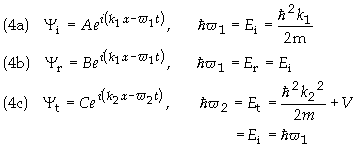
Since energy is conserved it follows that Ei = Et = Er
. The wavefunction
for the incoming, transmitted and reflected beams are, respectively
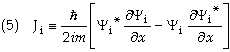
Using Eq. (4a) in
the relation for the current in Eq. (1) gives the x-component of the current
density
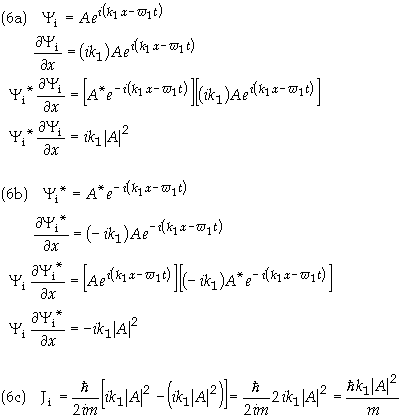
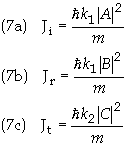
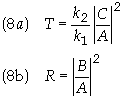
We these values
for the currents the transmission and reflection coefficients become
The
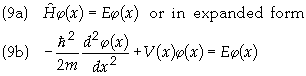
time-independent Schrodinger equation is
For the step
potential shown in Fig. 1 can broken up into two domains. Region I is the domain x
< 0 and Region II is the domain x > 0. The
wavefunction will be partitioned into two parts as well corresponding to each domain. In
Region I the Hamiltonian consists entirely of the kinetic energy term so Eq. (9b) reduces
to

In Region II the Hamiltonian has a kinetic
energy term plus a constant potential

The solution to Eq. (9) and (10) is
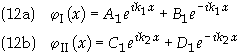
Since the time-independent Schrodinger
equation is second order there must be two boundary conditions. First note that we can set
since it is the coefficient of a wave coming from +infinity and since there is no such
wave we can set D = 0. They are determined by the condition that the wavefunction
and its first derivative must be continuous. Applying this criteria at x = 0 means
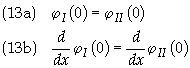
Taking the derivative of Eq. (12) gives
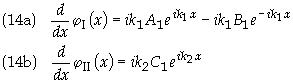
Applying the boundary condition in Eq. (13a)
gives

Appling the boundary condition in Eq. (12b)
gives

Eqs. (15) and (16) can be written simply as
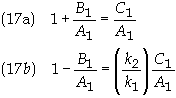
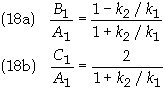
Eq. (17) can be solved for the ratios B1/A1 and C1/A1 to give
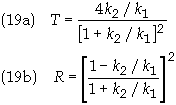
The transmission coefficient can now be
written as
General
Case of Step Potential for E < V
In Region I we
have the same situation as above and therefore the same solution as in Eq. (12a). The
relationship for the reflection coefficient will therefore have the same relation as
above, i.e. R will still be given as in Eq. (8b).
However in Region II the quantity E – V is negative. Therefore

There are two
solutions to Eq. (20), one of which is an exponentially increasing function. This must be
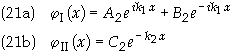
discarded since it leads to a diverging probability density. Therefore the solution is
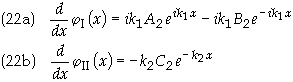
The derivatives
are
Just as above, applying the boundary
condition defined in Eq. (13a) gives

Applying the boundary condition defined in
Eq. (13b) gives

Eqs. (23) and (24) can be written simply as
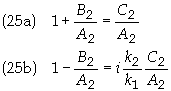
Eq. (25) can be solved for the ratios B2/A2 and C2/A2 to give
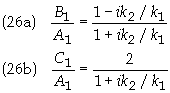
Since the right side of Eq. (26) is of the
form z*/z and therefore | z*/z| = 1. This gives
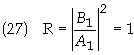
The transmission coefficient is found by
using the relation R + T = 1. It follows that T = 0. This means that the transmitted
current density is zero. The wavefunction in Region II is multiplied by a decreasing
exponential. The wavefunction therefore does not represent a propagating wave. Such a wave
is called an evanescent wave.
Rectangular Barrier and Tunneling:
Case E > V
Consider now a rectangular barrier for which
E > V as shown in Fig. 2
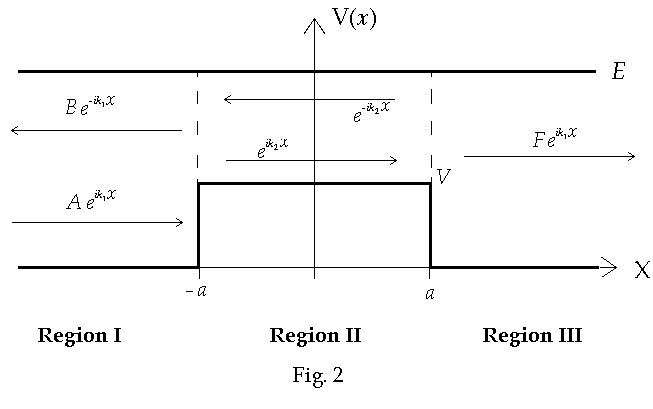
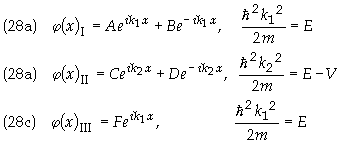

The boundary conditions are

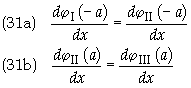
Applying the boundary conditions in Eq. (30)
gives

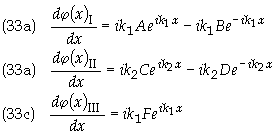
Applying the boundary conditions in Eq. (31)
gives

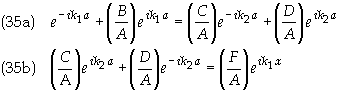
Dividing Eq. (34) by A gives
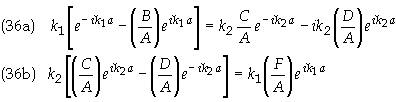
Summary of results
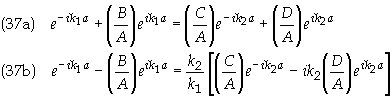
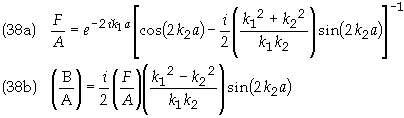
After some tedious algebra these equations
can be put into the form
From a calculation similar to Eq. (7) it can
be shown that the transmission and reflection currents are
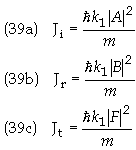
Therefore the transmission and reflection currents are, respectively
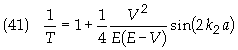
Substituting Eq. (38a) into 1/T gives
To find R use the relation T + R = 1 to give R = 1
– T.