Probability
Physics
World
The heart of quantum mechanics is
probability. Quantum mechanics is probabilistic in nature making nature non-deterministic.
To illustrate this idea we consider first simple examples from everyday life.
Below we use a die as an example of an
experiment in probability. The cup on the left represents an initial state which is
labeled |Y>. Each shake of the cup and toss of the die is considered a
different experiment which begins in exactly the same state each time, e.g. the die is
sitting on the bottom of the cup at the center with the number “1” facing up. An
experiment consists in shaking the cup and tossing the die. Each time the die is tossed it
lands with a particular number facing up. The particular outcome of each run of this
experiment is labeled with the number. For example: If the cup is shook and then die
tossed and lands heads up with the number “6” showing then the state will be
referred to as |Y6>. This is referred to as an eigenstate of the system. Shaking
the cup and tossing the die is an observation of the system. This observation is assigned
an operator that will be denoted  for
“Observe the face of the die” and the actual number on the face of the die
denoted n. The act of observing places the system into an eigenstate of the operator . The operator, , is an example of an observable.
An eigenstate is defined as satisfying the following relation when operated on by
for
“Observe the face of the die” and the actual number on the face of the die
denoted n. The act of observing places the system into an eigenstate of the operator . The operator, , is an example of an observable.
An eigenstate is defined as satisfying the following relation when operated on by

For a fare roll of a die the probability is
the same for each face of the die landing face up. The probability is 1/6. I.e. P(1) =
P(2) = …. = P(6) = 1/6. The initial state of this system is represented as

Eq. (2) can be written more simply, and
generally, as
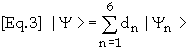
where, for our example of a fair roll of a
die, dn = 1/6 which is also the probability of any
particular outcome. In our example of the die it has the same value of all outcomes, i.e. P(n) = dn. The diagram below illustrates three runs on
an experiment which is started from the same initial state |Y>.
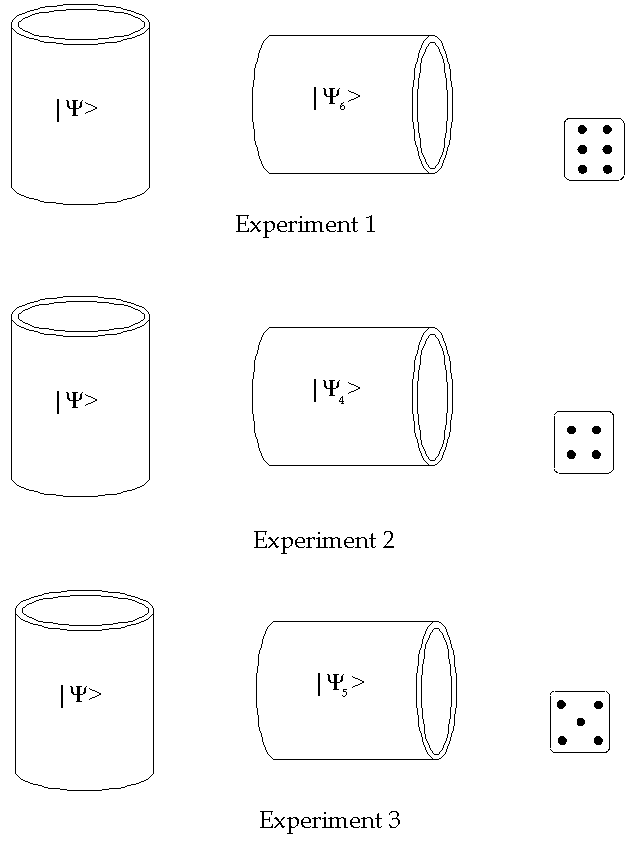
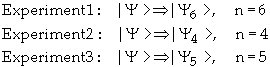
This is a rather simple example of
probability since the physical quantity, e.g. the numbers on the face of the die, are
integers and the probability is the same for all outcomes. The expectation or average
of an observable  with eigenvalues an is defined as
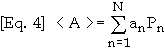
where N is the number of values that an
may take on. For the die example
above,

The uncertainty, DA, of
the observable is define as

Substituting the equality
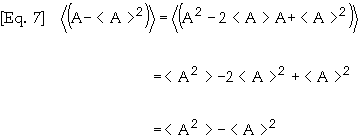
gives

The quantity <A
2>
is calculated as any other operator [The
eivenvalues of A2
are (an)2
], i.e.
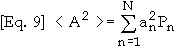
For the die we get

Therefore the uncertainty in the number on
the face of the die is found to be

Thus the
uncertainty in the number that shows up on the face of the die is a statistical value that
does not apply to any single measurement of the number of the face of the die. This should
be kept in mind when thinking about Heisenberg's uncertainty relation for position and
momentum.
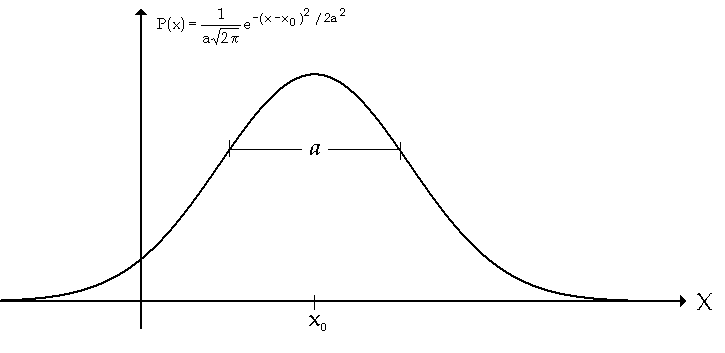
For some quantum states the physical
quantities are real numbers that take on any value in a given range and are
therefore not denumerable (i.e. cannot be put into a one-to-one correspondence with the
integers). The probability then becomes a probability density. One example, a
Gaussian distribution, is shown below
Physics World