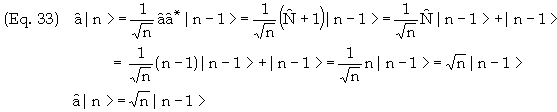
where
where
 i.e. K = mw02, m is the mass of the particle and K is the
spring constant. In terms of
i.e. K = mw02, m is the mass of the particle and K is the
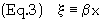
spring constant. In terms of  = x and
  Eq. (1) becomes

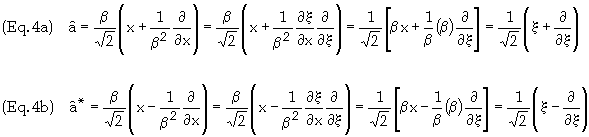
The
time-independent Schrodinger equation for the harmonic oscillator, in terms of the
creation and annihilation operators is given by
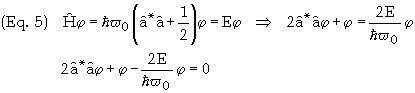
 in
terms defined in Eq. (4), i.e.
in
terms defined in Eq. (4), i.e.
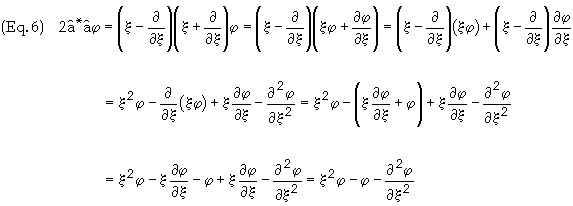


 the equation
  , in terms of Eq. (4), becomes
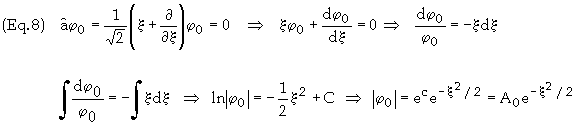
to be
positive since this amounts to multiplication by an arbitrary phase factor. Therefore

A0 is chosen such that  , i.e.

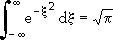
becomes

can also be expressed in terms of x
as follows.

when is expressed in terms of the variable x.
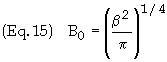
Therefore


Solving for B0 gives
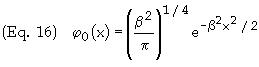
 be used in what
follows.
be used in what
follows.
 is
proportional to
is
proportional to  . I.e.

 . Note
that
. Note
that  . Thus

The arbitrary
phase factor will always be chosen to have the value of unity. Similarly  is proportional to
  . I.e.


Therefore
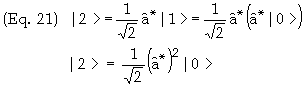

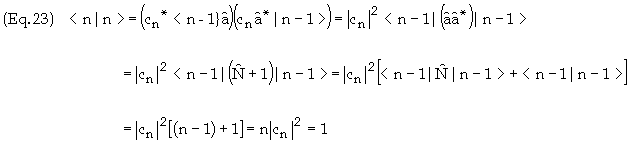
We therefore have
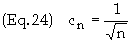
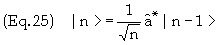
Once again we
follow the same procedure above for Eq. (21) but now for n = 3 to get


 we have

where

 acts on exp(-x2/2)
results in an nth order polynomial multiplied by exp(-x2/2),
i.e.
acts on exp(-x2/2)
results in an nth order polynomial multiplied by exp(-x2/2),
i.e.

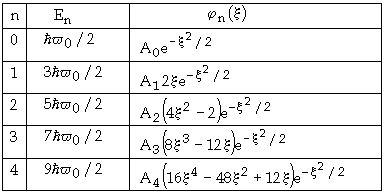
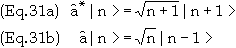
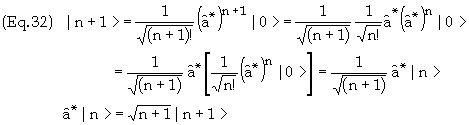
to
give