
Harmonic Oscillator
in the expression
for the Hamiltonian giving
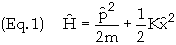
where K is the
spring constant.  is the operator for
the x-component of momentum. The time-independent Schrodinger equation (for one-dimension)
is the operator for
the x-component of momentum. The time-independent Schrodinger equation (for one-dimension)

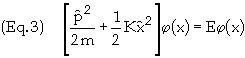
Substituting  and
and  = x into Eq. (2)
gives
= x into Eq. (2)
gives

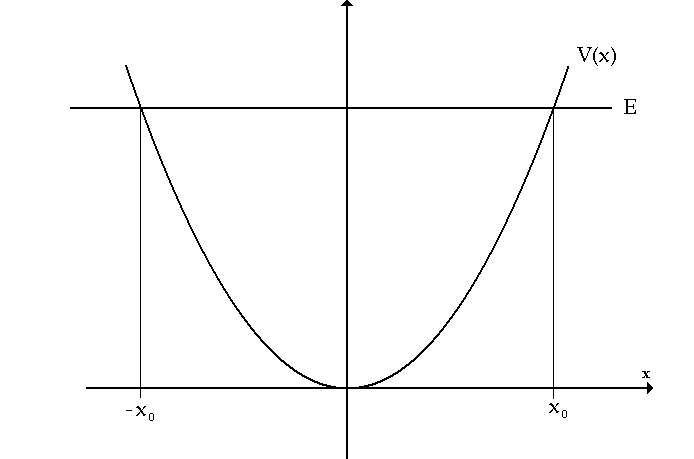
As seen in the
above diagram the classical region is given when the kinetic energy is positive, i.e. for
E > V. This corresponds to the interval –x0 < x < x0.
 where
where
 , i.e. K = m

The relation  will prove useful and is
derived here.
will prove useful and is
derived here.
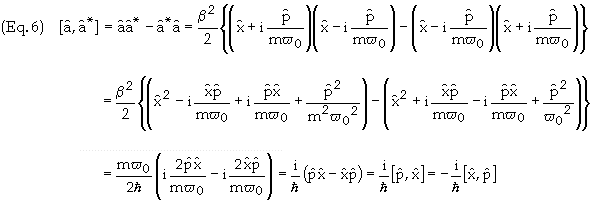
 results in



and gives


Adding Eqs. (10)
and (11) gives


yields
the final result
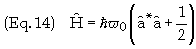
At this point it
will prove convenient to define the following operator

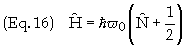
 . From Eq. (16) and Eq. (8) we get the
following relation
. From Eq. (16) and Eq. (8) we get the
following relation

 is
an eigenket of
is
an eigenket of  corresponding to the eigenvalue n - 1.
That is to say
corresponding to the eigenvalue n - 1.
That is to say

 has
on an eigenket of ; It reduces the eigenvalue by one. E.g.
has
on an eigenket of ; It reduces the eigenvalue by one. E.g.

is
called the annihilation operator. In a
similar fashion

 is an eigenket of corresponding to the eigenvalue n + 1. That is to say

 has
on an eigenket of ; It increases the eigenvalue by one. E.g.
has
on an eigenket of ; It increases the eigenvalue by one. E.g.

is
called the creation operator.
Eigenvalues of the Hamiltonian
The expectation of the Hamiltonian, e.g. Eq. (1), in the state is found to be

Note that for any
Hermitian operator the expectation of the square of in
the state is given by

 . Therefore

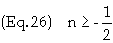
Eq. (26) implies
that all eigenstates corresponding to n < -1/2 must vanish. This situation is obtained if we set

Eq. (27) implies
that
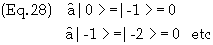
to Eq. (27) and noting the definition  it
follows that
it
follows that

Therefore the
eigenvalue of corresponding
to  is
zero. Multiplying the relation
is
zero. Multiplying the relation  by gives

Or since

Therefore the
eigenvalue of corresponding
to  is one. In a similar fashion it can be shown that
the eigenvalue of corresponding
to is
n where n is an integer. The eigenvalues of the Hamiltonian are therefore found as follows
is one. In a similar fashion it can be shown that
the eigenvalue of corresponding
to is
n where n is an integer. The eigenvalues of the Hamiltonian are therefore found as follows

Therefore the
possible values of the energy for the quantum harmonic oscillator are
