
Orthogonal Transformations
Back
to Physics World
Back
to Geometrical Math for GR
Einstein's
Summation Convention
Typically the unit vectors i, j, and k are used in vector analysis in Cartesian coordinates to represent the unit vectors which are parallel to the x, y and z axes, respectively. I.e. any vector A can be represented in terms of these unit vectors as
If we change notation then Einstein's summation convention can be used, i.e.
Einstein's Summation Convention: If an index appears twice in a term, once as a superscript and once as a subscript, then summation is implied over the range that the indices are allowed to take on.
Example: Define the following

The summation convention can now be used to express A

Similarly we can choose another Cartesian coordinate system, rotated with respect to the first, and thus use another basis to express A, i.e.

Bases
If all vectors in an n-dimensional vector space Rn can be written in terms is the set of vectors V = {v1, v2, .... , vm} then the set is said to span Rn. The V set is called a spanning set of S. If
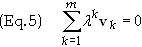
implies that lk
= 0 for all k then the vectors in V are said to be linearly
independent. It can be shown that the dimension of a linearly independent
spanning set has dimension m = n. If
any vector in Rn
can be written in terms of a set, V, of linearly independent vectors
which spans Rn
then that set is called a linearly independent spanning set, or simply a basis,
for Rn.
It can be shown that the number of basis vectors equals the dimension of the
vector space, i.e. m = n. If the magnitude of all the vectors in the basis
equals one then that basis is said to be normalized. If the set of vectors are
orthogonal, i.e. then they further satisfy the relation ek
Note: The basis {v1, v2, .... , vn} will be represented simply by writing {vn} unless otherwise noted.
Orthogonal Transformations
For purposes of
illustration a 3-dimensional Cartesian coordinate system will be used. However
the concepts presented here apply to n dimensions. Let {ej} and {
 } be two different orthonormal bases. Since the bases are orthonormal if follows
that ek
} be two different orthonormal bases. Since the bases are orthonormal if follows
that ek . Any position vector r can be represented as

In order to solve for
 in terms of xj take
the dot product of each side of Eq. (6) and use the orthogonality conditions and
the definition
in terms of xj take
the dot product of each side of Eq. (6) and use the orthogonality conditions and
the definition
 , I.e.
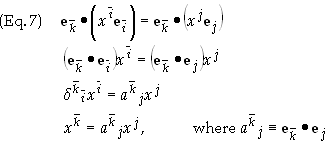
This result represents the
transformation
. This same procedure can be used to solve for xk,
as follows
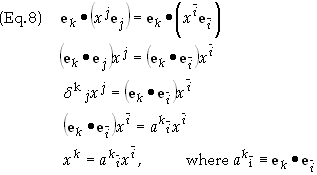
This result represents the
transformation
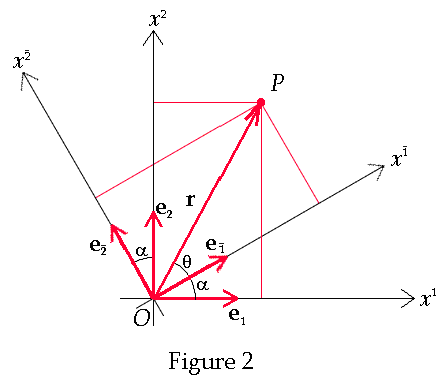
 . Example: Consider the passive
transformation that results from rotating the xy-axis and representing
the components of the position vector in terms of the new axes as shown below
. Example: Consider the passive
transformation that results from rotating the xy-axis and representing
the components of the position vector in terms of the new axes as shown below
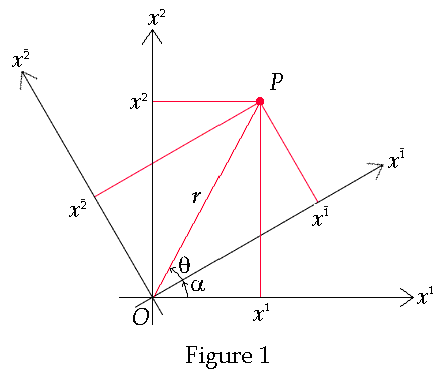
We can find the new
coordinates
 in terms of the old coordinates (x1,
x2)
in two different ways. The first is geometrically and the second using the
method described above. Using the geometric method first we start by referring
to the diagram and note that
in terms of the old coordinates (x1,
x2)
in two different ways. The first is geometrically and the second using the
method described above. Using the geometric method first we start by referring
to the diagram and note that
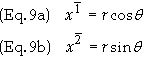

Eq. (10) can readily be
solved for
in terms of (x1,
x2)
to give
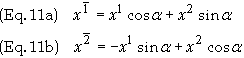
The other method mentioned
above requires that we first find the direction cosines
, which can be picked off from the Figure 3 below
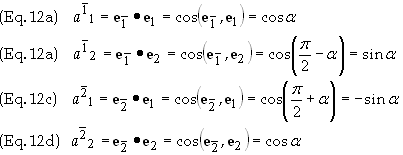
When Eq. (12) is substituted into Eq. (7) the transformation in Eq. (11) readily results.

Recall Eqs. (7) and (8)
above, i.e.
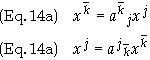

which implies

This expression is known as the orthogonality condition. In matrix language Eq. (14a) may be expressed as

Likewise Eq. (14b) may be expressed as

where AT is the transpose of A. The orthogonality condition may now be written as

This implies that AT is the inverse of A, i.e.

Definition
of Orthogonal
transformation [1]: Any linear
transformation
 that has the property
 is called an orthogonal
transformation and
is
known as the orthogonality condition.
is called an orthogonal
transformation and
is
known as the orthogonality condition.
References:
[1] Tensors,
Differential Forms, and Variational Principles, David Lovelock and Hanno
Rund, Dover Pub., pages 19 to 21.