
The Gravitational Field
Back
to Physics World
Back to General
Relativity
Einstein made two
statements in the 1916 paper which are associated with the term gravitational field [Note: hab º
diag(1,-1,-1,-1)]
The
case of the ordinary theory of relativity arises out of the case here
considered, if it is possible, by reason of the particular relations of the
gab
in a finite region, to choose the system of reference in the finite region in
such a way that the gab
assume the
constant values [hab].
We shall find
hereafter that the choice of such co-ordinates is, in general, not possible for
a finite region. ... the quantities gab are to be regarded from the
physical standpoint as the quantities which describe the gravitational field in
relation to the chosen system of reference. For, if we now assume the special
theory of relativity to apply to a certain four-dimensional region with
co-ordinates properly chosen, then the gab
have the values
[hab]. A free material point then moves,
relatively to this system, with uniform motion in a straight line. Then if we introduce new space-time coordinates x0,
x1,
x2,
x3,
by means of any substitution we choose, the gab in this
new system will no longer be constants but functions of space and time.
At the same time the motion will present itself in the new coordinates as
a curvilinear non-uniform motion, and the law of this motion will be independent
of the nature of the moving particle. We
shall interpret this motion as a motion under the influence of a gravitational
field. We thus find the occurrence
of a gravitational field connected with a space-time variability of the gab.
So, too, in the general case, when
we are no longer able by a suitable choice of co-ordinates to apply the special
theory of relativity to a finite region, we shall hold fast to the view that the
gab describe
the gravitational field.
Later
on in this article Einstein writes
If
the
Gmab
vanish, then the point
moves uniformly in a straight line. These quantities therefore condition the
deviation of the motion from uniformity. They are the components of the
gravitational field.
These
statements, taken together, often confuse people. Consider the expression for
the gravitational force as it is calculated in general relativity
where
va
º
(c, vx,
vy,
vz).
Compare this to the Newtonian expression

where
F is
the Newtonian potential. It for these reasons that the components of the metric
tensor, gab,
are considered to be a set of
10 gravitational potentials in general relativity. Consider also the
relationships from general relativity
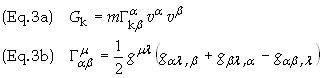
Compare
this from the relationships from Newtonian mechanics
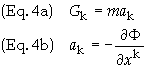
For this
reason Einstein referrer to the Gmab
as
the components of the gravitational field. It is also the reason why MTW state that No G’s
means no “gravitational field”... [1]
Therefore the following comparison is to be made
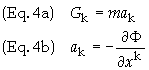
There is
another comment that has also confused people, i.e. “We thus
find the occurrence of a gravitational field connected with a space-time
variability of the gab.”
The first thing to notice is what the acceleration, ak,
means in Eq. (4). Consider a particle moving with constant velocity in an
inertial frame of reference in flat spacetime. The components of acceleration, ak,
will vanish if and only if the spatial axes are Cartesian. In what follows the
spatial coordinates will be Cartesian. The second thing to notice is that the
variability of the potential is a necessary condition for the non-vanishing of
the gravitational field at a specific point. It is not a sufficient condition.
I.e. the potential may vary in a region and yet the field may vanish at a point
in that region. To illustrate this in a Newtonian context consider two point
objects of equal mass sitting on the x-axis, one at x = +a
and one at x = -a. The Newtonian potential is shown in Fig. 1
below
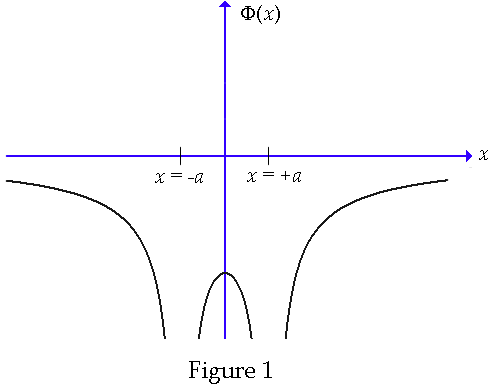
The
gravitational potential, F, is
given by
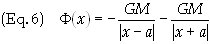
Notice
how F is
constant nowhere on the x = axis. The gravitational acceleration is given
by Eq. (4b)

Notice
how ax
vanishes at x = 0. It is important to take note that Einstein's
definition of the gravitational field is not the one commonly used today. The
presence of a gravitational field is now synonymous with a non-vanishing Riemann
tensor.
References:
[1] Gravitation,
Misner, Thorne and Wheeler, W.H. Freedman and Company, (1970), p. 467
Back
to General Relativity
Back
to Physics World