
Speed of Light in a Gravitational Field
Back
to Physics World
Back
to General Relativity
Speed of Light
in a Uniform Gravitational field
The metric in a uniform
gravitational field is, according to the equivalence principle, identical to the
metric in a uniformly accelerating frame of reference [1]
where c is the speed of
like in a vacuum in a Minkowski frame of reference. Since light moves on null
geodesics we set ds2
= 0

Divide through by dt2
to obtain
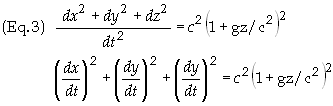
Now substitute vx
º
dx/dt, vy
º dy/dt, vz
º
dz/dt, v2
º vx
2
+ vy2
+ vz
2
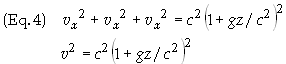
Let F = gz.
Note that we choose the arbitrary additive constant that is usually associated
with a Newtonian potential, to be zero. Our final result is obtained by taking
the square root of both sides of this expression

This is exactly the result
obtained by Einstein in 1907 [2]. The speed of light in Eq. (5) is known as the coordinate
speed of light. Eq. (4) states that as light rises in a uniform
gravitational the coordinate speed will increase. If the light travels in the
opposite direction the coordinate speed of light will decrease.
Speed of Light
in a Schwarzschild Gravitational Field
The gravitational field of
a spherical body is described by the Schwarzschild metric

As above we set ds2
= 0 in Eq. (1)

Divide through by dt2
, and
substitute vr
º dr/dt,
vq
º dq/dt,
vf
º df/dt
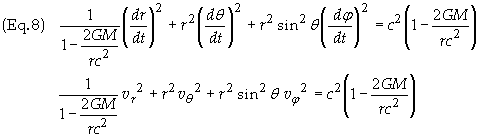
If the light is radial,
i.e. vq
= vf
= 0, then Eq. (7) simplifies to
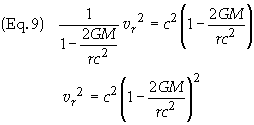
If we now take the square
root of both sides of Eq. (9) then we have the speed of light that is traveling
radially in a Schwarzschild geometry
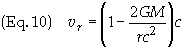
Therefore as light gets closer to the center of the gravitating object the coordinate speed of light slows down.
References
[1] The Principle
of Equivalence, F. Rohrlich, Annals of Physics, 22, 160-191 (1963)
[2] The Principle of
Relativity, Lorentz, Einstein, Minkowski, Weyl, Dover Pub. See
article which starts on page 99, i.e. On the Influence of Gravitation on the
Propagation of Light.
Back
to General Relativity
Back
to Physics World