
Relativistic
Charged Particle
Physics
World
Back to Electrodynamics
Total
Energy of a Relativistic Charged
Particle moving in and Electromagnetic Field
The non-covariant
Lagrangian for a charged particle in an electromagnetic field is given by
[1]
F is
the Coulomb potential and A is the magnetic vector potential.
The total time derivative of L is

Using
Lagrange’s equations
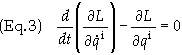
Eq.
(2) can be written as

or
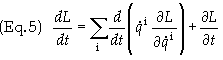
Rearranging
terms in Eq. (5) gives
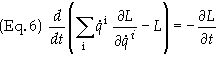
The energy
function h is defined as [2]
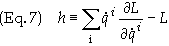
If
h were expressed in terms of canonical momentum then h would be
equal to the Hamiltonian H of the system. In terms of h
Eq. (6) can be written as
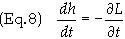
If L,
as defined in Eq. (1), is not an explicit function of time then it follows that h
= constant, i.e. h is an integral of motion. Evaluating the
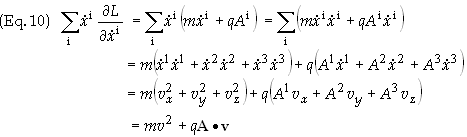
partial derivative in Eq. (7) yields

The
summation in Eq. (7) becomes
Substituting
Eq. (10) into the expression for the energy function, i.e. Eq. (7) gives
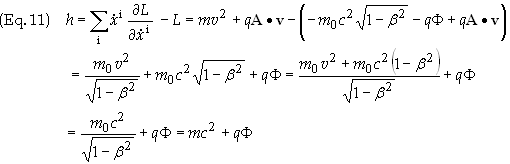
Thus h
= W = the total energy of the particle, hence the name energy
function. Further more

E
= gm0
is the inertial energy of the particle and
V = qF is the potential energy of the particle. E
can be written as the sum of the particles kinetic energy, K,
and its rest energy, E0. Then W
becomes

If the
Lagrangian does not contain the time explicitly then h is conserved i.e. h
= constant.
Derivation
of the Lorentz Force
Equation from the Relativistic Lagrangian
Taking
the total time derivative of Eq. (9) we get
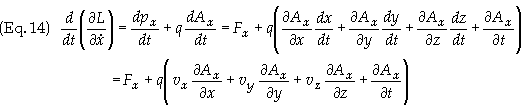
Taking
the partial derivative of Eq. (1) with respect to x gives
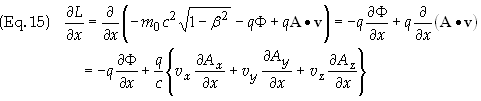
Equating
Eq. (14) with Eq. (15) gives, according to Lagrange's Equations,

Noting
that
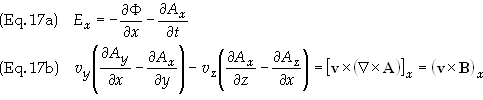
Eq.
(16) reduces to

Similar
results hold for y and z. Thus the final solution is

where
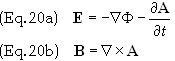
The
Lorentz Force Equation derived from
the Covariant Form of the
Lorentz Force Equation
The covariant form of the Lorentz
Force equation is [3]
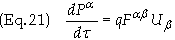
where
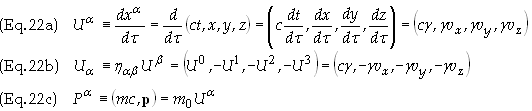
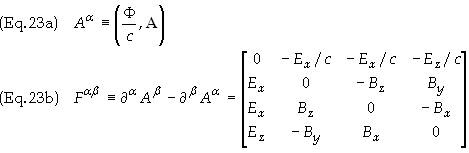
Consider the time
component of Eq. (21), i.e.
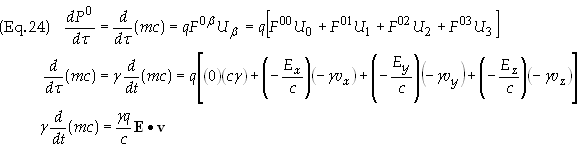
Canceling common factor of
g
from both sides of Eq. (24) reduces that equation to
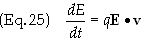
where E = mc2. Now consider the x component of Eq. (21) by setting a = 1 to get
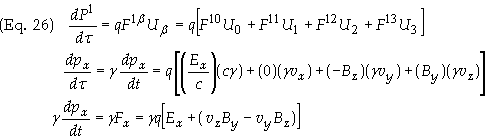
Eq. (26) simplifies to

Similarly Fy
and
Fz
are obtained from Eq. (20) by setting a =
2 and 3 respectively. The final result is

which is identical the Eq.
(19). Thus the following pair of equations is equivalent to the covariant form
of Maxwell's equations
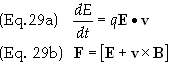
If both F and A do not depend on the time explicitly, i.e. F = F (r) and A =A(r), then E = -ÑF and Eq. (25) becomes


It therefore follows that

which is
the same result obtained in Section 1 in Eq. (13) if the constant equals the
total energy W.
Derivation
of the Lorentz
Force Equation from the Covariant Lagrangian
The covariant
relativistic Lagrangian L
for a charged particle in an electromagnetic field is given by [4]

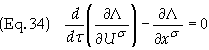
The covariant
Lagrange equations, written in terms of proper time t,
is given by [5]
Taking
the partial derivative of Eq. (32) with respect to Us
we get
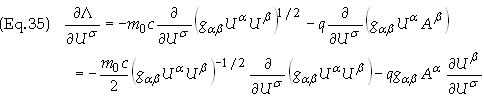
The
first term can be simplified by noting that

Thus Eq.
(34) reduces to

Taking the total derivative of Eq (37) with respect to proper time t gives

To find the second term in
the covariant Lagrange equations we take the partial derivative of the covariant
Lagrangian, i.e. Eq. (33), with respect to xs
to give
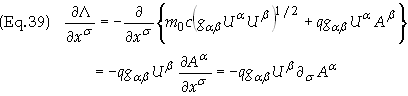
Eqs. (38) and (38) are
equated to give
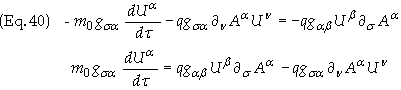
Multiply Eq. (40) by gms to give
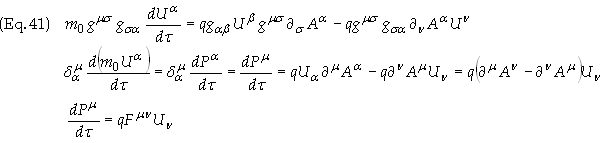
Eq. (41) is the equation
of motion. It can readily be shown by following the same procedure as above that
the Lagrangian

will also produce Eq. (41).
[6]
References:
[1] Classical Electrodynamics - 3rd Ed.,
J.D. Jackson, John Wiley & Sons, (1999), page 582 Eq. (12.12).
[2] Classical Mechanics - 3rd Ed., Goldstein, Poole & Safko, Addison
Wesley, (2002), page 61 Eq. (2.53).
[3] Ref. 1, page 580 Eq. (12.3).
[4] Ref. 1, page 584 Eq. (12.31).
[5] Ref. 2, page 321 Eq. (7.163).
[6] Ref. 2, page 352 Eq. (7.147).