Lorentz Force and Generalized Potential
Physics
World
Back to Electrodynamics
Vectorial
Approach
The
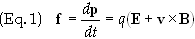
Lorentz force on a charged particle moving in an electromagnetic field is given
by
Substituting
the values of the electric and magnetic fields in terms of the Coulomb and
vector potential, respectively, i.e.
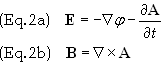
the
Lorentz force becomes

Recall
the vector identity

Letting a
= v and b = A we obtain

The
terms including spatial derivatives of the velocity are zero which leaves

Solving
for v´(Ñ´A)
gives

Substitute
this expression into Eq. (3)
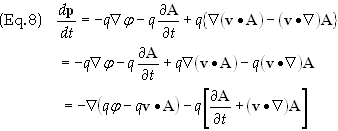
The
first term on the right hand side is an example of what is known as a generalized
potential and usually labeled U, i.e.

The
second term is the convective derivative of A whose value is the
total derivative of A, i.e.
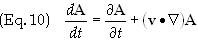
Substituting
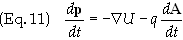
the expressions in Eqs. (9) and (10) into Eq. (8) we obtain
Eq. (12)
can be rearranged to give
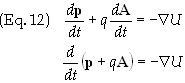
The canonical
or generalized 3-momentum, P, for a charged particle in an EM
field has the value

Therefore
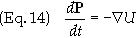
in terms of P and U the Lorentz force in Eq. (1) can be written as
The time
rate of change of the canonical momentum is called the canonical 3-force
and will here be labeled F. Thus Eq. (1) now takes on the simple form

Analytical Approach
The
result obtained above in Eq. (15) can more readily be obtained using Lagrangian
mechanics. Start with the Lagrangian for a charged particle in an
electromagnetic field

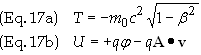
If we
define the following quantities
Then the
Lagrangian can be expressed in a more familiar form

The canonical
momentum of a particle, p,
is defined in terms of the Lagrangian as
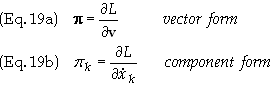
Inserting
these into Lagrange’s equations
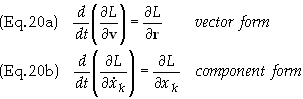
we get
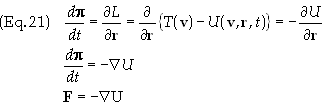
F
is the canonical force defined as the time rate of change of the
canonical momentum. It can readily be shown that p has the value

The
result in Eq. (21) is identical to the result obtained above in Eq. (15).
Back
to Electrodynamics
Physics World