Lorentz
Force
Physics
World
Back to Electrodynamics
The Lorentz
force, f, on a particle having a charge of magnitude q is

The rate
at which work is done on a particle equals f·v.
This equals the time rate of change of the particle’s kinetic energy, T,
i.e. dT/dt = f·v.
The kinetic energy is related to the inertial energy E by E
= T + E0
where E0
= m0c2
and m0
is the particle’s proper mass. For cases of constant proper mass, dT/dt
= dE /dt. Therefore

Eq. (1)
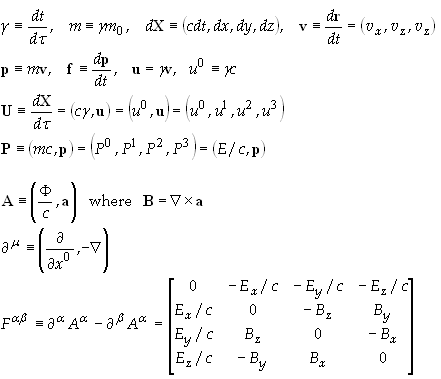
and (2) are exact expressions which can be recast into a manifestly covariant
form. Multiply Eq. (2) by g
º dt/dt
and simplify, inserting u
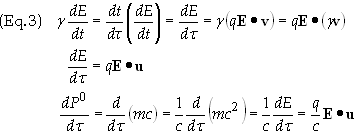
Substituting
the appropriate components from the 4-momentum and faraday tensor F into
Eq. (3) we obtain
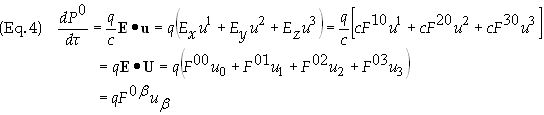
Thus Eq.
(4) is the time component of the Minkowski four-force, K º
dP/dt.
This is the 4-force on a particle in an inertial frame of reference. To get the
spatial portion multiply Eq. (1) through by g and simplify

The
components of Eq. (5) are

The left
hand side of Eq. (6) is the spatial portion of a four-force. We may now place
this in covariant form. This means we must replace each item in Eq. (4) by a
tensor quantity. Start by writing u´B
in component form
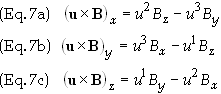
The
components of the magnetic field are related to the Faraday tensor, Fba,
as
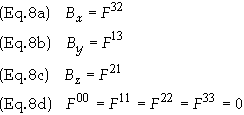
Substitute
Eq. (8) into Eq. (7) to yield
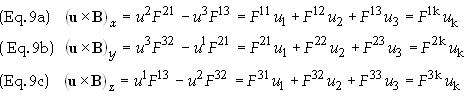
Eq.
(6) may now be written in terms of tensor quantities
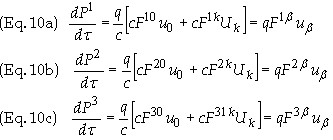
Eq. (4)
and (10) thus comprise 1 set of equations which can be expressed as (note that u
is the spatial part of the velocity 4-vector U)
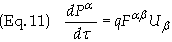
Note that Eq. (11) has the exact same content as Eqs. (1) and (2). We have simply placed them into tensor form. The geometric form of this equation is
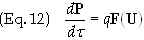
Eq. (12) is the manifestly covariant form of Eqs. (1) and (2)
Back
to Electrodynamics
Physics World