St. Paul's Evangelical Lutheran Church, which had been founded in 1830, built its permanent sanctuary in 1856. They employed a full-time minister to tend to the flock. Its small congregation included individuals from several different ethnic backgrounds. An Irish-American widow, Elizabeth Gibbens, moved with her three sons to five acres directly across from the church. Elizabeth had been a "Radical Methodist" in Blue Rock Township, but soon became a Lutheran. Her sons, however, remained Methodists and traveled to Sonora every Sunday to the Wesley Chapel Methodist Episcopal Church located there. Elizabeth's son, John Gibbens, would eventually become my great-great-grandfather.
The population had increased by five percent between 1850 and 1860. One thousand, one hundred and two white individuals now resided in Perry Township. Five hundred and fifty-seven of these individuals, or 50.5%, were females. Five hundred and forty-five, or 49.5%, were males. One hundred and ninety-eight families lived in the township. The average family size had decreased slightly to about 5.5 members per household.
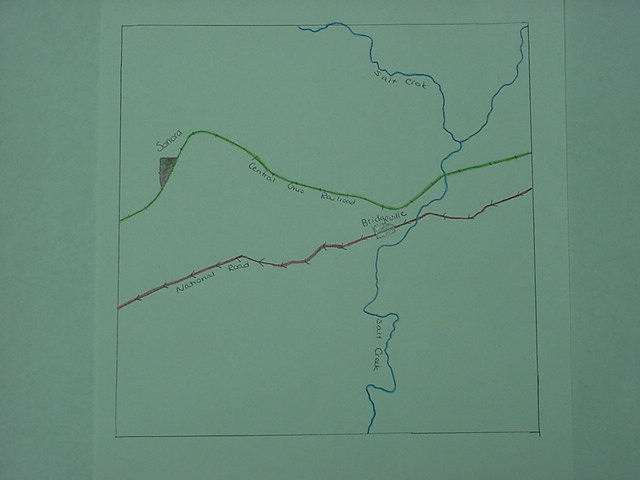
Perry Township was still primarily agricultural, but the railroad industry had brought several new jobs to the township. Seven men were employed as railroad hands, and one man was employed as a gatekeeper. Sonora now employed a telegraph operator and a justice of the peace. Two school teachers were necessary, and the township boasted a full-time music teacher, as well. Five merchants set up shop in Sonora. Women worked as seamstresses, washerwomen, and housekeepers.
The average family held $2,334.73 worth of real estate. This average, however, can be deceptive. Most of this real estate was owned by farmers and founding families. The Livingoods, for example, owned 758 acres which surrounded the town of Bridgeville. Their land was worth more than four times the average amount of real estate owned by a family. The average family also held approximately $863.64 worth of private estate. Once again, farmers and founding families usually held a disproportionate amount of private estate.
Perry Township had faced many changes in the 1850's, but far greater changes were forthcoming. The Civil War was about to start, and Perry Township would send 62 males, approximately 11% of the male population in Perry Township, to fight for the Union. Nearly a quarter of these men would die in the war.
Sources Used:
1860 Census
Biographical and Historical Memoirs of Muskingum County, Ohio. Chicago, IL: The Goodspeed Publishing Company, 1892.
Combination Atlas Map of Muskingum County, Ohio. Philadelphia, PA: L. H. Everts and Company, 1875.
Violet Gibbens, interview by author, 9 September 2001.
History of Muskingum County Ohio. J. F. Everhart and Company, 1882.
Donna (Gibbens) Nash, interview by author, 13 September 2001.
Sutor, J. Hope. Past and Present of the City of Zanesville and Muskingum County, Ohio. Chicago, IL: S. J. Clarke Publishing Company, 1905.