
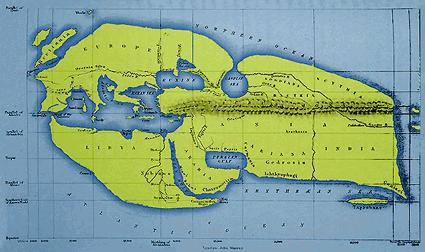
Strabo (22AD) (Geography)
---------------------------------
Taken from several websites
The mode of life among the Troglodytae is nomadic. Each tribe is governed by tyrants. Their wives and children are common, except those of the tyrants. The offence corrupting the wife of a tyrant is punished with the fine of sheep. The women carefully paint themselves with antimony. They wear about their necks shells, as a protection again fascination by witchcraft. In their quarrels, which are pastures, they first push away each other with their hands, they then use stones, or, if wounds are inflicted, arrows and daggers. The women put an end to these disputes, by going into the midst of the combatants and using prayers and entreaties.
Their food consists of flesh and bones pounded together, wrapped up in skins and then baked, or prepared after many other methods by the cooks, who are called Acatharti, or impure. In this way they eat not only the flesh, but the bones and skins also. They use (as an ointment for the body?) a mixture of blood and milk; the drink of the people in general is an infusion of the paliurus (buckthorn); that of the tyrants is mead; the honey being expressed from some kind of flower. Their winter sets in when the Etesian winds begin to blow (for they have rain), and the remaining season is summer.
They go naked, or wear skins only, and carry clubs. They deprive themselves of the foreskin, but some are circumcised like Egyptians. The Ethiopian Megabarae have their clubs armed with iron knobs. They use spears and shields which are covered with raw hides. The other Ethiopians use bows and lances. Some of the Troglodytae, when they bury their dead, bind the body from the neck to the legs with twigs of the buckthorn. They then immediately throw stones over the body, at the same time laughing and rejoicing, until they have covered the face. They then place over it a ram's horn, and go away. They travel by night; the male cattle have bells fastened to them, in order to drive away wild beasts with the sound. They use torches also and arrows in repelling them. They watch during the night, on account of their flocks, and sing some peculiar song around their fires. . . .
Strabo sceptically relates the story of Posidonius that a certain Eudoxus attempted to circumnavigate Libya (Africa) at the time of Ptolemy VIII Physcon Euergetes II (146-117 BC). Posidonius noted the lack of evidence to substantiate this claim, but went on to give a lengthy account of the voyage of Eudoxus, which Strabo reported in full, in order to refute it (Strab. 2.98). He goes so far as to accuse Poesidonius of either inventing it wholly himself or of being over-credulous in accepting it on hearsay. He is particularly suspicious of the role played by the Indian sailor. Nevertheless, modern scholarship has considered the facts of Eudoxus' two voyages seriously. They fit in well with the conditions then prevailing in the Indian Ocean, where Alexandrian merchants controlled sea-borne trade in the Red Sea, Nabataeans and South Arabians controlled overland caravan trade across Arabia.
Strabo mentions Satyrus, who because of his job: exploring Troglodytae is believed to have rounded cape Ras Hafun and visited at least the northern part of Azania.
We know only for sure that he spend lots of time in Northern Somalia:
In sailing from Heroopolis along Troglodytica, a city is met called Philotera (modern Al-Ghurdaqah), after the sister of Ptolemy, it was founded by Satyrus, who was send to explore the hunting-ground for elephants, and Troglodytica itself.
The date 115-87 B.C. is of special interest because it coincides with an event of global significance, namely the discovery of the monsoon winds in the Indian Ocean by Alexandrian navigators. (Said to have been discovered by a sailor called Hippaulus). We are told that a shipwrecked Indian sailor was discovered, half-dead, by coast guards on the Red Sea, and was brought to the Pharaoh. To gain favor, the Indian promised to guide any of the King's navigators on a voyage to India. Eudoxus of Cyzicus, an adventurous Greek seaman employed by Ptolemy VIII for navigation up the Nile, was appointed to that mission.
A direct journey to India was successfully guided by the Indian sailor in 118 BC.
They left with different trade objects and brought back a cargo of ivory, aromatics and precious stones within that same year which the king immediately confiscated.
Two years later, after the death of Ptolemy VIII, Cleopatra, his widow, takes over the government and Eudoxus was send again with more cargo then first (traveling without the Indian sailor).
On his way back, he was thrown by the winds on the coast of Ethiopia (below Cape Guardafui), he visits some places there, makes friends among the people, gives them some food, including wine and dried figs, which they do not know. In return he gets help and guides, he wrote also down some words of their language. He found a wooden prow, carved with a horse heat, floating in the water. He was told by the Africans that it came from a wrecked ship of men from the west, and decided to take the piece with him.
Back in Egypt, (He stayed away for about eight years) there is no more Cleopatra in power, but the son of Ptolemy. Hr is for the second time deprived from his profits, because they found out that he had kept behind several things for his own profit.
The piece of wood that he had brought with him, he puts it in full view on the market and sailors recognize it as part of a ship of Cadiz.
This established to him proof that there was a sea route around the coast of Africa.
He tried then to sail around Africa (paying himself for the expenses): First attempt failed near Canary Islands, never returned from 2nd try.