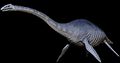
| There is an enormous gash in the earth that splits the Scottish highland in two, which forms a chain of lakes, rivers and canals or what some call lochs. They connect the North sea and the Atlantic Ocean. One of these lakes is Loch Ness which is the largest freshwater lake in the British Isles, it is about forty kms long, and at one point it is about two kms wide. It can get up to three hundred metres deep and it is very cold and murky. A great place for a monster to live and stay hidden most of the time. This interduction leads us to the question does the Lock Ness monster really exist. A new road was build around the edge of the loch in 1933, because the road was so close to the lock reports of the Loch Ness monster soared. One of the first reports that year came on the 14th April. The owners of a Inn in Drumnadochit, the Mackay's observed an giant creature "rolling and plundging in the loch. They reported it to the man incharge of regulating salmon fishing in the loch, Alex Campbel. He also witnessed the monster several times him self after told of the Mackay sighting. Alex Campbel described the creature as having a long neck about two metres long and a smallish head with a serpent look about it, and a large hump behind. He thought the monster was around ten metres long. The first photograph taken of the Loch Ness monser was taken in 1933 by Hugh Gray. Gray reported "I immediately got my camera ready and snapped the object which was then two or three feet above the surface of the water. I did not see a head, for what Itook to be the front parts were under water, but there was considerable movment from what seemed to be a tail. In 1934 was a land sighting of the monster. Athur Grant veterinary student was riding his motorcycle one evening. He said he almost ran into it as it crossed the road. Grants description of the creature, small head, long tapering headand tail with a bulky body and flippers. This seemed to match the description of a Plesiosaurs. The Plesiosaurs is aquatic reptile related to the dinosaurs, it has been exstinct for sixty five million years. The first moving pictures of the monster was taken in 1960. Tim Dinsdale was visiting the lake and captured the monster on film. The film does not show much but a group of Royal Air Force photographic experts pronounced that the object was "probably" animate and could have been up to ninty feet long. Dinsdale was so convinced by the photos that he gave up his career as a aeronautical engineer and spent the next twenty years looking for it. He had two more sightings of the creature but nothing conclusive to proof the existance of the LochNess monster. In 1970 the academy of Applied Science, headed by Dr. Robert Rines used automatic cameras and sonar to monitor the loch. In 1972 the underwater camera got four frames of what appears to be a flipper about two to two and half metres long. In 1975 one of the teams cameras captured a fuzzy image what looked like the face of the creature. A small submarine was also used to explore the dept of the lake but there was no convincing evidence. Skeptics say that the monster could be type of whale, a long necked seal, giant otter, giant eel and even a giant sea slug. Some skeptics say that the water is to cold for a reptile. Recent studies show that dinosaurs were warm blooded and that the Plesiosaurs could also have been warm blooded and making it possible for the creature to live in this environment. REFERENCES. Dead or alive. HTTP//unmuseum.mus.pa.us |
| LOCH NESS MONSTER "NESSIE" |
 |
 |
 |
|
| By Jeff Fausch Paranormal Field Investigators |