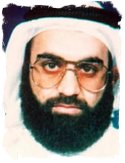
 | has emerged as the top terrorist organizer for the Sept. 11th terrorist attacks, a senior U.S. law enforcement and counterterrorism official said Tuesday. Mohammed, one of the FBI's most-wanted terrorists and a Kuwaiti lieutenant of Osama bin Laden, is alive, at-large and in the Afghanistan region, the law enforcement official told The Associated Press on Tuesday, June 4, 2002. |
June 4, 2002 - 7:46 PM EST
WASHINGTON (AP) - Investigators believe they have identified
a Kuwaiti lieutenant of Osama bin Laden as the likely mastermind
of the Sept. 11 terrorist attacks, a senior U.S. counterterrorism
official said Tuesday.
Khalid Shaikh Mohammed, designated one of the FBI's most-wanted
terrorists, is at large in Afghanistan or nearby, the law enforcement
official told The Associated Press.
U.S. investigators believe Mohammed planned many aspects of the
Sept. 11 attacks, turning bin Laden's calls for dead Americans into reality.
"There's lots of links that tie him to 9-11," the official said, speaking on
condition of anonymity.
"He's the most significant operational player out there right now."
Other bin Laden lieutenants are also believed to have helped put together
the attacks, the official said. But evidence is mounting that Mohammed
was at the center of the operational planning.
A second U.S. official, also speaking on the condition of anonymity,
acknowledged that Mohammed played a critical role in planning the attacks
but said questions remain about the extent of his leadership.
The official said other bin Laden lieutenants, including Abu Zubaydah,
now in U.S. custody, are also believed to have played top organizational roles.
According to the counterterrorism official, within three months of Sept. 11,
the FBI learned that Mohammed had moved money that was used to pay
for the attacks and since then the United States has gathered other significant
evidence pointing to him as the key planner.
The official declined to go into detail, citing a need to protect intelligence information.
Mohammed is accused of working with Ramzi Yousef in the first bombing of the
World Trade Center, which left six dead in 1993. He and Yousef, hiding in the
Philippines, also are accused of plotting in 1995 to hijack and bomb several
trans-Pacific airliners heading for the United States.
Yousef, now serving a life sentence in the United States, also is believed to
have planned to crash a plane into CIA headquarters.
Mohammed was charged by federal prosecutors in New York in 1996 in connection
with the alleged 1995 plot. The FBI describes him as in his mid-thirties, sometimes
wearing a beard and glasses, and slightly overweight. His aliases include:
Ashraf Refaat Nabith Henin, Khalid Abdul Wadood, Salem Ali and
Fahd Bin Abdallah Bin Khalid.
U.S. officials have repeatedly said that capturing or killing bin Laden's cadre of
lieutenants, men like Mohammed, is a key goal in the war on terrorism.
In some ways, they are considered as dangerous as bin Laden.
Where al-Qaida's leader serves as an inspiration to his followers, his top aides
conduct the nuts-and-bolts planning of attacks.
The lieutenants are said to pick targets and attack dates, provide money and
training to the foot soldiers and overseas cells chosen to carry them out,
sometimes at the cost of their own lives - and maintain operational secrecy.
Most of the 19 suicide hijackers are thought not to have known the entirety
of the Sept. 11 plot, or that they were going to die, but Mohammed apparently did,
the counterterrorism official said.
Mohammed has not been charged in connection with the attacks, which
crashed hijacked airliners into the World Trade Center and Pentagon,
leaving more than 3,000 dead.
He was a close associate of Abu Zubaydah, officials said.
Some of the hijackers trained at Abu Zubaydah's Khalden camp in Afghanistan,
officials said. Generally, though, the hijackers trained in groups of one or two at
several camps, and they were kept apart from most other trainees.
Abu Zubaydah, captured in Pakistan in March, is said to have told U.S.
interrogators that the hijacked plane that crashed in Pennsylvania was destined
for the White House, suggesting he knew of the planning.
According to investigators, the Sept. 11 attacks were largely paid for by
Shaikh Saiid al-Sharif, also known as Mustafa Ahmed al-Hisawi, who is bin Laden's
financial chief. Officials traced a number of financial transactions between him and
several of hijackers, but Shaikh Saiid was not believed to have the wherewithal
to plan an operation of Sept. 11's magnitude. He is at large.
A fourth bin Laden lieutenant, Tawfiq Attash Khallad, is also suspected of playing
a planning role. He met with future hijackers Khalid Almihdhar and Nawaf Alhazmi in
Kuala Lumpur, Malaysia, in January 2000, just before Almihdhar and Alhazmi entered
the United States. Khallad paid for some of the pair's travel before Sept. 11, the
counterterrorism official said.
Khallad, also believed to be a chief planner of the October 2000 USS Cole bombing,
remains at large, the official said.
Some key connections have yet to be worked out, the official acknowledged,
such as who selected the hijackers to conduct the operation.
Bin Laden and his top two deputies, Ayman al-Zawahri and Mohammed Atef, were
believed to have known about the attacks in advance, by virtue of their rank in
al-Qaida. Al-Zawahri's family was killed by a U.S. airstrike in Afghanistan.
It is not known where he is.
Atef, killed by U.S. airstrikes in November, had a martyrdom video of one of the
so-called "20th hijackers" - the ones who never made it on a plane - at his house.
Ramzi Binalshibh was a member of Atta's cell in Germany, but was unable to enter
the United States. He remains at large.
Bin Laden himself admitted foreknowledge of the Sept. 11 attacks on a Nov. 9
videotape of him having dinner with a Saudi sheik, al-Zawahri and some supporters.
 |