 |
|
|
|
|
|
|
|
|
|
|
|
|
|
|
Madeleine Leininger's Transcultural Theory |
|
|
She saw the urgent need for transcultural nursing in the mid 1950's. She also felt that transcultural nursing was an essential nursing and healthcare need worldwide. Transcultural nursing was defined as "a humanistic and scientific area of formal study and practice in nursing which is focused upon differences and similarities among cultures with respect to human care, health, and illness based upon the people's cultural values, beliefs, and practices, and to use this knowledge to provide cultural specific or culturally congruent nursing care to people" (Fernandez, 1997-2001). Essentially, transcultural nursing has focused on understanding cultures and their specific care needs and how to provide care that fits their lifeways rather than assuming professional nurses always know what is best for them (Leininger, 1998).
When establishing transcultural nursing more then four decades ago, Leininger (1998) held that "Care is the heart of nursing; Care is power; Care is essential to healing (or well-being); Care is curing; and Care is (or should be) the central and dominant focus of nursing and transcultural nursing decisions and actions". Transcultural nursing promotes and upholds these ideas because human beings are born, live, work and die within a culture care context and viewpoint. To neglect cultural factors such as one's religion, family ties, and economical, political, educational and technological factors can lead to non-caring and cultural negligence with often non-beneficial outcomes (Leininger, 1998).
-Harmeet, April 2002 |
|
|
 |
|
|
|
 |
|
|
|
|
|
|
|
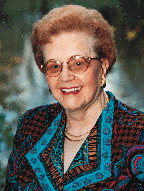
Madeleine Leininger, a nurse scientist and anthropologist, has developed the Cultural Care Diversity and Universality theory over the past three decades. She developed this theory in response to her growing conviction that culture dictates the way that individuals should receive care, based on the different ways that cultures meet their basic needs and respond to human interaction (Leininger, 1991). According to her theory "Cultural care involves those facets of culture that deal with individual and group health and well being, including efforts to improve upon the human condition or to deal with illness, handicaps, or death" (Frisch & Frisch, 1998). Leininger (1991) theorized that every culture had access to some form of folk or indigenous health care system and that some, but not all, had access to a professional health care system. |
|
|
|
|
|
|
|
|
|
References::
Fernandez, V. RN & Fernandez, K. RN. (1997-2001). Transcultural Nursing: Basic Concepts & Case Studies.
Frisch, N.C. & Frisch L.E. (1998). Psychiatric Mental Health Nursing. Toronto: Delmar Publishers.
Leininger, M.M. (1991). Culture Care Diversity & Universality: A theory of Nursing. New York: National League for Nursing Press.
Leininger, M. DR. (1998). What is Transcultural Nursing? Transcultural Nursing Society. |
|
|
|
|
|
|
|
Links: |
|
|
|
|
|
Home Page |
|
|
|
|
|
Next Page |
|
|
|
|
|
Previous Page |
|
|
|
|