
Systems theory can even be applied to nursing models. Nursing models are made up of several interrelated concepts which form part of the model as a whole. In fact, nursing models are best understood when you consider the interrelatedness of the concepts.
The objective of systems theory is to study the interactions between the parts of a whole (Leddy & Pepper, 1993). In accordance with systems theory, the nurse would be interested in the client's family's response to the client's illness because the nurse realizes the client is part of an influential family system.
Another key idea of systems theory is that a change in the internal environment causes a change in the external environment and vice versa. (Leddy & Pepper, 1993). For example, a near motor vehicle accident (change in the external environment) may effect an anxiety response (change in the internal environment).
Change, in systems theory, is said to occur to reduce tension; tension threatens the system's relative state of equilibrium and equilibrium is the goal. Input to the system is interpreted and then the system emits its output. This output then becomes new input for the system. This is referred to as feedback. The system, or person, is now different than it was prior to the input. This process is ongoing and dynamic, as the person as an open system is constantly responding to an ever-changing environment (Leddy & Pepper, 1993). -Brenda, April 2002


The solar system is made up of planets and interplanetary dust and gases. Each planet has a function and contributes to the whole solar system.
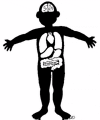
The human body contains many organs. Each organ is made up of specialized tissues and these tissues are made up of specialized cells. The cells have a function, the tissues have a function and the organ has a function.
Leddy, S. & Pepper, J. M. (1993). Conceptual Bases of Professional Nursing (3rd ed.). Philadelphia: J. B. Lippincott Company.