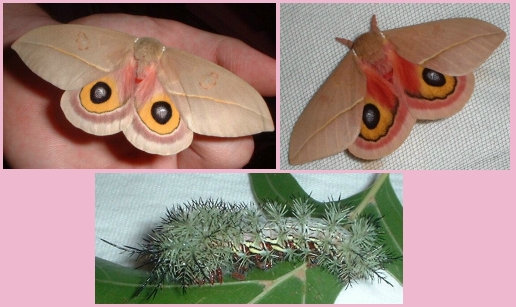
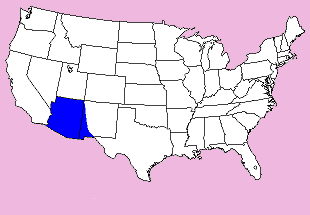
Range: The Pamina moth is found in most of Arizona and some parts of Southwestern New Mexico.
Map of this moth's Area:
Eggs and Larva
The female pamina moth carries,
depending on size of particular moth, approximately 100 - 250 eggs. Eggs are white with micropyles in them that turn black as the larva develope. In 1st instar, larva are reddish and gregarious. In 2nd instar, they become black and develope uricating spines. In 3rd instar, the larva take on a white tint to them and the uricating spines become painful when touched. They are still gregarious at that point. In 4th instar, larva become almost white and may or may not still be gregarious. With 5th instar larva have a green color with black and white tips on their spines. They are usually not gregarious in the final instar. Uricating spines are extremely painful, more so than the Io moth.
Cocoons
The Pamina moth makes a rather flimsy cocoon out of whatever is around. It will make some silk, but will also use leaves and it's own droppings if both are available. It leaves a small opening at one end of the cocoon.
Caring For Paminas, In All Stages:
Here are some notes that may be helpful when trying to raise Pamina caterpillars, especially if it's your first time raising them.Caring for the eggs
To care for Pamina eggs, just put them in a small container. It is best to be small, because the caterpillars like to crawl a lot when they first hatch, and if you put them in a bigger container, they will crawl away from the food you put in with them, and might not be able to get back. That's a lot of area for such a small caterpillar.
Food Plants
Here is a list of all food plants that I have ever used to raise Paminas on. In the odd occurance that you can not come by any of these, you should contact me.
Raising the Larva (Inside)
Pamina larva are slow growers, but nonetheless, easy to raise. The larva should be moved to a larger container by the time the larva are in 2nd or 3rd instar. Replace the food often. You may consider wearing gloves when changing leaves and cleaning the container. Or possibly putting more leaves than usual in, so as to have less-frequent changing to avoid the uricating spines.
Caring for the cocoons
Caring for the cocoons is pretty simple. Keep them inside. You should put them in an cool, dry environment. A basement works well. Do NOT put them in the refridgerator. Take the cocoons outside when temperatures reach 70's and 80's.
Return to Index.